Clerical Center Schwanberg
CastleRödelsee
Schwanberg Castle
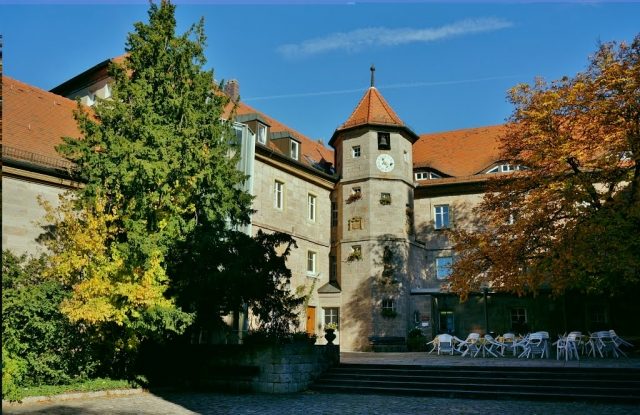
Schloss Schwanberg is a former noble residence in the municipality of Rödelsee in the district of Kitzingen. The complex stands on the mountain of the same name in the Steigerwald. The mountain was fortified even in pre-Christian times, when the Schwanberg section fortification was built.
History+
Schwanberg Section Fortification (until around 1250)+
The first traces of settlement on the Schwanberg date back to the Mesolithic period. The inhabitants of the surrounding settlements retreated to the densely forested mountain, surrounded by steep slopes. Around 1200 BC, the Celtic ramparts were built on the mountain, and the elevation was fortified for the first time. These so-called section walls are still recognizable. Around 400 BC, the Celts reached the mountain and renewed the fortifications of previous cultures. The last wave of settlement reached the Steigerwald around the 5th century AD. These were the Germanic great tribe of the Franks. The conquerors quickly recognized the strategic value of the mountain and immediately fortified it. Similar to the Staffelberg in Franconian Switzerland, the Vogelsberg in the Volkach Main loop, and the Marienberg in Würzburg, the Schwanberg was transformed into a fortress that was to secure the Frankish advance.
Schwanberg Castle (until 1525)+
With the Franks, Christianization also advanced in the Steigerwald area. A church was built on the mountain, dedicated to Saint Walpurga. In the course of the Middle Ages, however, the Schwanberg lost its strategically important significance and was downgraded to a simple castle. This building is documented from about 1250. At that time, the Fuchs family inhabited the complex, which they had probably received as a fief from the new lords of the area, the Prince-Bishops of Würzburg. In the course of the 14th century, there was another shift in power in Franconia. The Burgraves of Nuremberg were able to continuously expand their power base, originally located around the Free Imperial City, and also proceeded against the possessions of the Prince-Bishops. Burggrave Friedrich IV was able to acquire the Schwanberg. Until 1344, his family resided in the castle on the Steigerwald mountain. Later, the Lords of Seinsheim received the complex. During this time, there were also some farms on the Schwanberg that were assigned to the castle complex. For example, in 1303, Konrad Fuchs received a garden "in Swanenberge" and a farm as a fief. Friedrich Zollner zu Willanzheim was in possession of a "mansionem in castro Swanberg" (manse in Schwanberg Castle) in 1317/1318. In 1322, a small village in front of the castle (villula) was mentioned. The properties around the fortification last appeared in the sources in 1510. The chapel on the mountain had meanwhile become a popular pilgrimage destination for the faithful. This did not change despite the frequent changes of ownership. Since the middle of the 15th century, the Lords of Wenkheim were the new castle owners. The sources are largely silent about repairs to the old complex. The Peasants' War of that year brought about the complete destruction of the facilities on the Schwanberg.
Schloss Schwanberg (to this day)+
The peasant uprising also definitively ended the pilgrimage to the mountain. The ruins of the castle were acquired and rebuilt in 1605 by the Würzburg Prince-Bishop Julius Echter. At this time, the largely still preserved complexes were built. The next destructions followed in the Thirty Years' War of the 17th century.
Source: Wikipedia · Licence: CC BY-SA 4.0 · Image: Reinhold Schulz
This description is a machine translation of an excerpt from the linked Wikipedia article. The source text was written by its authors, the translation is by Mobile History; like the original it is licensed under CC BY-SA 4.0.
Location: 49.7261, 10.2720