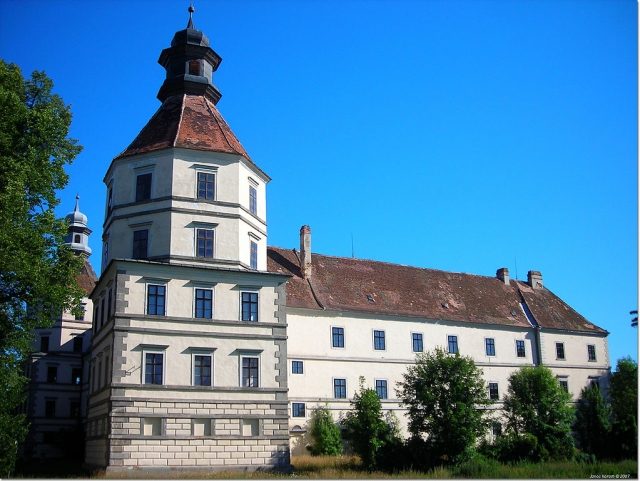
CastleSchwarzenau

Schwarzenau Castle

Schwarzenau Castle

The Castle can be visited

"Swarcenawe" is first mentioned in a document in 1150. It was then an estate of the Diocese of Passau. In 1197, a Pilgrim von Schwarzenau is mentioned. He was a follower of Kuenringer Hadmar II and is considered the builder of the first castle at the current location.

It was a moated castle with four towers. Previously, there was a small fortified complex on the Thurnberg north of the present castle. It was built by the Lords of Mühlbach around 1150. One of Pilgrim's namesakes adopted the name Streun in the second half of the 13th century. In 1298, an Albero Struno von Schwarzenau is mentioned in a document. Schwarzenau was never a free property.

After various feudal lords such as the Counts of Plain-Hardegg and the Counts of Görz-Tirol, the dominion became princely in 1500. The current castle was built between 1580 and 1592 as a Renaissance moated castle, partly using medieval building components. The builder was probably Reichard Streun. Georg von Streun sold Schwarzenau in 1636 to Karl Ulrici von Gänghofen due to his poor financial situation. In 1663, the castle must still have been in a defensible state, as it was then designated as a refuge for the population.

In 1664, Georg Friedrich von Lindenspür acquired the dominion. In 1692, Jakob Leopold Freiherr von Thavonat, who had married into the Lindenspür family, became the owner of the castle. The heiress married Franz Adam Graf Polheim in 1728. In 1796, Vinzenz Graf von Strassoldo bought Schwarzenau. From 1810 to 1815, Johann Baptist Bader and Kassian von Schuster were the lords of the castle. In 1815, Franz Xaver von Puchberg won the dominion in a lottery. His wife sold it three years later to Heinrich Freiherr von Pereira-Arnstein, in whose family the castle remained until 1884. Afterwards, the Widmann family took over the castle. In 1919, Dr. Alfred Porada Rapaport bought the estate, which was expropriated in 1939. During World War II, the castle served as a refugee home. At the end of the war and during the Russian occupation, the complex suffered severe damage and was left to decay. Only when Count Comelli-Stuckenfeld bought the building was the decay stopped.

Dr. Silvio Unterguggenberger acquired the castle in 1985 and had it completely restored by 1993. From 1991, it was made accessible to the public through exhibitions.

Take Mobile History with you

You are reading this text for free. Premium adds what matters on the road: descriptions read aloud, sites found through your camera, whole regions taken offline.

  • Every description, including the ~17,700 Premium sites
  • Audio guide: have descriptions read to you on location
  • AR finder: see sites through your camera, with distance and bearing
  • Unlimited saved sites

14 days free, then from €2.99 a month. Cancel anytime.

Source: Wikipedia · Licence: CC BY-SA 4.0 · Image: http://commons.wikimedia.org/wiki/File:Schloss_Schwarzenau.jpg

This description draws on the facts documented in the linked Wikipedia article; Wikipedia content is licensed under CC BY-SA 4.0. Wording and editing: Mobile History.

Location: 48.7442, 15.2611