CastleSchwarzenfeld

Schwarzenfeld Castle
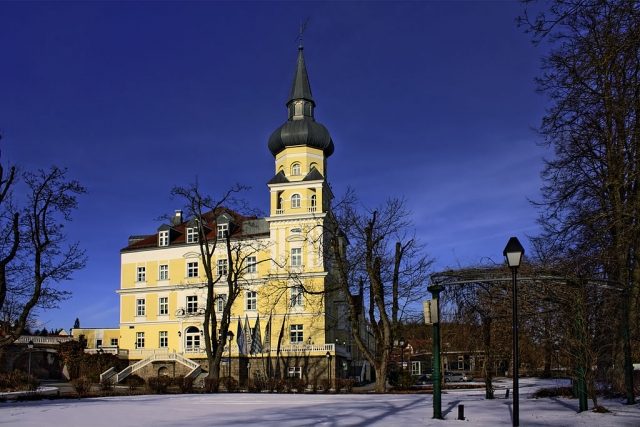
Schwarzenfeld Castle

Hotel

Schloss Schwarzenfeld is a castle in the market town of Schwarzenfeld and was the seat of the Counts of Holnstein from Bavaria. It was built in the 14th century and achieved its final form in the 19th century in the architectural style of romantic historicism. It is the landmark of Schwarzenfeld.

The castle was built and inhabited in 1372 by Conrad Pullenhofer before it passed into the possession of the noble family of Plankenfelser. They expanded the rather inconspicuous building and added four towers in the 15th century, which were probably destroyed during the Thirty Years' War and have not been rebuilt since.

In 1707, a fire destroyed the castle and the surrounding buildings, so it had to be completely rebuilt elsewhere; a new building (called "Plankenfelser Schlössl") was constructed on the foundations of the former castle. It was adapted with stepped gables of the time. At the beginning of the 19th century, the main building received its current form by removing the stepped gables in favor of a hip roof. Two small towers with onion domes were also added.

In 1794, the municipality of Schwarzenfeld and thus also the castle came into the possession of the Counts of Holnstein and was inhabited from 1857 by Count Maximilian Karl Theodor von Holnstein, who played an important role in the politics of the Kingdom of Bavaria as a Reichsrat, personal confidant, and chief stable master of the Bavarian King Ludwig II. Maximilian von Holstein was considered a friend of Prussia and was involved in the creation of the so-called Kaiserbrief, King Ludwig's consent to the founding of the German Empire in 1871. He had the castle expanded between 1890 and 1892 by Julius Hofmann to include the annex and the two towers in the style of the then-popular architectural style of historicism. At times, up to 160 workers were involved in the renovation, which gave the castle its final appearance. Surrounding buildings were also demolished to clear the view of the castle. Shortly after completion, the Count used the castle as a retirement home and died in 1895. His widow Maximiliane von Holnstein (née von Gumppenberg, 1850-1937) and his descendants eventually inhabited the castle for only a few more years, and after Countess Maximiliane moved out in 1907, the castle remained unused for a long time, apart from short-term leases. Economic and financial difficulties forced Countess Maximiliane von Holnstein to sell it to the National Socialist People's Welfare (NSV, Berlin) in 1936.

Use after 1945+

After the war, the castle served for several years as emergency accommodation for displaced persons and refugees, as well as temporary housing for classrooms and as a retirement home. Further opportunities for long-term use failed for a long time. For example, it was used as a dance hall, a sewing factory, and later as a riding hall.

In 1954, the market town of Schwarzenfeld acquired the property with the premise of preserving the castle as a landmark of our homeland and not allowing its external appearance to be changed. Attempts to make the castle available as an office building for the rural police or the Bavarian Red Cross also remained unsuccessful. Through various forced auctions, it often changed owners before it was converted into a discotheque in 1979.

On the night of June 24-25, 1982, the castle completely burned out, lay fallow as a ruin for many years, and had to be renovated several times to preserve the building fabric. In 1995, it was sold to a private owner, who completely gutted, renovated, and converted the castle into a conference hotel, which opened in 1996. It bears the name Hotel Schloss Schwarzenfeld.

Timeline+
  • 14th century: Construction of the castle (first mention in 1372)
  • 1707: Destruction of the buildings by fire and reconstruction
  • 1794: Transfer of ownership to the noble family of Holnstein from Bavaria
  • 1892: Expansion of the castle
  • 1907: Departure of the Holnsteins
  • 1936: Sale to the NS-Volkswohlfahrt Berlin
  • after 1945: The buildings are used for various purposes; no use becomes sustainable.
  • 1982: Fire at the castle
  • 1996: Opening of the Hotel Schloss Schwarzenfeld
The „Hofmarkschloss“+

In Schwarzenfeld, the long-lost Hofmarkschloss also existed previously.

Take Mobile History with you

You are reading this text for free. Premium adds what matters on the road: descriptions read aloud, sites found through your camera, whole regions taken offline.

  • Every description, including the ~17,700 Premium sites
  • Audio guide: have descriptions read to you on location
  • AR finder: see sites through your camera, with distance and bearing
  • Unlimited saved sites

14 days free, then from €2.99 a month. Cancel anytime.

Source: Wikipedia · Licence: CC BY-SA 4.0

This description draws on the facts documented in the linked Wikipedia article; Wikipedia content is licensed under CC BY-SA 4.0. Wording and editing: Mobile History.

Location: 49.3894, 12.1414