To be privately owned
CastleSeeburg (Mansfelder Land)
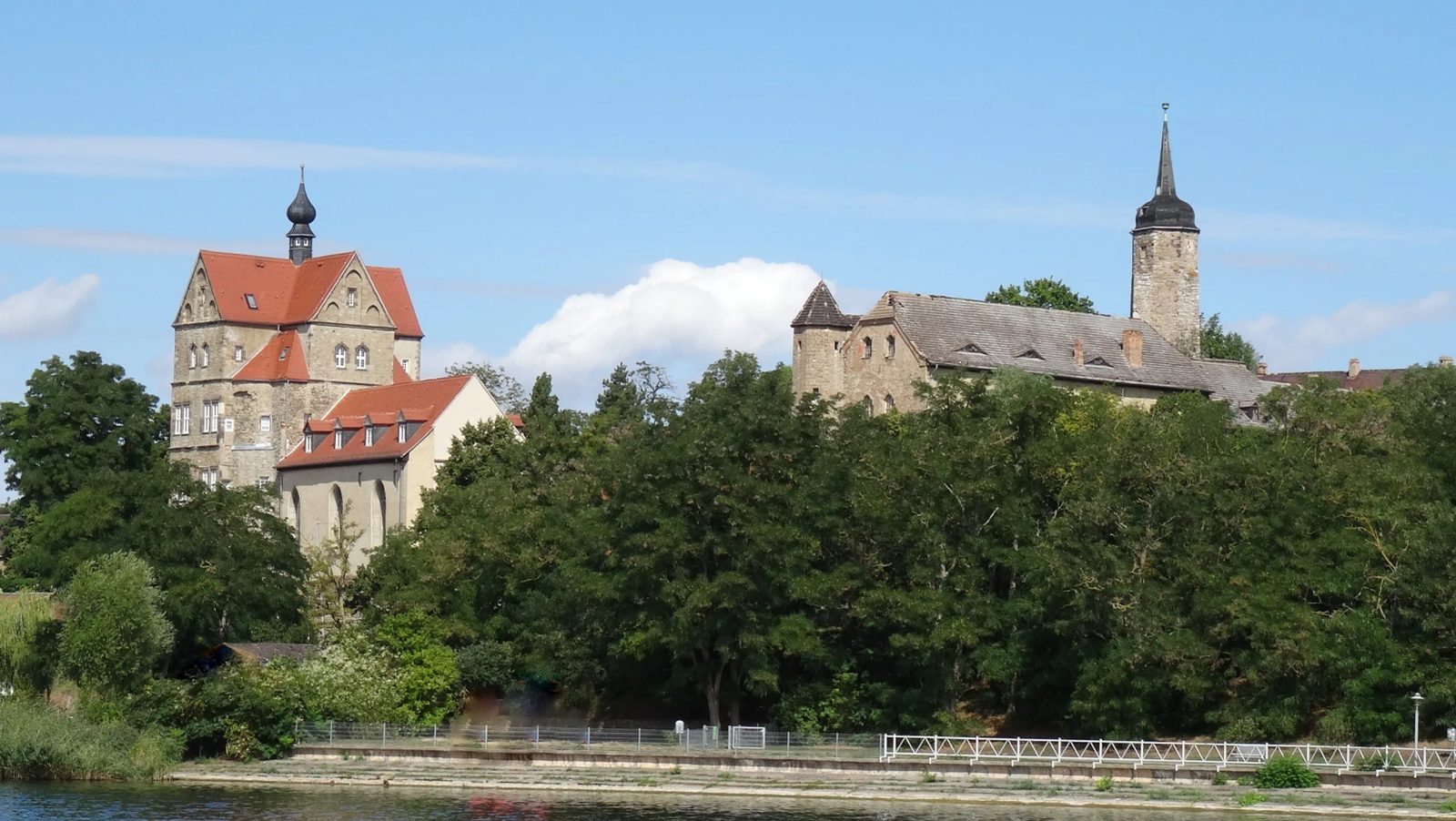
Seeburg Castle
More pictures
Seeburg Castle is a Renaissance castle in Seeburg in the Mansfeld-Südharz district, Saxony-Anhalt. The complex dates back to a castle that belonged to the so-called castles of the Hersfeld tithe register; it was the seat of the noble family of the same name.
History+
Research History+
Seeburg Castle on the Süßer See was for a long time equated with a Hoohseoburg (Hocseburg, Ocsioburg, etc.) mentioned several times in written sources in the 740s. Karlmann, the son of Karl Martell, undertook a military campaign into what is now Ostfalen in 743. In the process, he also conquered the Hoohseoburg, an important castle complex of the Saxon magnate Theoderich, and took him prisoner. Theoderich had to commit to submission and tribute payments to the Frankish Empire. But already a year later, in 744, there was an uprising. Theoderich was defeated and taken prisoner to the Frankish Empire. The castle was probably destroyed after the conquest. This also made the dating of all other castles in the Hersfeld tithe register back to the 8th century seem secure. This found seemingly independent support with the assumption of the medieval historian Walter Schlesinger that this tithe was to be identified with the tithe of the free people in the Hochseegau, which was donated to Hersfeld Monastery in 780. Schlesinger himself, by 1964 at the latest, distanced himself from some of his theories expressed in 1941, for example, from naming the Hassegau as Hochseegau. However, the lack of any archaeological finds from the 8th century, as well as the striking distance to the other places involved in the context of the Frankish conflicts with the Saxons, had long led to discussions about whether this equation was justified and to further localization proposals. In connection with archaeological excavations of the Hünenburg on the Heeseberg near Watenstedt, also proposed for the localization of the Hoohseoburg in 1927, finds and findings from the 8th century were discovered. It is therefore much more likely that the Hoohseoburg is to be identified with this castle located in the heartland of the Saxons and not with Seeburg on the Süßer See.
First Mention+
The oldest reliable information about the history of the castle is preserved in the Hersfeld tithe register. Here, Seeburg was mentioned at the end of the 9th century. In 1036, a Count of Seeburg was mentioned. This was Christin, Count of Seeburg (c. 1016 - before 1067). He was the son of Gebhard I of Querfurt, an important dynast of the region. Christin was the first of the family to bear the title of count. This is possibly due to his marriage to the Bavarian Countess of Gleiß. Christin probably began the construction of the stone castle at the western end of the old folk castle. The massive keep with a wall thickness of almost six meters was built under his son Wichmann I of Seeburg around 1080 (H. Wäscher). Further stone buildings, such as the palas, a chapel, and a first ring wall, can certainly also be attributed to his work. Wichmann I's grandson, Wichmann II of Seeburg (c. 1116–1192), was the most important personality of the family. He was elected Archbishop of Magdeburg in 1152. He was significantly involved in Albrecht the Bear's struggles against the Slavs in Brandenburg and the struggles against Henry the Lion. After the Archbishop of Cologne, he was considered the most influential prince in the empire.
Under his rule, Seeburg Castle was significantly expanded. The 1st curtain wall with flanking towers and the "Blue House", the archiepiscopal palace, and the gatehouse were built. In 1172, Wichmann founded a collegiate monastery at the western tip of the peninsula. Here, a new church and the corresponding residential buildings were built. A new access with the separate lower forecourt was created at the southeast corner of the complex.
Between 1182 and 1184, Wichmann donated the castle to the Archdiocese of Magdeburg. His brother Konrad I had died in 1182, and his son Konrad II of Seeburg was destined for the clergy. Konrad II became provost of the collegiate monastery in Seeburg. In 1287, Burchard IV from the rising family of the Counts of Mansfeld bought the lordship of Seeburg. Under the Counts, the castle became the most important late Gothic building in the county in the 15th century. In the second half of the 15th century, the second curtain wall with flanking towers and a gate castle was built. The lower part of the Widow's Tower was built during this time as a strong battery tower.
16th to 19th Century+
In 1501, the castle came into the possession of Count Gebhard VII of Mansfeld-Mittelort during one of the many divisions of inheritance. Like the entire Mansfeld comital house, he was seized by a veritable building frenzy and had the castle converted into a representative residential palace. From 1515–1518, the palas in the core castle was raised to create a 9.5 × 30 m² banqueting hall. The Widow's Tower received the multi-story residential extension. Not least because of the rampant building activity, the counts got into financial difficulties. In 1570, the county was therefore sequestered. In 1575, they had to sell the castle and office of Seeburg, which had been pledged to the Buchners since 1561, to Kuno Hahn from the Mecklenburg ancient noble family of Hahn. At the end of the 16th century, the keep was partially demolished and topped with the existing superstructure. In 1665, the "New House" was built in the Baroque style on the north and west sides of the core castle. In 1780, the Seeburg branch of the Hahn family died out, and the heirs of Geusau later sold the property to the Count of Ingenheim. In the 19th century, a new road was laid through the lower forecourt. The Blue Building was demolished for this purpose. The buildings of the outer bailey were torn down, and the moat between the outer and core bailey was filled in. In 1880, the Ingenheims sold the already significantly dilapidated castle to the Wendenburg family. After 1910, efforts were made to restore the castle in the style of the time. Erich Wendenburg had extensive construction work carried out in 1923 according to the designs of the architect Paul Schultze-Naumburg.
20th Century+
In October 1933, a National Socialist Gau leadership school for the Gau Halle-Merseburg was established in some rooms of the castle. The owner family Wendenburg was dispossessed by the Soviet occupation forces in 1945 as part of the land reform and had to flee to avoid imprisonment. Part of the castle became a vocational school, and a youth hostel was set up in the Widow's Tower. After the reunification, the Federal Republic of Germany did not return the family's property – like all others who were dispossessed between 1945 and 1949 – but instead sold it to outside investors. Since the late 1990s, the castle has been in divided private ownership, and the owners have changed several times. This has led to the castle not being renovated so far, standing empty and falling into disrepair. The Widow's Tower and the castle church, however, have been renovated and are owned by ObstGut LANGELS GbR. They are used as a residence, for holiday apartments, as a registry office, and for concerts and events. With the new construction of the orangery on the lakeside promenade, in cooperation with the Local Action Group (LAG) "Mansfelder Land", the municipality of Seegebiet Mansfelder Land and the operators of the castle café, another big step towards tourist use has now been taken, with the architecturally sophisticated new building, year-round operation is possible. Until the end of 2019, there was the Seeburg Castle winery, with its vineyards in Höhnstedt (Höhnstedter Kelterberg) and Seeburg (Seeburger Himmelshöhe). Thus, Seeburg belonged to the Mansfelder Seen Wine Route and the Saale-Unstrut region, and due to the existing apse, to the Romanesque Road. The new owners of the castle have terminated the winery and thus destroyed it. Seeburg Castle is located directly at the intersection of the Romanesque Road, the Lutherweg Saxony-Anhalt, the Himmelsscheibenweg and the Mansfelder Seen Wine Route.
Take Mobile History with you
You are reading this text for free. Premium adds what matters on the road: descriptions read aloud, sites found through your camera, whole regions taken offline.
- Every description, including the ~17,700 Premium sites
- Audio guide: have descriptions read to you on location
- AR finder: see sites through your camera, with distance and bearing
- Unlimited saved sites
14 days free, then from €2.99 a month. Cancel anytime.
Source: Wikipedia · Licence: CC BY-SA 4.0 · Image: Foto: Jörg Heldt (Community)
This description is a machine translation of an excerpt from the linked Wikipedia article. The source text was written by its authors, the translation is by Mobile History; like the original it is licensed under CC BY-SA 4.0.
Location: 51.4882, 11.7016