To be privately owned
Cultural Events
Seehaus Castle
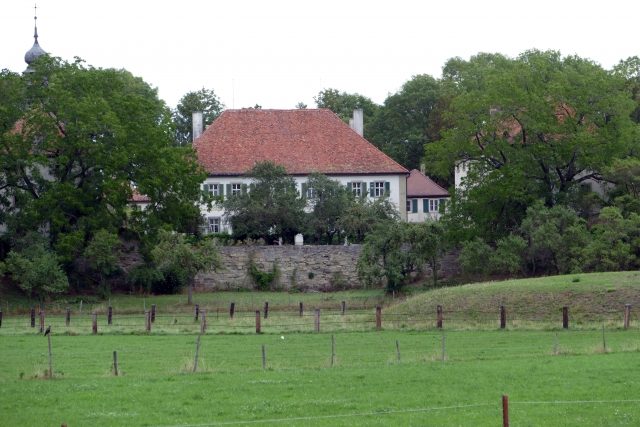
A castle is first mentioned around 1300 as "Hauss ym See" in the middle of a large pond on an island. The castle was destroyed in 1525 during the Peasants' War and in 1552 during the Second Margrave War. In 1553, it was rebuilt in the Renaissance style under Count Georg Ludwig von Seinsheim. During the Thirty Years' War, the castle was destroyed by the Swedes. In 1655, ownership passed to the Counts of Schwarzenberg, who rebuilt the castle. In 1780, a further new construction of the castle and its two side wings took place. A typical Baroque three-winged complex, which served administrative purposes. For example, the "tithe" from Schwarzenberg's fiefdom was collected and stored here. There was also Schwarzenberg's jurisdiction here in the form of detention cells and a small courtroom. The princely ancestral seat, Schwarzenberg Castle, is located about ten kilometers away in Scheinfeld.
The lake that once surrounded the fortified castle was drained around 1800 with the construction of the current building and converted into pastureland. The former moats are now forested and barely recognizable. Nevertheless, upon closer inspection, one can still discern the layout of the former Renaissance predecessor building.
After World War II, in the course of the territorial reform in 1947, one third of the land was ceded to refugees and new settlers. The Schwarzenbergs, among others, parted with Seehaus Castle and the adjacent manor farms. In the post-war period, the castle occasionally served as a refugee camp and changed owners several times.
In 1971, Günter and Ingeborg Kobow from Berlin acquired the building and renovated it. They used it exclusively privately as a second home and hosted countless parties and concerts with their large circle of friends. To accommodate all the visitors, many guest rooms were installed.
In 1998, the castle passed to Ingrid Laux (née Kobow), Jochen Kobow, and Jan Kobow. After Jochen Kobow's death in 2001, his heirs separated from their share in favor of Ingrid Laux and Jan Kobow, who gradually introduced Seehaus to limited public use.
Since 2001, public concerts have been held in Seehaus. It is used privately for celebrations such as weddings, baptisms, concerts, and balls. Orchestras and choirs also rehearse in Seehaus and record CDs in the acoustically excellent chapel. Bavarian Radio has also produced in the chapel.
Take Mobile History with you
You are reading this text for free. Premium adds what matters on the road: descriptions read aloud, sites found through your camera, whole regions taken offline.
- Every description, including the ~17,700 Premium sites
- Audio guide: have descriptions read to you on location
- AR finder: see sites through your camera, with distance and bearing
- Unlimited saved sites
14 days free, then from €2.99 a month. Cancel anytime.
Source: Wikipedia · Licence: CC BY-SA 4.0 · Image: Mobile Geschichte
This description draws on the facts documented in the linked Wikipedia article; Wikipedia content is licensed under CC BY-SA 4.0. Wording and editing: Mobile History.
Location: 49.5883, 10.3614