Academy
Café-Restaurant
Seeheim Castle

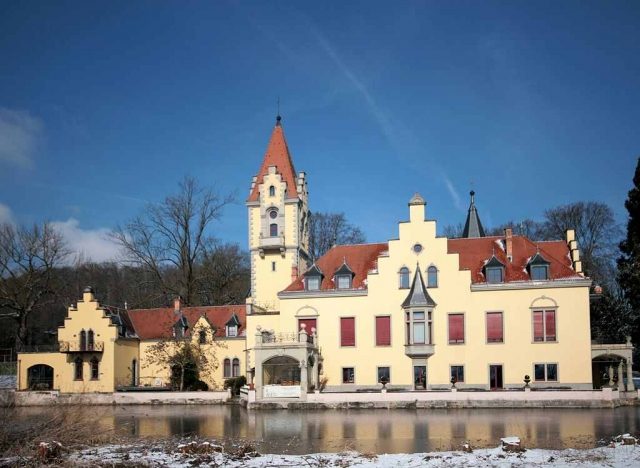
Schloss Seeheim is a castle-like villa in the Neo-Renaissance style in Konstanz on Lake Constance. Adolf von Scholz had it built in 1889/90 on older foundations according to plans by Hermann Eggert as a residence for himself and his family. His son, the poet Wilhelm von Scholz, lived there from 1924 to 1969.
The castle is located almost at the eastern end of the headland between the "Konstanz Bay" of Lake Constance and Lake Überlingen ("Horn", tip of the Bodanrück) on its southern shore between the "Bodensee-Therme" and the "Hörnle" beach and outdoor pool. Originally, it lay directly on a small bay on the shore of Lake Constance; as part of an urban development measure in the 1970s, a dam with a public promenade was built in front of it.
Around 1230, Petershausen Monastery took over most of the "Eichhornwald" (today "Lorettowald") from Reichenau Monastery. This also included the area on which Schloss Seeheim was later built. Franz Theodor Lips, chief bailiff of the Teutonic Order of Altshausen, bought this area in 1659, which at that time was called "Landkomturliches Rebgut zu Hinterhausen". Lips was probably the builder of the predecessor building. In 1672, the Teutonic Order Commandery of Altshausen acquired the vineyard from him. With the secularization of the Teutonic Order's property in the course of the Reichsdeputationshauptschluss of 1803, the area of the present castle fell to the Grand Duchy of Baden.
The Konstanz banker and textile manufacturer Jacques Louis Macaire de L´Or (1740-1824) acquired the Seeheim property from Grand Duke Leopold of Baden in 1816 for 6080 guilders plus fees, as trustee for Hortense de Beauharnais. Hortense, Queen of Holland, Duchess of Saint-Leu, daughter of Josephine de Tascher and Alexandre Vicomte de Beauharnais, adopted daughter of Emperor Napoleon I and wife of his brother Louis Napoléon Bonaparte, came to Konstanz in 1815 after the collapse of the Napoleonic era. Since January 1816, she had lived in a building in Petershausen called "die Laterne". Through the acquisition of the Seeheim property, the building is presumed to be Hortense's residence. In her notes she writes:
"La maison, que j´habitais, était située au bord du lac. Les vents déchainés contre elle avec force, les ouragans affreux qui menacaient de la renverser, cette nature en désordre étaient trop d´accord avec I´état de mon âme... (The house I lived in was located on the shore of the lake. The winds raging against it with force, the terrible hurricanes threatening to overturn it, this nature in disarray was too much in agreement with the state of my soul.)"
Political pressure on the Grand Duchy of Baden (especially from the French government) forced Hortense de Beauharnais to leave Konstanz in Baden in 1817. As her new official main residence, she acquired Schloss and Gut Arenenberg in the same year and had it extensively rebuilt. However, Hortense de Beauharnais kept her Seeheim property near Konstanz and continued to use it as a country house for occasional stays. In 1822, Schloss Seeheim officially passed from the banker Macaire into the possession of Hortense, who gradually had the castle park extended. It was not until 1834, shortly before Hortense's death, that the property was sold. The subsequent owners were Anton Meßmer, municipal councilor and merchant from Konstanz; Anatol Freiherr von Leykam, Austrian general and adjutant to Radetzky; Adolf Guhl from Stühlingen; Theodor Friedrich Bettex, educator from the "Bildungsanstalt Salon" near Ludwigsburg; the city of Konstanz; and Ernst Lang, fruit grower and fruit wine producer from Baden-Baden. In 1885, Adolf von Scholz acquired the Seeheim property from Ernst Lang.
From 1889 to 1890, a new building in the Historicist style was erected on the foundations of the predecessor building according to plans and under the direction of architect Hermann Eggert from Strasbourg. The new castle became the residence of Adolf von Scholz and his family. Prince Bismarck and Ferdinand Graf von Zeppelin were present at the opening. After his father's death, Seeheim became the residence of the poet Wilhelm von Scholz and his second wife Gertrud (Gertie) née Richter (1899-1986) in 1924. Wilhelm von Scholz died in Schloss Seeheim in 1969, after which his widow Gertrud von Scholz owned the castle.
Heinz Weidenfeld, head of the Konstanz Volksbühne, co-heir and executor, took over the Seeheim property in 1986 after the death of Gertrud von Scholz. Eberhard Teufel, auditor, became owner of the main wing in 1988, and Wolfgang Horn, lawyer, owner of the west wing of Schloss Seeheim.
From 1993 to 1996, a fundamental renovation of the roofs and walls, drainage, static securing of vaults at risk of collapse, the veranda, the ceiling between the bel étage and the attic, removal of dry rot, restoration of ceilings, conversion of the attic, installation of a glass elevator, a new central heating system and new sanitary facilities were carried out. The measures were carried out according to the plans and under the direction of Sabine Hermann, an architect in Konstanz. In 1996, the Schloss Seeheim Academy was opened under the direction of Gabriele Nardella (President) and Helmut Bachmaier (Director), and in 2006 a café-restaurant "Schloss Seeheim" under Eberhard Teufel.
Take Mobile History with you
You are reading this text for free. Premium adds what matters on the road: descriptions read aloud, sites found through your camera, whole regions taken offline.
- Every description, including the ~17,700 Premium sites
- Audio guide: have descriptions read to you on location
- AR finder: see sites through your camera, with distance and bearing
- Unlimited saved sites
14 days free, then from €2.99 a month. Cancel anytime.
Source: Wikipedia · Licence: CC BY-SA 4.0 · Image: http://de.wikipedia.org/wiki/Datei:Schlo%C3%9F_Seeheim_Konstanz.jpg
This description draws on the facts documented in the linked Wikipedia article; Wikipedia content is licensed under CC BY-SA 4.0. Wording and editing: Mobile History.
Location: 47.6658, 9.2118