CastleForchtenberg-Sindringen

Sindringen Castle
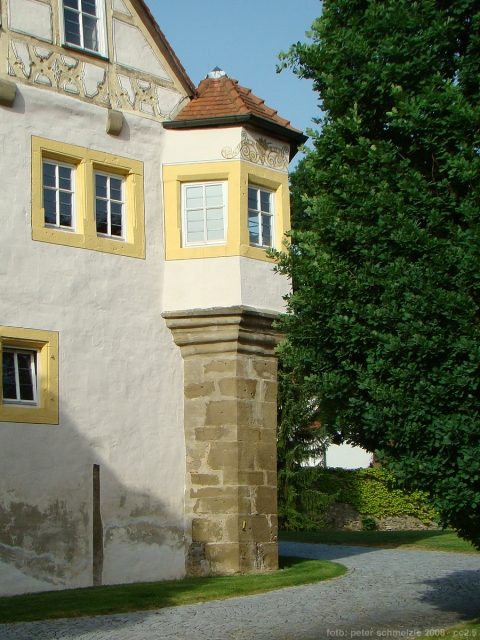
Sindringen Castle

To be privately owned

Sindringen Castle, looking kindly upon the old town, was once a fortress and probably the seat of the Lords of Sindringen. When the castle was built is not documented. It is first mentioned in a document in 1328. However, the name Anselmus von Sindringen is mentioned as early as 1094, which suggests that the castle also stood around that time. Town and castle came to Hohenlohe in 1328, five years after Forchtenberg had passed to Kraft von Hohenlohe. The castle now became the seat of Hohenlohe bailiffs and officials, one of whom was Konrad von Sindringen in 1345. Respected men originated from the Sindringen noble family. Some, however, also succumbed to robber knighthood and then disappeared from Hohenlohe. There are no written sources on the building history of the castle and palace. During the great division of the country in 1553, Sindringen did not fall to the Hohenlohe-Neuenstein line like Forchtenberg, but to Hohenlohe-Waldenburg.

The Waldenburg family then rebuilt the castle for their officials. After Hohenlohe became Württembergian in 1806 and no longer had officials in service, Hohenlohe-Waldenburg leased the castle with its barn and small garden. In 1813, it was sold to Adam Hanselmann for 3000 guilders. In the same year, it passed to the Sindringen mayor Georg Michael Schuppart, who set up a dye works on the ground floor. Until 1919, five different owners are mentioned. Most recently, the castle was the farmstead of a declining agricultural enterprise. Decay threatened the dilapidated buildings and the castle visibly lost its last splendor. With this picture in mind, the Sindringen local council urged the city of Forchtenberg in 1975 to buy the castle and secure its preservation. The Forchtenberg municipal council saw the great financial burden but nevertheless agreed to a purchase. The city paid 70,000 Marks for the area, planned the renovation of the castle and the installation of five apartments. Costs of 2.3 million Marks were expected. In 1981, the probably unique favorable opportunity arose to find a private individual who would take over the property, renovate it according to the plans approved by the State Office for Monument Preservation, and use it himself. The castle with its mighty tower at its old height and its outbuildings is today a jewel in the historic town and has been newly given to Sindringen. With its wine press, bakehouse, and prison, renovated by the city, and friendly-looking bourgeois houses in the neighborhood, it is an urbanistic treasure.

Take Mobile History with you

You are reading this text for free. Premium adds what matters on the road: descriptions read aloud, sites found through your camera, whole regions taken offline.

  • Every description, including the ~17,700 Premium sites
  • Audio guide: have descriptions read to you on location
  • AR finder: see sites through your camera, with distance and bearing
  • Unlimited saved sites

14 days free, then from €2.99 a month. Cancel anytime.

Source: Wikipedia · Licence: CC BY-SA 4.0 · Image: https://commons.wikimedia.org/wiki/File:Sindringen-schloss3.jpg

This description draws on the facts documented in the linked Wikipedia article; Wikipedia content is licensed under CC BY-SA 4.0. Wording and editing: Mobile History.

Location: 49.2802, 9.4795