To be privately owned
Sondermühlen Castle

The Sondermühlen Estate is located in Germany, within the municipality of Melle, in the southern part of the Osnabrück district, not far from the border with the federal state of North Rhine-Westphalia. The Osnabrück district belongs to Lower Saxony.
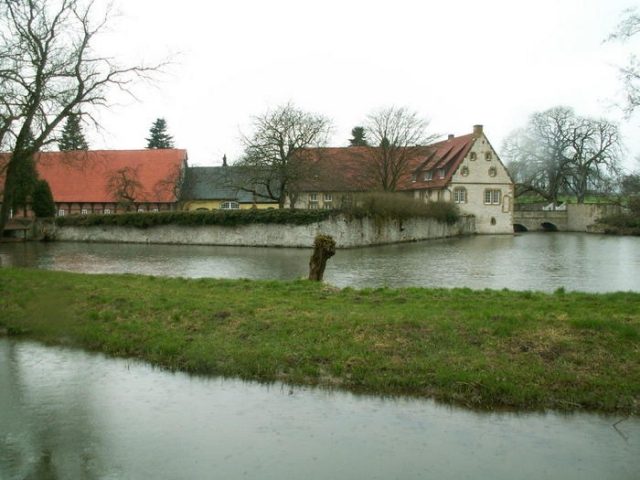
The current (2013) Sondermühlen Estate is a castle complex completely surrounded by moats. The moats are fed by the Violenbach stream. The manor house was already demolished in 1841/42. Preserved to this day are the chapel from 1587, the economic wing probably built in the 16th century, and the gatehouse with bridge from 1682. In the southeastern part of the estate, there is a water mill with a mill pond.
There are different theories regarding the origin of the Sondermühlen Estate. According to the current private owners, the estate was first mentioned in a document in 1350. In fact, the feudal register of the same year documents the enfeoffment of a Hermann Wulf and a Nikolaus von Gesmele with a farm, two houses, and the "mill in Nordenfelde" each. In the course of the 15th century, Johann and Lubbert von Arnholte as well as Johann von Vincke are mentioned as feudal lords of the "Sundermühle in Nordenfelde". In 1479, a knight Ebbeke von Vincke consolidated several properties in the area that his ancestors had already owned. Many sources name this year as the year of the estate's creation. After the death of Knight Ebbeke, two more generations of the Vincke family followed. Thereafter, from 1558 to 1778, the von Nehem family were lords of Sondermühlen for seven generations. After the death of the last Nehem, the estate changed hands several times within a short period. Thus, in 1796, it was sold in bankruptcy proceedings to the Osnabrück Cathedral Chapter. After secularization, it initially fell to the Kingdom of Hanover. Under Napoleon, it was later divided and assigned to several French officers. After the Congress of Vienna, it again fell to the Kingdom of Hanover. The majority of the estate has been state-owned ever since. The lands are now divided among the former tenants and Heuerlinge (day laborers). The forests are state property and belong to the Palsterkamp Forestry Office. The remaining estate was acquired by Clemens Graf von Platen Hallermund, lord of Königsbrück Castle (Melle), in 1972 for his daughter Sabine, married to the doctor of economics Karl-Friedrich Freiherr von Richthofen, who restored the then dilapidated estate and still lives there today.
The then well-known poet Friedrich Leopold Graf zu Stolberg (1750–1819) lived at Sondermühlen during his last years. Today, the Graf-Stolberg-Allee, which leads to the estate, commemorates him. His widow, Countess Sophie Charlotte Eleonore von Redern (1765–1842), engaged the poet Luise Hensel as her companion and as governess for her daughters Maria Theresia, Amalie, and Pauline; Luise Hensel lived at Sondermühlen Estate from 1821 to 1823.
Origin of the Name+
The name Sondermühlen derives from the term "Sundern," a term that originated in the early Middle Ages for privately owned land. This land apparently included a mill. According to some sources, Sondermühlen was still referred to as "Gut Sundermühlen" in the 19th century.
Take Mobile History with you
You are reading this text for free. Premium adds what matters on the road: descriptions read aloud, sites found through your camera, whole regions taken offline.
- Every description, including the ~17,700 Premium sites
- Audio guide: have descriptions read to you on location
- AR finder: see sites through your camera, with distance and bearing
- Unlimited saved sites
14 days free, then from €2.99 a month. Cancel anytime.
Location: 52.1648, 8.3473