Administration department
CastlePirna
Sonnenstein Castle
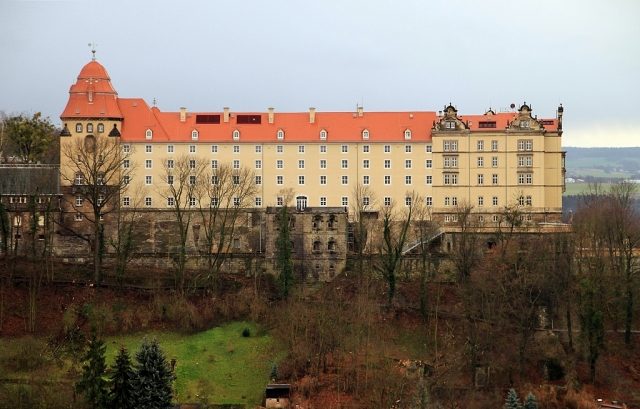
In Pirna, a town in the Sächsische Schweiz-Osterzgebirge district in Saxony, Germany, Sonnenstein Castle stands on a rock plateau above the Elbe. Originally a castle complex, it developed into a fortress and later a palace, which today serves as the administrative seat of the district.
History+
The origins of Sonnenstein date back to the 10th century, when a Slavic fortification was built on the rock plateau. Around 1200, a castle was erected here, controlling the Elbe ford and protecting the trading post of Pirna. The Castrum Pirne was first documented in 1269. The castle belonged temporarily to the Bohemian Crown, and in 1372 was the scene of the signing of the Pirna Treaty for border regulation. From 1405, it came into the possession of the Meissen margraves and became the administrative seat of the Pirna district. After destruction by fire and storm at the end of the 15th century, it was rebuilt. Under Elector Moritz, a palace was built between 1545 and 1548, while Elector August had the defensive structures expanded into a Saxon state fortress. During the Thirty Years' War, the fortress successfully withstood a Swedish siege in 1639. After the Seven Years' War, Sonnenstein lost its military status in 1764 and was converted into an asylum for the mentally ill in 1811, known for its reform psychiatric concept.
Source: Wikipedia · Licence: CC BY-SA 4.0 · Image: Norbert Kaiser
This description draws on the facts documented in the linked Wikipedia article; Wikipedia content is licensed under CC BY-SA 4.0. Wording and editing: Mobile History.
Location: 50.9614, 13.9461