To be privately owned
Sprinzenstein Castle

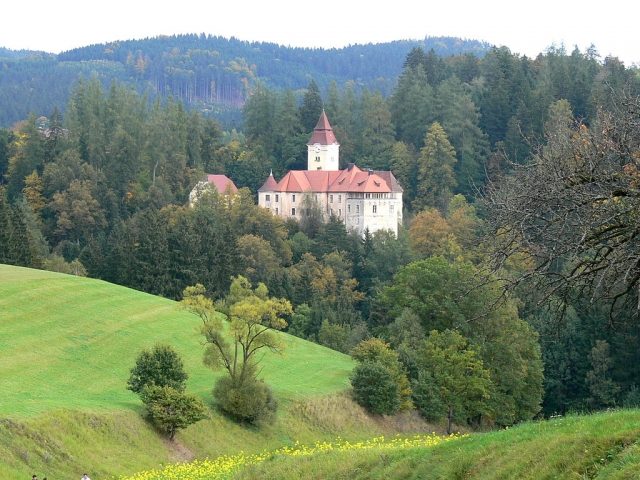
Sprinzenstein Castle is a castle complex in Upper Austria. It is located near the town of Sarleinsbach in the Mühlviertel region. The original castle was built in the 13th century and, after a fire in 1583, was expanded into a Renaissance castle. Today, it is privately owned.
The first owner mentioned in 1253 is the knight Siboto von Sprinzenstein. He was a Passau ministerialis who came from the Tannberg family. Around 1264, a Chunrad von Tannberg is named as the owner. Due to disturbing the peace, he had to cede the property to Count Albrecht von Habsburg in 1281. This made half of it a princely fief. In 1328, the castle came as a Passau fief from the Tannbergs to Ortolf von Marsbach. Hans von Marsbach built the chapel in 1369.
After his death, Wernhard den Grans followed as lord of the castle, and in 1382, Jutta die Marspöckin followed, who married Rudolf von Scherffenberg in 1396. In 1421, Wolfgang von Scherffenberg sold the princely castle to his cousins Georg, Hans Ulrich, Ruger, and Gundacker von Starhemberg. The second, Passau half was not sold until 1525 to Dionys Praun, who soon after owned the entire castle.
In 1529, Bishop Ernst von Passau, on the recommendation of the later Emperor Ferdinand I, enfeoffed Paul Riccio, the Emperor's personal physician, with the castle. In 1540, Riccio was elevated to the rank of Baron. In 1583, a fire caused severe damage to the castle. During the reconstruction, the castle was converted into a habitable Renaissance castle. In 1591, a coat of arms unification with the coat of arms of the extinct Jöchl zu Jöchlsturm family took place at Sprinzenstein. Around 1602, the castle burned down again. By 1632, the castle was restored and given its present appearance.
Baron Wenzel Reichard von und zu Sprinzenstein received the Imperial Count status (1646) under Emperor Ferdinand III and the hereditary Imperial Mint Master office above and below the Enns (1672). After the castle had been uninhabited for many years and increasingly fell into disrepair, because the owners preferred to reside at the more centrally located Neuhaus Castle on the Danube or in Linz, it was fundamentally renovated and rebuilt between 1735 and 1738 by master builder Haiberger for the new lord of the castle, Franz Ernst von Sprinzenstein, under the guardianship of the Barons von Hoheneck, after the older Sprinzenstein line died out in 1728. The Sprinzensteins inhabited the castle until after the Second World War.
Maximilian Guido Raimund Maria Count Sprinzenstein was the last of his lineage; he bequeathed the castle to his grandson Leopold Hieronymus Count Spannocchi, the son of Lelio Spannocchi. The castle remains in the possession of this family to this day.
Construction+
The castle is situated on a rock above the valley of the Kleine Mühl and was adapted to the terrain during construction. In the nearby village of Sprinzenstein stands the former castle tavern, founded in 1574 by Johann Albrecht von Sprinzenstein with imperial license. The farm buildings are also located on the access road. The former drawbridge has been replaced by a stone bridge, and the moat has been filled in.
The castle is adorned on both sides by semi-circular towers. On the highest tower of the castle is the emblem, a small "Sprinz" (a type of bird). The entrance area still recalls the old castle construction. The hook-shaped palas is built into the west wing. The castle courtyard is adorned by a 17th-century colonnade. The double coat of arms Sprinzenstein/Thürheim is attached to the arcades. Inside there is a family archive and a library. Much of the former Baroque furnishings are still preserved. The castle chapel west of the keep is dedicated to the Blessed Virgin Mary. The richly figured altar from 1631 depicts the Coronation of Mary.
Name+
According to legend, a farmer saw a "Sprinz" on a rock. Although he chased it away several times, the "Sprinz" always returned to the same stone. The farmer took this as a sign, dug, and found a great treasure. Thereupon, he had a castle built on the rock, which he named "Sprinz auf den Stein" (Sprinz on the Stone) and was elevated to the nobility.
Take Mobile History with you
You are reading this text for free. Premium adds what matters on the road: descriptions read aloud, sites found through your camera, whole regions taken offline.
- Every description, including the ~17,700 Premium sites
- Audio guide: have descriptions read to you on location
- AR finder: see sites through your camera, with distance and bearing
- Unlimited saved sites
14 days free, then from €2.99 a month. Cancel anytime.
Source: Wikipedia · Licence: CC BY-SA 4.0 · Image: http://commons.wikimedia.org/wiki/File:Sprinzenstein_-_Schloss_8.jpg
This description draws on the facts documented in the linked Wikipedia article; Wikipedia content is licensed under CC BY-SA 4.0. Wording and editing: Mobile History.
Location: 48.5478, 13.9436