Cultural Events
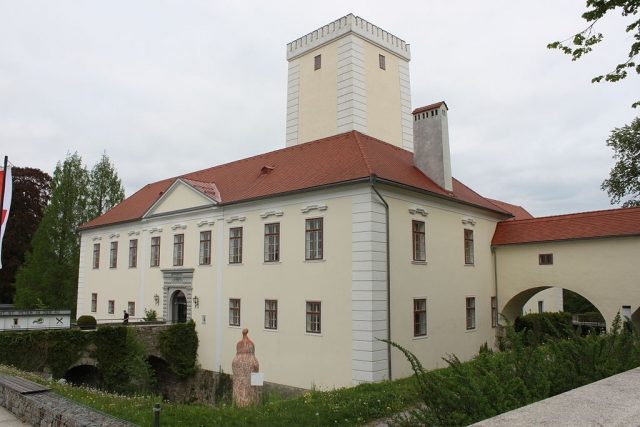
St. Peter in der Au Castle

St. Peter in der Au is a castle-church complex, presumably dating back to the High Nobles of Url. These are frequently mentioned in documents between 1120 and 1286. However, it is assumed that the predecessor of the current castle was built under Otto IV von Lengenbach in the first quarter of the 13th century.
When Otto V died without heirs in 1236, St. Peter became princely property. The Schenken von Dobra seized the castle, although the last Lengenbacher had bequeathed it to Admont Abbey. It was not until 1277 that a settlement was reached, whereby one third was transferred to the monastery and the rest remained with the heirs of Dietrich von Dobra as an hereditary leasehold of Admont.
Abbot Heinrich II of Admont was able to acquire the entire lordship for the monastery in 1293 against compensation. He subsequently had the castle modernized. In 1298, Duke Albrecht I pledged the estate to the Bishop of Freising. After the pledge was lifted in 1330, princely burgraves or administrators took care of the administration. In 1412, Reinprecht von Wallsee, who had taken possession of the castle in a feud with Christian von Zinzendorf, had to return it. From 1450 onwards, there were frequently changing pledge lordships (including Pankraz von Plankenstein, Hans von Rohrbach, and Leonhard von Hohenfeld).
The most famous lord of the castle, however, was Baron Wilhelm Seeman von Mangern. Between 1557 and 1587, he had the Gothic castle transformed into a Renaissance palace. From 1621, St. Peter was owned by Countess Katharina von Losenstein (née Seemann) and Jakob von Herberstein. In 1682, Gottlieb Graf Windischgrätz followed, who commissioned a partial Baroque transformation of the castle. St. Peter remained with his family until 1845. The next castle owner was Wilhelm Freiherr von Schönewitz. He undertook a restoration in the Historicist style but was replaced as early as 1851 by Arthur Graf Segur-Cabanac. His family kept St. Peter until after the Second World War.
After the war, the castle was sold to the municipality but soon passed into private ownership. In recent decades, the castle has been largely neglected. A comprehensive renovation only took place a few years ago, after it had returned to the ownership of the market town of St. Peter in 1999 and was adapted for the Lower Austrian State Exhibition in 2007. Today, the castle is primarily used for events.
Take Mobile History with you
You are reading this text for free. Premium adds what matters on the road: descriptions read aloud, sites found through your camera, whole regions taken offline.
- Every description, including the ~17,700 Premium sites
- Audio guide: have descriptions read to you on location
- AR finder: see sites through your camera, with distance and bearing
- Unlimited saved sites
14 days free, then from €2.99 a month. Cancel anytime.
Source: Wikipedia · Licence: CC BY-SA 4.0 · Image: http://commons.wikimedia.org/wiki/File:SchlossStPeterInDerAu05.jpg
This description draws on the facts documented in the linked Wikipedia article; Wikipedia content is licensed under CC BY-SA 4.0. Wording and editing: Mobile History.
Location: 48.0458, 14.6252