Museum
Starhemberg Castle

Starhemberg Castle is a Renaissance-style castle complex and was first mentioned in documents in 1246. It is located on a hill west of the market square of Haag am Hausruck in Upper Austria. The castle houses the Haag Local History Museum.
Gundaker IV von Steyr, a ministerialis of King Ottokar I Přemysl, built the first stone castle before 1236, after which he later named himself. It is referred to as "Storchenberch" in a Passau urbarium from the 13th century and was a bishop's fief. However, the Starhembergers held the high jurisdiction as a fief of the Schaunbergers. In the struggle for the royal dignity between Frederick the Fair and Louis the Bavarian, the castle was conquered in 1322 by Grams von Uttendorf, a field captain of Louis. Ten years later, it was ceded by the Bavarians to Duke Albrecht II and Otto IV. However, the Starhembergers continued to reside in their ancestral castle until 1379, as they had not given up their claims to the Passau fief. Duke Albrecht III finally compensated them with 3,000 pounds of silver. The castle was then mostly administered by stewards or given as collateral. Thus, in 1414, Reinprecht von Wallsee became the pledge lord. The Starhembergers also held the dominion – this time as pledged property – in the first half of the 15th century. However, they were soon replaced by the Anhanger, who were followed by the Jörger. Both in 1461 and 1491, the castle was again pledged to the Starhembergers. In 1498, King Maximilian I sold the dominion, including the regional court, to Christoph Jörger. He had the still castle-like palace rebuilt and made more comfortable. As one of the leaders of the Protestant noble uprising of 1620, Helmhard Freiherr von Jörger, who was born here, was outlawed. His possessions were confiscated.
Emperor Ferdinand II first pledged Starhemberg to the city of Wels and then sold it to the Diocese of Passau in 1627. The bishops appointed stewards for administration. During the Upper Austrian Peasant War of 1626, Starhemberg Castle was taken by the rebels under Achaz Willinger. The archive was destroyed and the armory plundered. In 1632, another peasant uprising broke out in the Innviertel, which ended with the execution of six leaders. The remains of the quartered were publicly displayed in Grieskirchen, Hofkirchen, and Haag. In the War of the Spanish Succession, the Bavarian General Litzelburg besieged and occupied the castle. When Passau was secularized in 1803, Starhemberg fell back to the Austrian state and was administered by the Court Chamber. On his way to Austerlitz, Napoleon stayed overnight in the castle in 1805. In 1809, it served as a French military hospital. From 1810 to 1816, Haag, along with the Innviertel, belonged to Bavaria. In 1836, the Austrian state privatized the dominion. New owners were Michael Fink from Braunau and Franz Seyrl from Ried. The latter became sole owner from 1847. From 1915 to 1916, the Austrian army used the castle as a military hospital. Hugo Seyrl sold the property in 1916 to Hans Hatschek, who undertook major renovations and restorations between 1923 and 1925. This significantly changed the appearance of the complex. During the Second World War, it served as a transit camp for refugees. Starhemberg Castle is still owned and inhabited by the Hatschek family today. Concerts take place in the castle courtyard in summer.
Description+
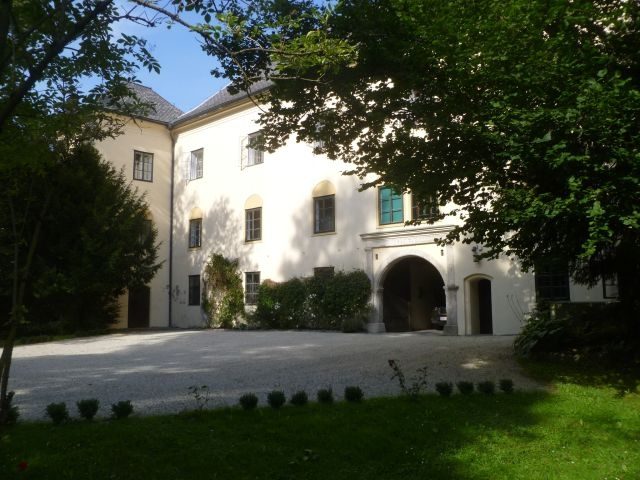
The stately castle is located on a wooded hill above the market town of Haag am Hausruck. It is in excellent condition. The elongated group of buildings essentially dates from the 16th century. However, over the centuries, the old wall lines have been overlaid by younger buildings, so that nothing today reminds of the former castle. The current appearance is strongly determined by the renovations of the 20th century. In the front part of the picturesque castle courtyard there is a remarkable Nepomuk fountain. The chapel located at the end of the courtyard was newly built during the restoration work of 1923/25. At that time, the main tower was also significantly raised, while the towers flanking the gatehouse were considerably shortened. On the gatehouse, the openings for the rollers of the former drawbridge can still be seen. However, the moat and the bridge have long since disappeared. Next to the Renaissance gate is a narrow pedestrian gate. One side of the courtyard is decorated with three-story arcaded galleries. However, the arcades of the lower two floors were walled up in the 19th century. The rooms of the older southern part are partly vaulted with barrel vaults with lunettes. Some rooms are equipped with beamed ceilings. In the north wing is the former brewery. It houses the Haager Heimatstuben, an interesting local history museum.
Take Mobile History with you
You are reading this text for free. Premium adds what matters on the road: descriptions read aloud, sites found through your camera, whole regions taken offline.
- Every description, including the ~17,700 Premium sites
- Audio guide: have descriptions read to you on location
- AR finder: see sites through your camera, with distance and bearing
- Unlimited saved sites
14 days free, then from €2.99 a month. Cancel anytime.
Source: Wikipedia · Licence: CC BY-SA 4.0 · Image: http://commons.wikimedia.org/wiki/File:Schloss_Starhemberg_%28Eingangsportal%29.jpg
This description draws on the facts documented in the linked Wikipedia article; Wikipedia content is licensed under CC BY-SA 4.0. Wording and editing: Mobile History.
Location: 48.1871, 13.6396