Private ownership
CastleEhingen-Rißtissen
Stauffenberg Castle
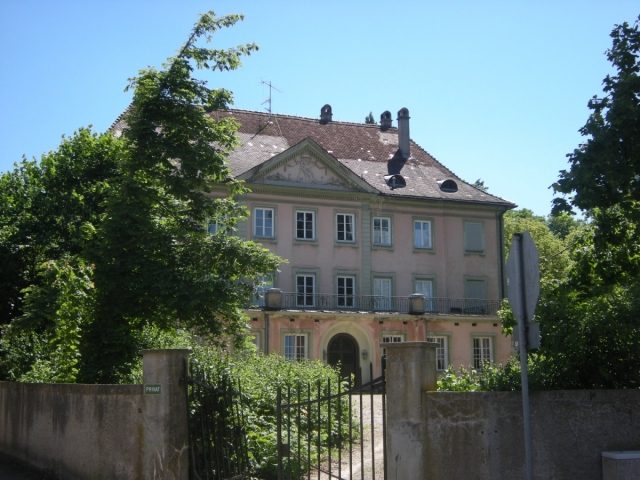
First mentioned as a manor house in 1275. The predecessor building of today's castle was destroyed by the Swedes during the Thirty Years' War. After 1650, Hans Jakob von Stauffenberg built a simple rectangular house with four round towers on the same site. Around 1784, Imperial Baron Hugo Damian Anton Schenk von Stauffenberg, also lord of Jettingen, Wilflingen, Lautlingen and Geislingen in addition to Rißtissen, began the construction of the new church, the predecessor building of today's rectory, and the execution of today's castle complex in the Louis XVI or Zopfstil. The house of Hans Jakob, which no longer corresponded to the taste of the era, was demolished.
The new complex consists of a rectangular, three-story, simple main building with a three-axis, hinted central risalit and also hinted single-axis corner risalits. This divides the facade into five parts. The vertical articulation of the main facade is taken over by rusticated pilaster strips. Two simple, two-story cavalier houses, arranged symmetrically to the transverse central axis of the main house, surrounded a paved courtyard of honor together with the main house. Today, the courtyard of honor has been replaced by a garden. The alliance coat of arms in the tympanum, the central gable field of the main house, is that of the builders, the (ennobled in 1791) Imperial Count Hugo Damian Anton Schenk von Stauffenberg and his wife, the Imperial Countess Antonie von Kageneck. Countess Antonia was one of the seven daughters of Imperial Count Johann Friedrich Fridolin von Kageneck from Munzingen (today a district of Freiburg im Breisgau), famous for their beauty. The external appearance of Rißtissen Castle, despite all the differences in its internal structure, is clearly influenced externally by the Kageneck Castle in Munzingen, which is a generation older. Countess Antonia's older sister, Countess Beatrix von Kageneck, was the mother of the important Austrian Chancellor Prince von Metternich, who often visited his Stauffenberg cousins in Rißtissen. The tympanum of the central risalit on the rear facade of the main house shows the initials of the builders' names in the form of a Zopf garland.
Source: Wikipedia · Licence: CC BY-SA 4.0 · Image: http://schloesserrundschau.de/bawue/schloesser/albdonau12.html
This description is a machine translation of an excerpt from the linked Wikipedia article. The source text was written by its authors, the translation is by Mobile History; like the original it is licensed under CC BY-SA 4.0.
Location: 48.2668, 9.8302