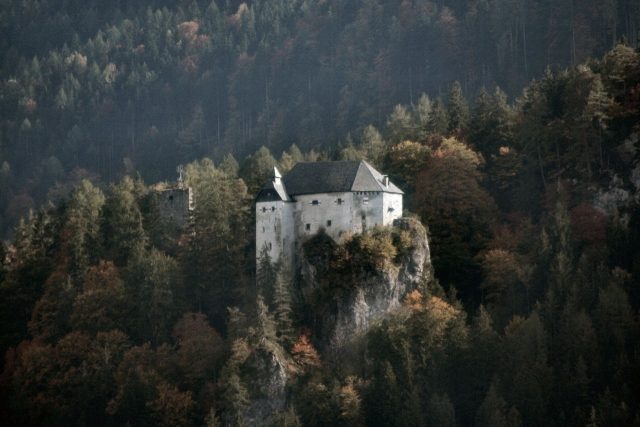
CastleDellach im Drautal

Stein Castle

Stein Castle

To be privately owned

The castle, also known as Burg Stein, is a well-preserved medieval rock castle situated on a steeply rising rock approximately 200 meters above the valley floor of the Carinthian municipality of Dellach im Drautal.

Schloss Stein was built in the late 12th century; around 1190, it was mentioned as being in the possession of Haidenrich de Lapide, a ministerialis of the Counts of Ortenburg. In the 13th century, Burg and Herrschaft Stein were owned by the Meinhardiner, Counts of Gorizia. Stein was first documented in 1440, when it was in the possession of the Counts of Cilli. In 1456, it passed to the Habsburg territorial princes. In 1500, Emperor Maximilian I enfeoffed Stein to Virgil von Graben and his son Lukas von Graben zum Stein. This branch of the Lords of Graben henceforth called themselves Von Graben zum Stein.

Inheritance Disputes over the Lordship of Stein

After the death of Christof David von Graben zum Stein in 1664, an inheritance dispute erupted over the Lordship of Stein, which was burdened with high tax debts. Both the Tyrolean Von Graben, descended from Georg von Graben, a son of Virgil von Graben, and the Lords of Lamberg laid claim to Stein. Christof David's grand-cousin Hans [Johann] Karl von Graben had already sought the inheritance from Innsbruck during Christof David's lifetime. When Hans Karl inquired about the exact relationship to the Von Graben von Stein who remained in Carinthia... "I must most painfully hear that it is believed that the Von Graben residing in Tyrol are bastards who emigrated from Carinthia." Hans Karl therefore drew up a precise family tree, in which he could clearly be regarded as a descendant of Virgil von Graben. After thorough research, he realized that Virgil, due to old age, did not seem to have acted as the feoffee at that time, but rather his son Lukas, the older brother of Hans Karl's father Georg von Graben. Thus, Hans Karl was only a collateral relative of the first feoffee and was not entitled to inherit according to the line of succession, as only direct descendants of Lukas von Graben zum Stein were entitled to inherit. Since the Lambergs were also only related to the Von Graben zum (von) Stein through the female line, the inheritance reverted to the Habsburg territorial princes. They sold it in 1668 to Balthasar de Pervellis. In 1681, Stein passed to the Orsini-Rosenberg family, who descended from the Lords of Graben. The castle complex is still in their possession today and is not publicly accessible.

Construction Details+

The keep, separated from the palas and originally connected to it by a wooden bridge, is now partially dilapidated and serves as an observation tower. A special art-historical feature is the double chapel located in the northeast corner. Two Romanesque chapels from the 15th century are arranged one above the other and connected by an opening in the ceiling. Both chapels, one dedicated to Saint Valentine and one to Saint Martin (created by Bartlmä Firtaler), house remarkable carved statues and vault paintings by the South Tyrolean artist Simon von Taisten.

Take Mobile History with you

You are reading this text for free. Premium adds what matters on the road: descriptions read aloud, sites found through your camera, whole regions taken offline.

  • Every description, including the ~17,700 Premium sites
  • Audio guide: have descriptions read to you on location
  • AR finder: see sites through your camera, with distance and bearing
  • Unlimited saved sites

14 days free, then from €2.99 a month. Cancel anytime.

Source: Wikipedia · Licence: CC BY-SA 4.0 · Image: http://commons.wikimedia.org/wiki/File:Burg_Stein.JPG

This description draws on the facts documented in the linked Wikipedia article; Wikipedia content is licensed under CC BY-SA 4.0. Wording and editing: Mobile History.

Location: 46.7324, 13.0216