Museum
Steinheim Castle

Steinheim Castle (also Burg Steinheim) is a former Mainz Electoral castle and palace complex in Hanau-Steinheim, Main-Kinzig-Kreis in Hesse. Today, it houses the Steinheim Castle Museum.
The complex is located in the old town of Steinheim, southeast of the Main river, on an elongated mountain spur (approx. 115 m above sea level), which rises about 15 m above the river valley and the surrounding area. To the east and south, the historic town center of Groß-Steinheim (also Obersteinheim) adjoins it. The transition between the spacious outer bailey and the old town is partly fluid, although large parts of the curtain wall are still preserved.
According to legend, Ida, the sister or daughter of Charlemagne (possibly Ida of Herzfeld), is said to have lived in the castle. However, no documentary or archaeological evidence for such an age of the castle has yet been found.
First mentioned in 1222 as castrum Steinheim, the castle was owned by the Lords of Eppstein. They called themselves "von Hainhausen" until the end of the 12th century and were wealthy in the region.
Around 1300, the castle was captured and partially destroyed by Landvogt Ulrich I of Hanau during a feud between King Albrecht I and the Archbishop of Mainz, Gerhard II of Eppstein. The castle must have been repaired very soon after. In 1320, the settlement of Steinheim received town rights, and in 1358, the Eppsteiners gained the right to levy tolls on the Main.
Probably financial difficulties forced the Eppsteiners to pledge half of the castle to the Counts of Katzenelnbogen and the Lords of Hanau. In 1393, it became a complete pledge to the Lords of Cronberg. Finally, in 1425, Gottfried VII of Eppstein sold Steinheim for 38,000 Rhenish guilders to the Archbishopric of Mainz, where it remained until 1803. The Archbishops of Mainz partly used the castle as a residence, probably more frequently when traveling to their possessions in the Main region. They had previously acquired territories in the Bachgau and Maingau. The castle in Steinheim was expanded, later developed into a palace-like structure, and became the center of the Amt Steinheim.
Located not far from Hanau Castle and town, the castle secured the archiepiscopal possessions against the Lords and Counts of Hanau, who also owned territories south of the Main. During the Thirty Years' War, Steinheim Castle, town, and Amt were confiscated by King Gustav II Adolf of Sweden and given to the younger Hanau Counts Heinrich Ludwig (1609–1632) and Jakob Johann (1612–1636) for their support of the Swedish cause. However, this only lasted until the Battle of Nördlingen. During the siege of Hanau Fortress in 1635/36, the imperial general Guillaume de Lamboy took up quarters in Steinheim Castle.
Towards the end of the 18th century, the Archbishops of Mainz had large parts of the complex demolished, including the half-timbered upper floor of the main building and the former curtain wall in the present castle courtyard. Plans for a new building could no longer be realized due to the secularization by the Reichsdeputationshauptschluss in 1803. The complex fell to Hesse-Darmstadt, which, although giving the side facing the Main a palace-like appearance with classical-style alterations, only used the castle to a limited extent until 1813. This was followed by frequently changing uses; since 1938, a museum has been located in the rooms. In 1978, the buildings were handed over by the State of Hesse to the City of Hanau. After a phase of renovation and re-conception, the current museum was opened in 1986.
Complex+
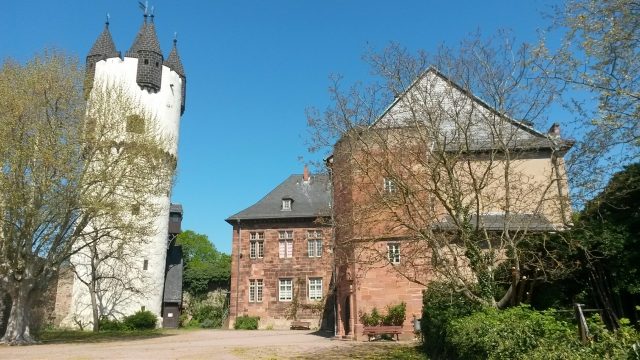
Of the castle and palace complex, the 26 m high keep with a stone spire and smaller turrets on the battlements, as well as parts of the curtain wall and retaining walls, are still preserved. The large residential building still has parts of the castle from the 13th/14th century. It is built of sandstone ashlar, in which the clamp holes of the construction crane are still partly visible. In the extensive outer bailey, the stable building, the administrative registry, a well, and parts of the defensive wall with a brick parapet walk are still preserved.
The castle wall of the core castle, which was demolished in the 18th century, is no longer visible. Its foundation is now hidden under the paving in front of the main building. Its location was secured by archaeological excavations in 1989/90.
Current Use+
In the main building of the castle, in addition to living quarters, is the Steinheim Castle Museum, which focuses on local history (on the upper floor) and regional prehistory and early history with finds from the former district of Hanau. In the cellar vault, a reconstructed Roman Mithraeum is shown. Tower climbs are also possible as part of guided tours. Changing exhibitions and club events take place in the stable in the outer bailey.
Take Mobile History with you
You are reading this text for free. Premium adds what matters on the road: descriptions read aloud, sites found through your camera, whole regions taken offline.
- Every description, including the ~17,700 Premium sites
- Audio guide: have descriptions read to you on location
- AR finder: see sites through your camera, with distance and bearing
- Unlimited saved sites
14 days free, then from €2.99 a month. Cancel anytime.
Source: Wikipedia · Licence: CC BY-SA 4.0 · Image: Jörg Heldt
This description draws on the facts documented in the linked Wikipedia article; Wikipedia content is licensed under CC BY-SA 4.0. Wording and editing: Mobile History.
Location: 50.1086, 8.9161