CastleSteinhöfel

Steinhöfel Castle

Steinhöfel Castle

Hotel

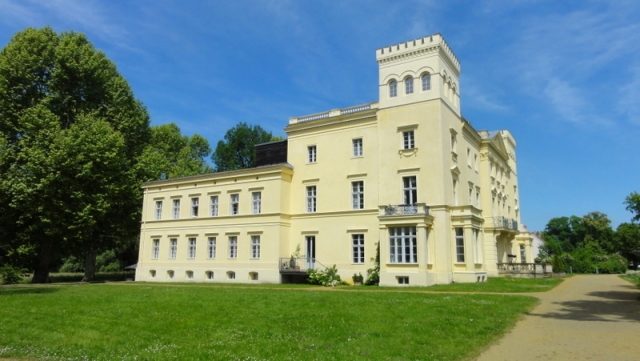
Steinhöfel Castle is a late-classical castle in the municipality of Steinhöfel in the Oder-Spree district of Brandenburg. With its English-style park, it is still considered one of the most beautiful noble residences in the Mark region. It owes its current appearance to the von Massow family, who expanded it several times since the late 18th century. Extensively restored around the year 2000, the ensemble is now used as a listed hotel.

Earlier History

The history of the ensemble is poorly documented in some phases and can only be traced through art historical evidence. Around 1730, the local von Wulffen family, who also owned an estate in Alt Madlitz, built a manor house, the basic structure of the current castle. It is unclear whether they already owned the neighboring Templar Castle (until 1949) in Tempelberg at that time. During the Seven Years' War, Frederick the Great rested briefly in the park of the estate with his staff shortly before the Battle of Kunersdorf. In 1774, the building with the village and estate was sold for 65,000 Reichstalers to the Minister of State, Baron Joachim Christian von Blumenthal.

In the Possession of Valentin von Massow

In 1790, Valentin von Massow acquired it. Massow was a regimental comrade of the Prussian Crown Prince Frederick William, who valued him for his artistic understanding. Massow, who later became the Crown Prince's Lord High Marshal, had the existing Märkisch manor house complex completely rebuilt in the early classical style between 1790 and 1795 by David Gilly, who brought in his son Friedrich Gilly to assist. The "model estate" Steinhöfel became an "initial building of new artistic, horticultural, and economic ideas," whose influence on subsequent rural building activity "cannot be overestimated."

Gilly extended the nine-axis, two-story manor house with two low side wings. The main building received a mezzanine floor under a flat hip roof. The entrance was emphasized by a three-axis, slightly protruding central section with pilaster articulation. The window openings were cut into the smooth facade. The otherwise usual reference to the builder's status and origin was missing. Rosette discs served as the only decorative elements.

The farm buildings, which had previously stood opposite the manor house, were completely demolished. In their place, a tree-lined, elongated pond surrounded by a meadow was created, spanned at the end by a small bridge as a point de vue, as the center of a park. The whole now appeared as an extension of the village green. The park could be entered from there through a portal flanked by two sphinxes by Gottfried Schadow. The castle seemed to be shifted sideways into the park, and its main axis no longer had the usual, stately axial alignment within the estate and garden complex. In addition, garden architecture buildings were added to the park: a temple used as a library, a Chinese house, a grotto, an artificial waterfall, and an aviary. Gilly rebuilt several farmsteads along the village green and the buildings of the farmyard at its other end.

The Crown Prince and Crown Princess Luise, who became the Prussian royal couple in 1797, visited Massow in Steinhöfel in 1794. They liked the castle, village, and park so much that they asked Massow to have the Gillys build their dream summer residence. This happened from 1797 in Paretz.

Around 1820 and 1840, the owners initiated changes that made Gilly's main building unrecognizable. Schinkel was probably involved. Theodor Fontane described Steinhöfel after a visit in 1862. Around 1880, they had the building rebuilt in a late-classical style. A risalit with a triangular gable was created in the central part of the building, and the ground floor was rusticated with plaster. A balcony was placed in front of the central risalit on the first floor, and a bay window in front of each of the corner towers on the ground floor.

In the 20th Century

With the commissioning of the Oderbruchbahn in 1911, Steinhöfel received a train station. In 1930, the estate was sold for 725,000 Reichsmark to a solvent farmer.

From 1945, Steinhöfel was in the Soviet Occupation Zone. In 1945, the owners were dispossessed and expelled by the communists. The castle, soon architecturally disfigured, served as a department store for the consumer cooperative and was considered "neglected" in 1958, the park "devastated by tractors, but little deforested." The deep well of the former estate became the site of a small waterworks.

Today

After German reunification, the castle was initially partially restored externally in 1991 and from 1992/93 also with funds from the German Foundation for Monument Protection.

In the mid-nineties, investors were sought for the development of the castle and its facilities. A Berlin entrepreneur presented plans to transform the entire village into a health resort with a riding school, casino, and beauty farm.

From 2000, the castle was completely restored and developed for its current use as a hotel.

Steinhöfel Castle Park is still of supra-regional importance today. The castle itself, as a hotel, offers about 50 beds in about 25 rooms, some stately and with park views, which follow the historical floor plan in the main building.

In 2010, the castle served as a filming location for the final episode of Alisa – Follow Your Heart.

Take Mobile History with you

You are reading this text for free. Premium adds what matters on the road: descriptions read aloud, sites found through your camera, whole regions taken offline.

  • Every description, including the ~17,700 Premium sites
  • Audio guide: have descriptions read to you on location
  • AR finder: see sites through your camera, with distance and bearing
  • Unlimited saved sites

14 days free, then from €2.99 a month. Cancel anytime.

Source: Wikipedia · Licence: CC BY-SA 4.0 · Image: Jörg Heldt

This description draws on the facts documented in the linked Wikipedia article; Wikipedia content is licensed under CC BY-SA 4.0. Wording and editing: Mobile History.

Location: 52.3974, 14.1659