To be privately owned
Stetten Castle

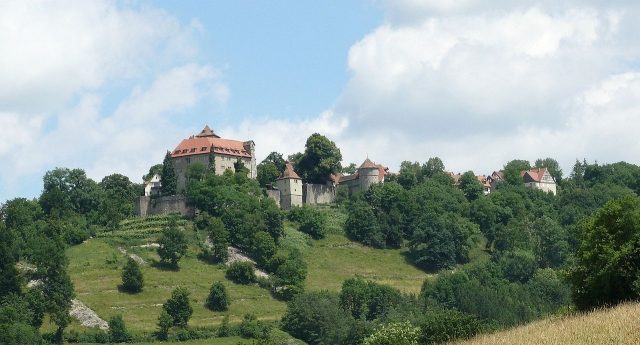
Stetten Castle is the official place name for the ancestral castle of the Barons of Stetten and the adjacent hamlet. Today, they are a district of the county town of Künzelsau in the Hohenlohe district in Baden-Württemberg. The castle complex is a shield wall castle, considered one of the best-preserved knight's castles from the Staufer period. The complex is still owned and inhabited by the founding family.
The small knight's castle is a hilltop castle on a western spur above the Kocher valley, which flows northwest here, flanked by two deeply cut stream valleys that flow into the river from the east. Below the castle, on the right slope of the river valley and on the bank, lies the village of Kocherstetten.
The castle complex was never destroyed or significantly altered structurally during its existence. Construction measures were only undertaken to keep up with the times in terms of defense. Therefore, it still shows the original form of a high medieval knight's castle.
On the mountain side, a neck ditch separates the outer bailey from the mountain. It is fortified with two round towers and accessible from the outside through a half-timbered gatehouse. Another ditch behind it separates the core castle from the outer bailey, facing the ditch with a 13-meter-high, 19-meter-long, and 2.5-meter-thick Romanesque shield wall. A keep built onto the northern part of this wall further strengthens the fortification here; it has a rectangular floor plan and shows bossed ashlar on the outside. The core castle is secured by four additional towers, and a Zwinger (outer ward) runs around it.
Within the core castle are several half-timbered buildings and a chapel. The complex was built around 1200, probably on a predecessor complex, which, however, cannot be structurally proven. The first mention of the Knights of Stetten is found in a document from Komburg Monastery from 1098, in which an Odelricus de Steten appears. A Zurich de Stetten mentioned in 1166 and a Sifridus de Stetten mentioned in the same year are also likely to have belonged to this family. The Knights of Stetten were then vassals of the Hohenlohe family during the Staufer period.
The castle was first structurally expanded around the year 1400. To better protect the core castle against the increasingly common firearms, the neck ditch in front of the outer bailey was excavated. At the same time, a curtain wall with semicircular flanking towers was erected. In the middle of the 15th century, the corner towers of the curtain wall were added in a further construction measure. In 1488, the Lords of Stetten became embroiled in a fierce dispute with the Lords of Hohenlohe over Tierberg Castle (Tierberg Feud). During this feud, the Hohenlohe besieged Stetten Castle and conquered the outer bailey. After tough negotiations and with the involvement of various arbitrators, the warring parties were able to reach a peaceful agreement, which is why there was no major damage or even destruction of the castle.
The last new building was the baroque "Outer House" in the outer bailey in 1716, which has a castle-like appearance; this is probably how the current place name came about. The last major structural change took place in 1870. At that time, the inner ditch was partially filled in and the gatehouse was rebuilt, so that carriages could then also enter.
Take Mobile History with you
You are reading this text for free. Premium adds what matters on the road: descriptions read aloud, sites found through your camera, whole regions taken offline.
- Every description, including the ~17,700 Premium sites
- Audio guide: have descriptions read to you on location
- AR finder: see sites through your camera, with distance and bearing
- Unlimited saved sites
14 days free, then from €2.99 a month. Cancel anytime.
Source: Wikipedia · Licence: CC BY-SA 4.0 · Image: https://commons.wikimedia.org/wiki/File:Schloss_Stetten_290608.jpg
This description draws on the facts documented in the linked Wikipedia article; Wikipedia content is licensed under CC BY-SA 4.0. Wording and editing: Mobile History.
Location: 49.2674, 9.7692