CastleDeutschfeistritz-Kleinstübing

Stübing Castle
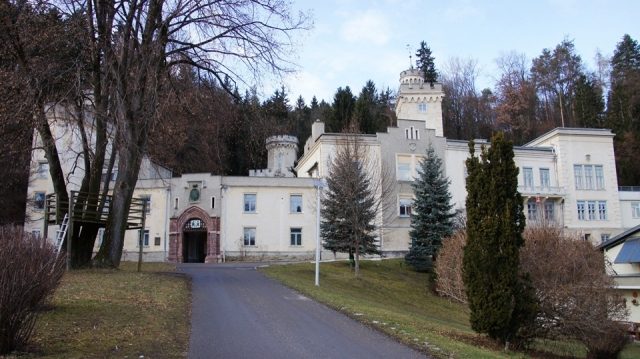
Stübing Castle

To be privately owned

Stübing Castle is a castle in Kleinstübing, a village in the market town of Deutschfeistritz in Styria. Its history dates back to the first half of the 12th century. Today, the castle serves as the administrative building for the SOS Children's Village Stübing.

The castle is situated on a small hill above the cadastral community of Kleinstübing, which belongs to the market town of Deutschfeistritz, formed by the last spur of a ridge descending from the Gamskogel to the east-southeast. It is a large, regular, quadrangular building around a rectangular, spacious courtyard, which was rebuilt in the 19th century in the so-called Windsor style. Traces of old fortifications are still preserved, such as parts of almost leveled moats, sparse remains of defensive walls, and the deep gate entrance. Originally, it was probably just a house without a keep but with walls and a moat.

In 1130, three high-ranking brothers, sons of Rafolt I of Traisen, appear in a dedication for Garsten Monastery: Adalbero of Feistritz, Swiker of Gösting, and Bernhard (Bero) of Stübing. The latter was an uncle of Konrad Henne, the son of Adalbero of Feistritz, who resided in Himberg near Deutsch-Feistritz. Bero of Stübing had only two daughters, Hildegard and Fromut. He is mentioned for the last time in 1175. With him, the free lords of Stübing died out in the male line. Their successors with the same surname were already ministeriales of the sovereign. In 1179, Otto and his son Herrand, and in 1210, Wernhart of Stübing are mentioned. Stübing probably fell to the sovereign after the extinction of the free lineage and was then granted by him to a family of ministeriales, who then named themselves after the castle. It is also not excluded that the Stübinger, who now appeared as sovereign ministeriales, were related to the free lineage.

In 1249, Walbrunn and his wife Berchta of Stübing are mentioned; in that year, they donated a vineyard in Stübing to Vorau Abbey. Then the family disappears, because Gerwolf of Stubnih, mentioned in 1314, was a vassal of the Stubenberger and had nothing to do with the fortification of Stübing. Apparently, the Stübinger were related or connected by marriage to the Gradner family, because around the beginning of the 14th century, their fortification came into the possession of this family. Gradner fiefs near Stübing, namely two vineyards near the Ulleinshof, were granted to Lady Margaret the Rich of (Deutsch)Feistritz, who, with the permission of the Gradner, donated them to Seckau Abbey in 1397.

The Gradner were succeeded in possession by Erasmus Steinwald of Fladnitz, who bequeathed Stübing to his grandson Georg Breuner, who received the sovereign fiefs over Stübing in 1417. In the last decades, the estate seems to have fallen into complete disrepair, as Breuner immediately began to expand it; in 1448, Philipp Breuner was granted by Emperor Friedrich "his estate in Stubming above the village next to the vineyard" - presumably the property mentioned as "Ulleinshof" in 1397 - with all rights, freedoms, and customs, as "other princely freedoms in Styria" possess, and in 1453 he received a Burgfried (castle peace district) for the seat, which extended from the Königsgraben to the Enzenbach.

Philipp was succeeded in 1458 by Hans Breuner, and he by his son Jörg, who was awarded Stübing in the fraternal inheritance division from Bernhard and Friedrich Breuner in 1472 and again in 1476; in 1475 he was enfeoffed with Stübing. In the Hungarian War, he seems to have sided with the emperor's opponents, because in 1480 Emperor Friedrich ordered Pankratz Gosseneder to bring him to obedience with armed force. He was followed in 1496 by his brothers Bernhart and Friedrich, then Hans Breuner, who in 1509 received two farms from Admont Monastery for a loan of 100 guilders (in 1541 Philipp Breuner created a manor farm from these farms for his castle). Stübing came to Christof Breuner in 1524, who in 1528 had the Burgfried granted in 1453 and 1514 confirmed. Philipp Breuner continued to expand Stübing, led a lavish life, and participated in a tournament in Vienna (1567) shortly before his death. His son Gottfried sold Stübing in 1577 to his brother Kaspar's wife, Leonara, who bequeathed the lordship to her son Jakob. After his early death, his father Kaspar Breuner administered it. In 1615, a daughter of Hans Sigmund von Wagen took over the lordship, but sold it in 1630, as he had to leave the country as a Protestant, to Georg Amelreich von Eibiswald.

From him, Johann Anton Prince of Eggenberg acquired it in 1635 with 92 pounds of Pfennig Gülten. The Eggenbergers merged the lordship of Stübing with the lordship of Waldstein. After the death of the last Prince of Eggenberg, Stübing passed in 1717 through marriage to Johann Wilhelm Count Sinzendorf, or rather to his wife Josefa Maria, née Princess Eggenberg. In 1730, Gottfried Count of Dietrichstein acquired the lordships of Stübing and Waldstein for a total of 140,000 guilders.

The Dietrichsteins allowed the estate to fall into disrepair. Count Wilhelm Palffy-Daun von Erdöd acquired the dilapidated property in 1863 and had it renovated in the Windsor style. Before 1959, the castle was privately owned by Franz Fattinger, who ran a model agricultural enterprise there. In 1960, the castle was sold to SOS Children's Village Austria. The subsequent renovation work deprived the castle of much of its romantic and graceful appearance.

Today, the castle houses the administration of the SOS Children's Village Stübing, as well as apartments and event rooms.

Design+

The castle is a regular, quadrangular building enclosing a rectangular courtyard, and was renovated in the Windsor style starting in 1863. The courtyard is bordered on the mountain side by a defensive wall. The main building is located in the northern part of the complex. A semicircular tower stands in the southern part. Between the former and now secularized castle chapel, which was formerly dedicated to the Holy Trinity, and the tower, there is a connecting section with the entrance gate.

Today, the original fortifications are still partially recognizable. Parts of the otherwise filled-in moats and also remnants of the defensive walls can be found. Until 1960, the castle was surrounded by park and garden grounds.

Take Mobile History with you

You are reading this text for free. Premium adds what matters on the road: descriptions read aloud, sites found through your camera, whole regions taken offline.

  • Every description, including the ~17,700 Premium sites
  • Audio guide: have descriptions read to you on location
  • AR finder: see sites through your camera, with distance and bearing
  • Unlimited saved sites

14 days free, then from €2.99 a month. Cancel anytime.

Source: Wikipedia · Licence: CC BY-SA 4.0 · Image: http://www.wehrbauten.at

This description draws on the facts documented in the linked Wikipedia article; Wikipedia content is licensed under CC BY-SA 4.0. Wording and editing: Mobile History.

Location: 47.1801, 15.3214