CastleGloggnitz-Stuppach

Stuppach Castle
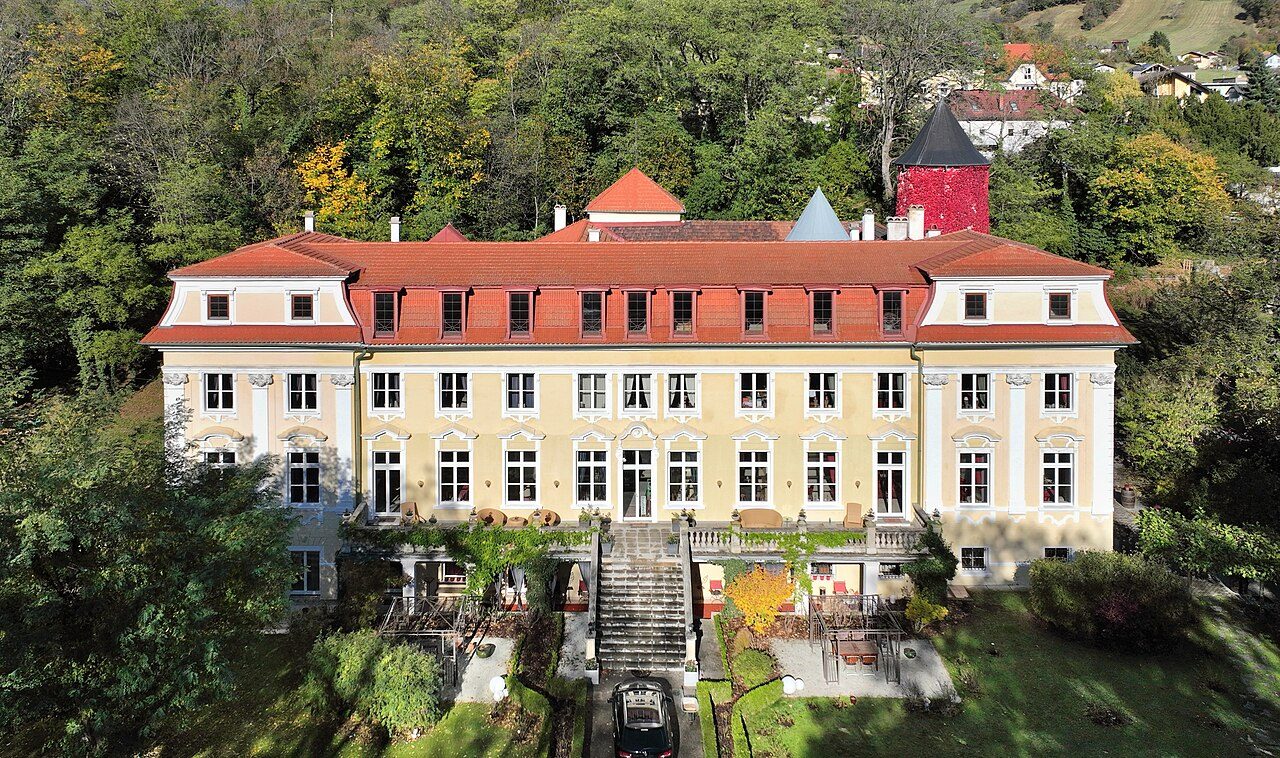
Stuppach Castle

Cultural Events

Stuppach Castle is the ancestral castle of the Counts of Wurmbrand-Stuppach. It is located in the town of Gloggnitz, cadastral community of Stuppach, in Lower Austria at the foot of the Semmering.

First mentioned in 1130, the three-story building extends from SW to NE (41 m front length) and belongs to different construction periods. The northern part from the entrance with the 18 m high, round corner tower with keyhole embrasures forms the medieval core (16th century), the western part including the chapel dates from the Renaissance period (17th century) and the southern part is from the Baroque period (18th century). Additions and extensions (terrace, altana, staircase in the inner courtyard ...) were made at a later time. The building contained around 50 rooms, including two halls. The 36 rooms (blue, red, yellow, green...) were well equipped.

From 1763 to 1827, Count Franz von Walsegg lived at Stuppach Castle. In 1791, he commissioned Wolfgang Amadeus Mozart to compose a Requiem for his deceased wife. The result was Mozart's Requiem, one of Mozart's most famous and beloved works. The original score remained at Stuppach Castle until shortly after Count Walsegg's death. Today, the original score can be admired in the Austrian National Library. It is considered the most valuable exhibit in the music collection.

The decay began in 1936: in 1938, the castle housed the SA's district school. When the Soviet army marched in in 1945, the castle was supposed to be blown up, which the assigned SS man refrained from doing, as the village above would probably have been partially affected. While attempting to burn documents, they were surprised by Soviet soldiers. Afterwards, the Soviet field bakery was housed here, simply sticking the oven pipe out the window. In 1946, they overheated the oven, which caused a fire and destroyed most of the southern roof structure, thus largely turning the castle into a ruin. The firefighters were sent home with the words: "Castle doesn't matter, men healthy better!" Later, due to outstanding taxes, the castle was requisitioned by the municipality, and social housing was located in the still largely preserved north wing until the revitalization mentioned below. The castle chapel on the west side was used for special church services long after the church was built in the immediate vicinity; it had a so-called "emergency roof". The otherwise missing roof caused structural decay, the walls were load-bearing, but entering the wooden beam ceilings was life-threatening. Since the revitalization mentioned below, it has been a jewel in the landscape, not only but ultimately also for the art scene, there is a new access road.

The castle and estate have been separated since the forced auction in 1937 and have different owners. The current castle comprises the revitalized and largely restored main building with approximately 2400 m² as well as a freestanding west wing (originally a water mill), whose restoration is still pending.

The revitalization of the main building began in the late 1980s. In 1997, it was the venue for the charity event and world premiere of the play "Mozart's Requiem – A Play about its Genesis". Since then, Stuppach Castle has also been known as "Mozart's Last Castle". The term was coined by Austrian television during a recording of parts of the event.

Since its revitalization, Stuppach Castle has increasingly developed into a location for art and culture. Events – especially salon concerts – are regularly held with internationally successful artists and performers.

Currently, work is underway on the realization of a major project: The story surrounding "Mozart's Last Castle".

Take Mobile History with you

You are reading this text for free. Premium adds what matters on the road: descriptions read aloud, sites found through your camera, whole regions taken offline.

  • Every description, including the ~17,700 Premium sites
  • Audio guide: have descriptions read to you on location
  • AR finder: see sites through your camera, with distance and bearing
  • Unlimited saved sites

14 days free, then from €2.99 a month. Cancel anytime.

Source: Wikipedia · Licence: CC BY-SA 4.0 · Image: C.Stadler/Bwag / CC BY-SA 4.0 via Wikimedia Commons

This description draws on the facts documented in the linked Wikipedia article; Wikipedia content is licensed under CC BY-SA 4.0. Wording and editing: Mobile History.

Location: 47.6790, 15.9621