CastleLöbichau - Tannenfeld

Tannenfeld Castle
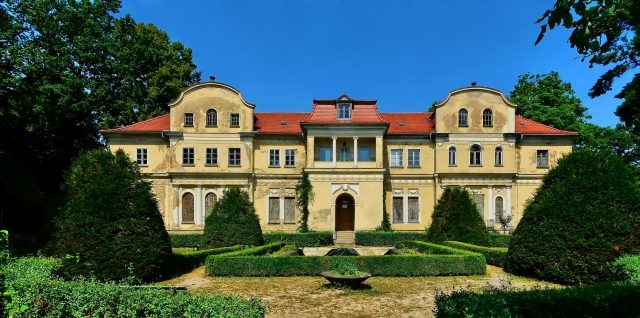
Tannenfeld Castle

Uninhabited

The first documented mention as Tanniveld occurred between 1181 and 1214. The small late Baroque castle complex with an English-style landscape park was built around 1800 for the then Duchess Dorothea of Courland. Together with Löbichau Castle, "Tannenfeld Manor" formed the so-called "Musenhof Löbichau" until 1821. Especially due to its owner, it attracted numerous illustrious guests from politics and cultural life.

In 1899, Dr. Arthur Tecklenburg acquired the property and established a sophisticated private sanatorium and nursing home for psychiatry and neurology, where the young Hans Fallada was also a patient. The manor was largely redesigned in 1899, and in 1911, a stylistically appropriate extension was added, along with the creation of a small French garden to the south. Tecklenburg generously expanded the entire complex into the "Kurhaus Tannenfeld". He built guesthouses and villas with resonant names such as Tannegg, Planegg, Talegg-Waldegg, and in 1910, Haus Brunegg as a reception building and chief physician's residence. Utility buildings and a water tower had been built in 1905. In the 1920s, two sun lounges were added to the park.

The 15-hectare park with rare trees was renovated, and from 1908 onwards, a large variety of azaleas and rhododendrons were planted. The centerpiece of the park, which transitioned into woodland, was a charming pond with an island and a continuous small stream.

Tecklenburg's successor was his son-in-law, Dr. Lemmer. After Lemmer's death, the expropriation of the castle in 1945 under Soviet occupation, and further pressure, the then 79-year-old Tecklenburg decided to hand over the remaining houses to the Thuringian State Social Insurance Institution in 1949. From 1951 to 1985, the complex housed a specialist clinic for neurology and psychiatry. After the retirement of director Rolf Schubert (1950 to 1985), no successor in this field was found. A rehabilitation center for cardiovascular diseases, psychosomatic disorders, and rheumatic diseases moved into the buildings, most recently a retirement home.

Since 2002/2004, the castle and almost all the houses have been vacant. The landscape park has retained its charm, although the former central pond is completely silted up. One of the two sun lounges has fallen into disrepair.

The entire Tannenfeld complex is a cultural monument according to the Thuringian Monument Protection Act. The owner is the Altenburger Land district, which is trying to find a suitable investor with an appropriate usage concept.

Take Mobile History with you

You are reading this text for free. Premium adds what matters on the road: descriptions read aloud, sites found through your camera, whole regions taken offline.

  • Every description, including the ~17,700 Premium sites
  • Audio guide: have descriptions read to you on location
  • AR finder: see sites through your camera, with distance and bearing
  • Unlimited saved sites

14 days free, then from €2.99 a month. Cancel anytime.

Location: 50.8745, 12.2526