CastleThallwitz

Thallwitz Castle

Thallwitz Castle

Uninhabited

In the varied Mulde landscape with lush flora and fauna, Thallwitz, first mentioned in 1253, is located on the eastern terrace edge.

Historical information about Thallwitz is sparse and partly contradictory. Thallwitz is said to have belonged to the Wurzen Collegiate Abbey before 1382. In the 15th century, Thallwitz became episcopal-Meissen table land, and at the beginning of the 16th century, probably by Bishop Johann VI, it was given as a fief to Ludwig von Canitz.

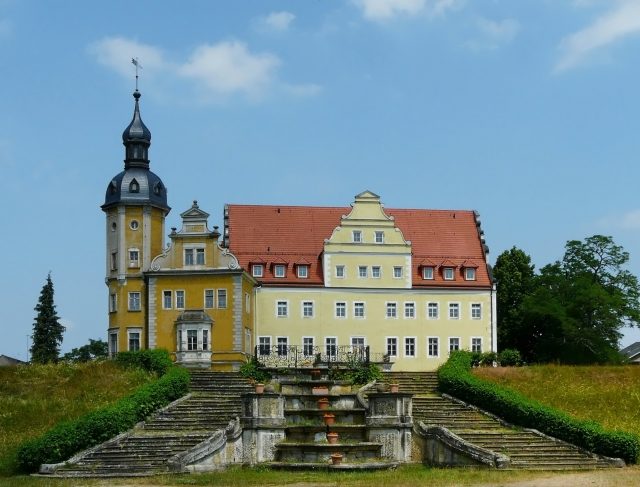
The castle dominating the town, a three-story Renaissance building with original volute gables, a stair tower, and a vaulted portico, was built around 1580 under the Counts of Canitz on a simple rectangular floor plan. At its northwestern corner, a bay window extending over two floors enlivens the plain facade. Dormer windows subdivide the steep roof.

In the following centuries, the castle belonged to various owners, including the Lords of Nischwitz, von Ploetz, von Holtzendorf, and the von Hoym family. At the end of the 18th century, Thallwitz came into the possession of the Counts of Reuss-Ebersdorf. The Princely House of Reuss ruled the area around Greiz, Schleiz, and Gera in eastern Thuringia. For Heinrich XIV Reuss, Arwed Rossbach extended the noble residence into a hunting lodge in 1880. In doing so, he added a wing in the style of the German Neo-Renaissance to the west of the castle. From 1942 until June 1994, the "Wolfgang Rosenthal" Clinic for Plastic and Reconstructive Maxillofacial Surgery was housed in the castle. However, the state of Saxony closed the institution. Since then, the buildings, renovated at a cost of millions, have stood empty.

In front of the castle is an interesting staircase with a sandstone cascade, from which water once gushed into the basin below. In the lower valley, a small bridge leads to the main avenue, which divides the symmetrically arranged park. The original baroque garden with orangery, flower parterres, hedges, and avenues dates back to the chamberlain and chief stable master Christoph Sigismund von Holtzendorf - an influential nobleman at the court of August the Strong - around 1700.

In 1764, Friedrich August Krubsacius redesigned the castle terraces on behalf of the Electoral Saxon Privy Councillor Gotthelf Adolf von Hoym. Flowerbeds with curved rococo ornaments were created, intended to integrate the lower meadows. The park harmoniously merges into the adjacent landscape protection area.

Take Mobile History with you

You are reading this text for free. Premium adds what matters on the road: descriptions read aloud, sites found through your camera, whole regions taken offline.

  • Every description, including the ~17,700 Premium sites
  • Audio guide: have descriptions read to you on location
  • AR finder: see sites through your camera, with distance and bearing
  • Unlimited saved sites

14 days free, then from €2.99 a month. Cancel anytime.

Source: Wikipedia · Licence: CC BY-SA 4.0 · Image: Thomas Eichler

This description draws on the facts documented in the linked Wikipedia article; Wikipedia content is licensed under CC BY-SA 4.0. Wording and editing: Mobile History.

Location: 51.4325, 12.6794