The Castle can be visited
Thammenhain Castle
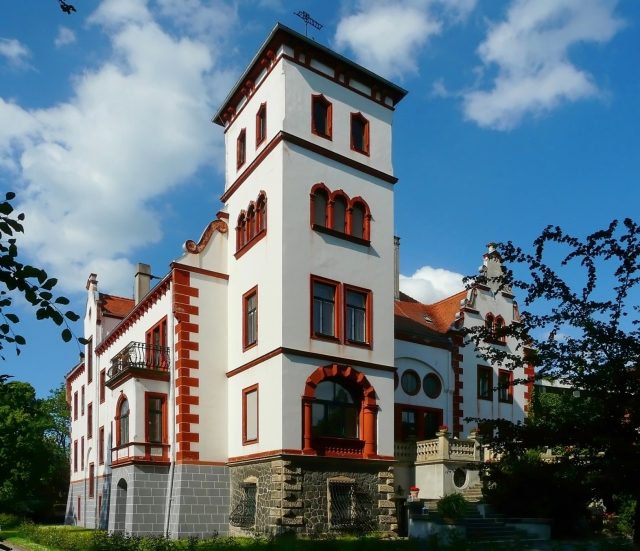
Northeast of Wurzen, on the edge of the Dahlener Heide, we find the white and red painted Thammenhain Castle. The charming surroundings of the spacious castle park with its swan pond are particularly good for relaxation. The lords of the castle, Rüdiger and Friedrich von Schönberg, have reacquired parts of the old family property. The castle awaits guests with its magnificent reception rooms and apartments. Thammenhain Castle is living family history. After the death of Christian Donat von Freywald, Joachim Loth von Schönberg was enfeoffed with Ober- and Nieder-Thammenhain in 1666. The von Schönberg family remained in possession of the estate until their expropriation and expulsion by the communists in 1945, and are so again today.
Although today's castle is characterized by alterations from 1890/91, we still find traces of the former moated castle inside. The original builders are unknown, but in 1462 the Elector enfeoffed the brothers Dietrich and Hans von Körbitz as successors to their father with the village of Thammenhain. Subsequent owners were the families von Breitungen and von Stentzsch. Between 1522 and 1612, the von Lindenau family owned the estate. They were followed by, among others, Nikolaus von Loss, Heinrich von Brederlohe, and Donat von Freywald.
A period of continuity began when, in the mid-17th century, Joachim Loth von Schönberg came into possession of Ober- and Nieder-Thammenhain. In 1727, the manor fell to the House of Bieberstein from the Sachsenburg branch. During this time, an orangery and the Baroque garden were created. In 1788, Kaspar Heinrich Dam from the House of Pfaffroda took over the property. He or his widow Susanne Regine von Pfister had the moats filled in and the park redesigned. Finally, Kaspar Adolf Ferdinand Dam Freiherr von Schönberg commissioned the architect Adolf Leyn from Hanover to convert the castle in the style of the German Renaissance. Visitors see the castle as a two-story plastered building on an H-shaped floor plan. Its tower once had a curved dome, which had to give way to a tent roof in 1970. A two-flight open staircase leads to the garden via a veranda.
The living quarters were altered by Franz Schneider from Leipzig. Particularly impressive are the massive, two-story entrance hall and the wood-paneled ballroom with the gallery of ancestors. In the lower floor, star vaults from the 15th century have been preserved.
Several outbuildings completed the ensemble. A passage connected the castle with the manorial court, which adjoined the southern elongated baroque courtyard buildings to the east. Around 1900, the manorial court received a new belle étage and a new roof. A massive barn stood between the northern and southern courtyard buildings. The centerpiece was the court church, built in 1711 under Hanns Dietrich von Schönberg, which unfortunately fell victim to demolition in the mid-20th century. To the west, the coachman's building, restored in 1923, and the formerly festive orangery face the castle pond.
Today, the stately ensemble lacks the court church and the curved dome of the castle tower. The orangery, coachman's, and courtyard buildings appear alienated due to their structural changes. What remains is the old manorial court and, between it and the castle, the new chapel building.
Nevertheless, the castle complex captivates visitors. The south terrace, which opens the wood-paneled ballroom to the garden, is particularly eventful. The generously designed park offers space for relaxation and discoveries. Numerous rhododendrons, beeches, oaks, and elms lead visitors to the swan pond, in which the castle is reflected in its full size.
Take Mobile History with you
You are reading this text for free. Premium adds what matters on the road: descriptions read aloud, sites found through your camera, whole regions taken offline.
- Every description, including the ~17,700 Premium sites
- Audio guide: have descriptions read to you on location
- AR finder: see sites through your camera, with distance and bearing
- Unlimited saved sites
14 days free, then from €2.99 a month. Cancel anytime.
Source: Wikipedia · Licence: CC BY-SA 4.0 · Image: Thomas Eichler
This description draws on the facts documented in the linked Wikipedia article; Wikipedia content is licensed under CC BY-SA 4.0. Wording and editing: Mobile History.
Location: 51.4200, 12.8616