University of Bayreuth
Hotel
CastleThurnau
Thurnau Castle
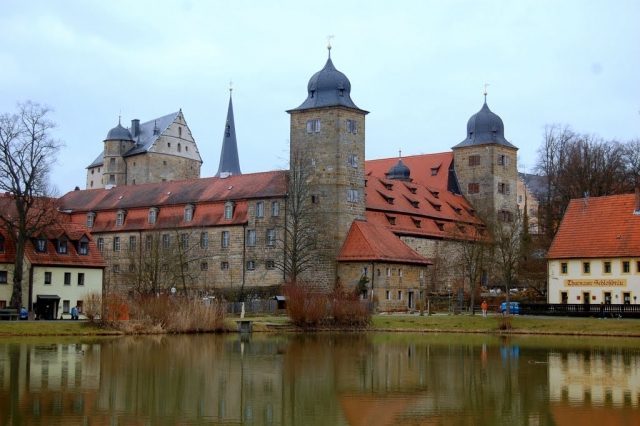
In Thurnau, Upper Franconia, stands a castle and palace complex that combines architectural styles from six centuries.
History+
The origins date back to the 13th century when the Knights of Förtsch erected the Kemenate, also known as Hus uf dem Stein. Between 1430 and 1477, the complex was expanded with an archive building and a residential wing. In 1565, the castle changed hands, passing to the families of Künsberg and Giech, who divided it among themselves in 1576. Hans-Georg von Giech had the Hans-Georgen-Bau constructed in the Renaissance style between 1600 and 1606. In 1731, the Counts of Giech acquired the Künsbergs' half of the castle and, in the same year, added the Carl-Maximilian-Bau in the Upper Courtyard, which houses the Schönburg Hall with landscape tapestries. After a fire in 1833, the gatehouse was rebuilt in Neo-Gothic style by 1837, and around 1840, the tea house was built. The last Count of Giech, Friedrich Karl, left the castle in 1923, and after his death in 1938 without direct descendants, the property passed to the Barons Hiller von Gaertringen. Since the 1970s, the castle has been undergoing extensive restoration.
Source: Wikipedia · Licence: CC BY-SA 4.0 · Image: Maciek Wegrzyn
This description draws on the facts documented in the linked Wikipedia article; Wikipedia content is licensed under CC BY-SA 4.0. Wording and editing: Mobile History.
Location: 50.0243, 11.3958