CastleSchwechat

Thurnmühle Castle

Thurnmühle Castle

To be privately owned

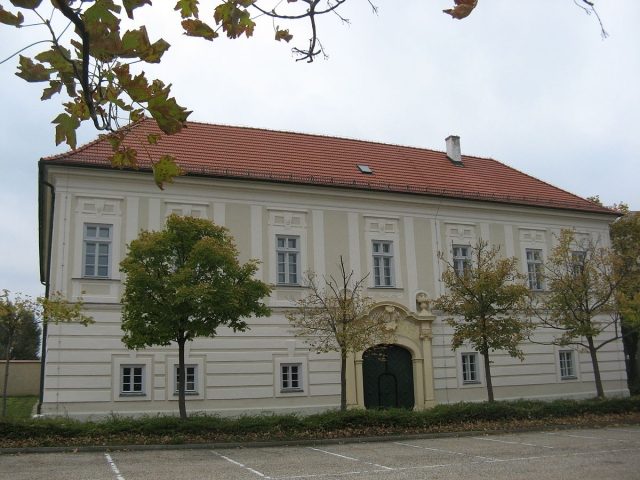
The Thurnmühle is a baroque manor house in the municipality of Schwechat in Lower Austria. It is located at Schloßmühlstraße 1 on the banks of the Schwechat river.

The formerly fortified complex was first mentioned in a document in 1162 under the name de Prato and in 1269 as Porz. The Veste Porz, which was owned by the Lords of Ebersdorf from the beginning of the 14th century, was destroyed in 1318 and 1529. In 1689, the property passed to Imperial Count Karl Maximilian von Thurn und Valsassina, who rebuilt the mill and the castle. This is also where the building's name comes from. In 1725, they were acquired by the Orientalische Compagnie, and in 1745 by the k.k. privileged Kattunfabrik, which erected operational buildings next to the castle in place of the mill. In 1902, a metal goods factory was established there, of which the Thurnmühle is the administrative building. It was restored around 1980 and belongs to the ski binding manufacturer HTM Tyrolia.

Architectural Description+

The baroque castle known as Thurnmühle is a two-story building around a square courtyard. A portal risalit projects from the facade in the northwest, with a chapel on its upper floor. On the northeast side is a pilaster-framed basket-arch portal with a curved canopy and side vases. In the center is a cartouche with a double eagle from around 1745. On the courtyard facade, two sides on the ground floor are open with basket-arch arcades, and an open staircase leads to the upper floor. Inside, some vaulted rooms are still visible, but their layout has been altered by partition walls.

Chapel+

The single-bay, cross-rib vaulted chapel on the upper floor, resting on flat pilasters, is decorated with gilded stucco. In the spandrels are reliefs of Saint Joseph with the Christ Child, James, Leopold, and Ambrose. The altar is a retable flanked by seven angelic figures, whose altarpiece depicts Saints Sebastian, Rochus, Rosalia, Florian, and John of Nepomuk before the Holy Trinity. It dates from Josef Ignaz Mildorfer from the mid-18th century.

Portal+

Part of the surrounding wall is still preserved around the building. Within it is the former main portal with a basket arch between pilasters with side pedestrian doors. A double eagle can be seen on the relief cartouche in the arch field of the curved gable canopy. Next to the gate stands the statue of Saint James on a curved pedestal, on which the coat of arms of the Orientalische Compagnie from 1767 is still partially visible.

Take Mobile History with you

You are reading this text for free. Premium adds what matters on the road: descriptions read aloud, sites found through your camera, whole regions taken offline.

  • Every description, including the ~17,700 Premium sites
  • Audio guide: have descriptions read to you on location
  • AR finder: see sites through your camera, with distance and bearing
  • Unlimited saved sites

14 days free, then from €2.99 a month. Cancel anytime.

Source: Wikipedia · Licence: CC BY-SA 4.0 · Image: http://de.wikipedia.org/wiki/Thurnm%C3%BChle#mediaviewer/Datei:Schlo%C3%9Fm%C3%BChlstra%C3%9Fe_04.JPG

This description draws on the facts documented in the linked Wikipedia article; Wikipedia content is licensed under CC BY-SA 4.0. Wording and editing: Mobile History.

Location: 48.1496, 16.4812