Museum
Cultural Events
Tiengen Castle
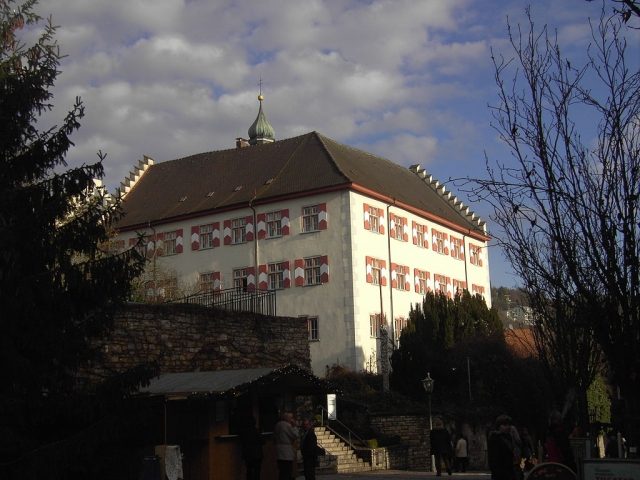
Tiengen Castle is a hilltop castle in the city of Waldshut-Tiengen in Baden-Württemberg. It was the administrative seat of the Landgraviate of Klettgau and belongs to the Federal Republic of Germany.
Tiengen Castle stands on an elevation (lower terrace), about ten meters above the historic old town, in the middle of today's city of Tiengen, at the exit or confluence of three valleys, a strategically favorable location. Immediately next to it is the baroque parish church of Maria Himmelfahrt.
Tiengen Castle is a complex of two buildings and consists of the old tower (called the Old Castle or Small Castle) and the New Castle. The Old Castle is an 11th-century defensive and residential tower of the Barons of Krenkingen. Although it was heavily ruined during the wars, it was probably never completely destroyed, just like the former castle church. Johann Ludwig I von Sulz had the castle rebuilt after the destruction in the Swiss War.
Around 1112, an oppidum is mentioned for the first time. A knight of Tiengen, Johannes miles de Toungen, is mentioned in 1225, he was a ministerialis of the Lords of Krenkingen, and a Hermannus de Toungen miles is mentioned in 1239.
In 1264, a Walterus scultetus de Toingen is mentioned; the city had a reeve and 6 councilors. In 1356, the council and the common citizens of the city of Tungen are mentioned. From 1413, a Vogt, elected by the city lord, stood above the reeve and the council. Until 1426, the city held judicial rights. Afterwards, it was transferred by Emperor Sigismund to the city of Constance. In 1331, a city court is mentioned for the first time; in 1434, it was stipulated that no citizen of Tiengen should be subject to other courts. Craftsmen are mentioned: in 1279 a blacksmith, in 1286 a tanner, in 1279 an innkeeper, in 1598 a tailor's guild, in 1690 a shoemaker's guild, in 1697 a cooper's guild.
Tiengen was an early minting site. Emperor Wenzel (HRR) granted Diethelm II von Krenkingen the right to mint coins in 1388. However, as early as 1275, marcae argenti boni ponderis oppidi in Tuengen are mentioned. In 1279, a Hugo monetarius de Tuengen (mint master) was mentioned, as was his son in 1285, Hugo filius de Tungen. As early as 1275, the Krenkingers had bracteates struck in Tiengen. In 1407, Dietrich von Eschbach is named as the mint master. After the Krenkingers, coins were minted for the Bishops of Constance, and then the Sulzers continued to have coins struck in Tiengen until 1680.
In 1229, Tiengen is mentioned as a market town (in foro Tuongen), in 1243 Civitate Tongen. Heinrich II von Krenkingen documents in 1294 in oppdio nostro Tuengen. The expansion into a market settlement was carried out by the Krenkingers. In 1262, Tiengen was a fief of the Prince-Bishopric of Constance. Diethelm von Krenkingen (the last of the old Krenkingen line) returned Tiengen to Bishop Otto III of Constance in 1413. In 1415, Reinold von Urslingen and his mercenaries tried in vain to conquer Tiengen. From 1413–1429, various lords held the fief, including the Bishops of Basel. In 1448, Bilgeri von Heudorf became the fief holder. In 1451, he handed over the city for the duration of his Italian campaign to Knight Melchior von Blumenegg (Blumnegg). In 1452, he took it back. Emperor Friedrich III, with whom he was in Italy, confirmed all previous privileges to the city. In 1467, Bilgeri attacked the mayor of Schaffhausen in the Hegau. This led to the older Swiss War. During its course, mercenaries from Lucerne, Zurich, and Schaffhausen attacked Bilgeri's seat in Tiengen. Afterwards (1468), Tiengen came to Schaffhausen. After Bilgeri's death in 1476, Tiengen returned to the Prince-Bishopric of Constance. Due to the decline of the Krenkingers, the Counts of Habsburg-Laufenburg had become holders of the County of Klettgau. Through the marriage of the last daughter of Count Johann IV (Ursula) to the Count of Sulz, the Landgraviate of Klettgau came to the Sulzers by inheritance in 1408. Bishop Otto IV of Constance now granted (1482) the castle and city of Tiengen to the Sulzers for 10 years. In 1493, the pledge was extended indefinitely. In 1499, during the Swabian War, 5000 Confederates besieged Tiengen; only 1000 horsemen and 100 mercenaries defended the city. Rudolf V von Sulz and Count Dietrich von Blumenegg left the city, which surrendered after four days of siege on April 21, 1499. Women and children were allowed to leave the city; the Austrian mercenaries, after swearing an oath of fealty, were also allowed to leave, dressed only in shirts. The nobles were released after paying ransoms, and the city was plundered and burned. To rebuild the houses, Count Rudolf von Sulz remitted all taxes and duties for 18 years, and then half for another 8 years. In 1634, 36 of 90 houses were abandoned. In 1641, the castle was burned (Thirty Years' War). Karl Ludwig zu Sulz was rarely in Tiengen due to his military career; he had appointed the Vogt Johann Jakob von Beck, who managed the Klettgau when he was not also on campaign. With Johann Ludwig II, the Landgraves of Sulz died out as city lords in 1687. Maria Anna von Sulz, the eldest daughter of the last Count of Sulz, married Ferdinand Wilhelm Eusebius (1652–1703), Prince of Schwarzenberg, in 1674.
Rooms+
In the Old Castle, today are the renovated rooms of the Bürger- und Narrenzunft 1503 (Citizens' and Fools' Guild 1503). This guild has also converted the former granary into an art gallery. The Tiengen Local History Museum is also located in the Old Castle.
The New Castle is first mentioned in 1575. The brothers Wilhelm (reigned from 1550 to 1564) and Alwig von Sulz (reigned from 1564 to 1572) are considered its builders. Wilhelm von Sulz also expanded Jestetten Castle. In 1983, a sandstone slab was found that states the following:
WHEN ONE COUNTED ONE THOUSAND FIVE HUNDRED
SEVENTY-ONE YEAR
ALEWIG THE WELL-BORN LORD A COUNT
OF SULTZ WAS
LANDGRAVE IN CLEGGOW VADUZ SCHELLEN-
BERG AND BLOMENEGK
OF THE HOLY ROMAN EMPIRE AT ROTWEILL COURT
JUDGE
ROMAN IMPERIAL MAJESTY AND PRINCE OF AUSTRIA
COUNSELOR
ON APRIL 24TH LAID THE FIRST STONE
SUPREME CAPTAIN IN UPPER ALSACE
AND LANDVOGT
TO THIS FAMILY AND LINEAGE MAY GOD
GRANT TO REIGN LUCK AND SALVATION
TO HAVE ETERNAL PART WITH HIM!
The completion of the entire complex with the garden extended until 1619. The construction of the chaplaincy building took place in two construction phases, as shown by the frescoes discovered in 1971 in the former knight's hall. These frescoes are magnificent hunting scenes very similar to those in Vaduz Castle (owned by Sulz from 1511–1611), apparently by the same artist. The inner courtyard, like today, had two entrances. The round-arched Renaissance gate is crowned by three coats of arms, that of Count Rudolf VII von Sulz and his two wives von Staufen and von Limpurg. Above this gate was a connecting passage between the two main buildings.
After the castle, after 75 years of existence, was burned down in the Thirty Years' War (between 1641 and 1648), it was completely rebuilt soon after. The castle included a washhouse and a farmyard (Maierhof) with stables and cellar vaults (today the rectory). From the government director Thaddäus von Weinzierl (1785–1812), there are still plans and a directory of the internal layout of the New Castle. It was the chancellery under the Schwarzenbergs and the administrative seat of the government, although the Princes of Schwarzenberg themselves usually ruled from their estates in Bohemia. The castle was only intended for representation; after the Schwarzenbergs, it housed the forestry office and the rooms served as apartments for officials. Joseph Bader and Heinrich Kaminski were born here.
After the sale of the castle and the noble lordship on July 19, 1812, to the House of Baden, the ancestral portraits were moved to the Schwarzenberg Castle Frauenberg (Hluboká) and the Sulz archive to Wittingau in Třeboň Castle there. The manorial archive went with the sale to the Baden State Archive (today Generallandesarchiv Karlsruhe).
Present+
Today, the traditional Schwyzertag festivals and the "Narrengericht" (Fools' Court) during Fasnet take place annually in the castle courtyard. Concerts, exhibitions, vernissages, and readings are offered in the vaulted cellar.
Take Mobile History with you
You are reading this text for free. Premium adds what matters on the road: descriptions read aloud, sites found through your camera, whole regions taken offline.
- Every description, including the ~17,700 Premium sites
- Audio guide: have descriptions read to you on location
- AR finder: see sites through your camera, with distance and bearing
- Unlimited saved sites
14 days free, then from €2.99 a month. Cancel anytime.
Source: Wikipedia · Licence: CC BY-SA 4.0
This description draws on the facts documented in the linked Wikipedia article; Wikipedia content is licensed under CC BY-SA 4.0. Wording and editing: Mobile History.
Location: 47.6349, 8.2750