Hotel
Tremsbüttel Castle

Tremsbüttel Castle is located in the municipality of Tremsbüttel in the Stormarn district in southern Schleswig-Holstein. As the residence of a former noble estate, it is actually a manor house, but due to its castle-like appearance, it has been referred to as a castle for quite some time. The late 19th-century building has housed a hotel operation since the dissolution of the estate's economy and is thus open to its guests; the park is freely accessible all year round.
In the Middle Ages, Tremsbüttel was located in the border region between the County of Holstein and the Duchy of Lauenburg. In the 13th century, there was a moated castle on the site under the knightly family von Wedel, who, as was customary at the time, soon named themselves after the estate. From the 14th century onwards, numerous changes of ownership took place, which led to Tremsbüttel subsequently belonging sometimes to Lauenburg, sometimes to Holstein, and the legal status of the later estate also changed several times. Thus, from the mid-15th century, Tremsbüttel was initially a noble court, then a noble estate, and finally also a ducal office. The knightly family Tremsbüttel was followed by the families Beynsflet and Heest, then the Lauenburg dukes and from 1544 the Schleswig-Holstein dukes, under whom the castle primarily served as a hunting lodge. The moated castle, originally consisting of little more than a fortified residential tower, was expanded into a hunting lodge during that time. From the mid-17th century, the estate passed to the old-established Ahlefeld family and from 1670 to Magnus von Wedderkop, whose son Gottfried later had the manor house Steinhorst built, which had a similarly eventful history of ownership.
In the 18th century, Tremsbüttel continued to serve as a ducal administrative seat, which was managed by Christian zu Stolberg-Stolberg from 1777 to 1800. Under the ducal bailiff, the estate experienced a cultural heyday. Around 1780, Stolberg had a new manor house built on the property and welcomed guests such as Matthias Claudius, Friedrich Gottlieb Klopstock, and Wilhelm von Humboldt to the estate. The Stolberg family was followed by numerous changes of ownership in the 19th century, the most significant of which took place under the Hasenclever family in 1883. The Hasenclevers, who came from the upper middle class, modernized the estate, introduced social benefits for the employees of the agricultural enterprise, and had the present manor house built. They resided at Tremsbüttel until 1939, when they had to sell the property for economic reasons. The estate was subsequently parceled out and gradually completely dissolved by 1961, and the manor house was converted into a castle hotel. As such, it has served under various operators to the present day. Among the most famous guests of the house were the Beatles, who stayed at the castle in 1966 as part of their only German tour. In 1983, the film "Catch your dreams" was shot here. For several years, the castle grounds also housed a car museum, primarily featuring classic cars, which was later moved to Hamburg and closed in 1997.
Buildings+
The Castle
The present castle stands at the end of an almost 800-year building history at Tremsbüttel. The first building was a simple moated castle erected in the 13th century, but there is no longer any record of its appearance. This fortified seat was expanded into a ducal hunting lodge in the 16th century, which fell into disrepair at the beginning of the 18th century and eventually became uninhabitable. As the immediate predecessor of the present castle, Count Christian Stolberg had a Neoclassical manor house built around 1780. This house, in the form of a simple palace, was two stories high and nine window axes wide, with the central three axes projecting like a risalit and emphasized by a frontispiece. A large fire in 1851 destroyed numerous estate buildings, and the Stolberg manor house was probably also damaged and eventually abandoned under the new owners.
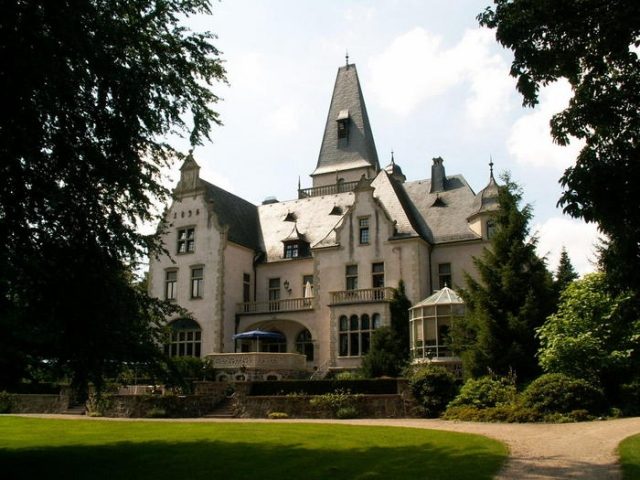
The Hasenclever family had the new manor house built by architect Hans Grisebach from 1894 to 1895. The castle is a typical building from the Historicism era, combining elements of Art Nouveau and Neo-Renaissance, and is considered one of the most remarkable examples of Eclecticism in Holstein. The multi-part building has two full stories and is accentuated by numerous decorative gables, turrets, and dormers. The eye-catcher of the castle is the donjon-like tower with its high, Gothic-influenced roof structure and the entrance portal. The interior of the castle received fixed furnishings with paneling and stucco work, combining the formal language of the Renaissance and Baroque with the floral motifs of Art Nouveau.
The Estate and Garden
The estate grounds as such are hardly recognizable today. The remains of the farmyard are located north of the castle; they were sold after the agricultural operation ceased and partly built upon.
The castle is surrounded by a 4-hectare English-style garden. Its conception still goes back to a landscape garden by Count Stolberg, which was designed with tall tree groups, lawns, and water features, but intentionally lacked romantic references through garden architectures and staffage buildings. Under Grisebach, the garden underwent a structural revision at the end of the 19th century; the pleasure ground was planted with lilac and rhododendron, and new paths were laid out. In the 20th century, a Japanese garden was added to the landscape park.
Take Mobile History with you
You are reading this text for free. Premium adds what matters on the road: descriptions read aloud, sites found through your camera, whole regions taken offline.
- Every description, including the ~17,700 Premium sites
- Audio guide: have descriptions read to you on location
- AR finder: see sites through your camera, with distance and bearing
- Unlimited saved sites
14 days free, then from €2.99 a month. Cancel anytime.
Source: Wikipedia · Licence: CC BY-SA 4.0 · Image: http://www.wehrbauten.de/thread.php?threadid=562
This description draws on the facts documented in the linked Wikipedia article; Wikipedia content is licensed under CC BY-SA 4.0. Wording and editing: Mobile History.
Location: 53.7438, 10.3127