Museum
CastleWaidbruck
Schloss Trostburg
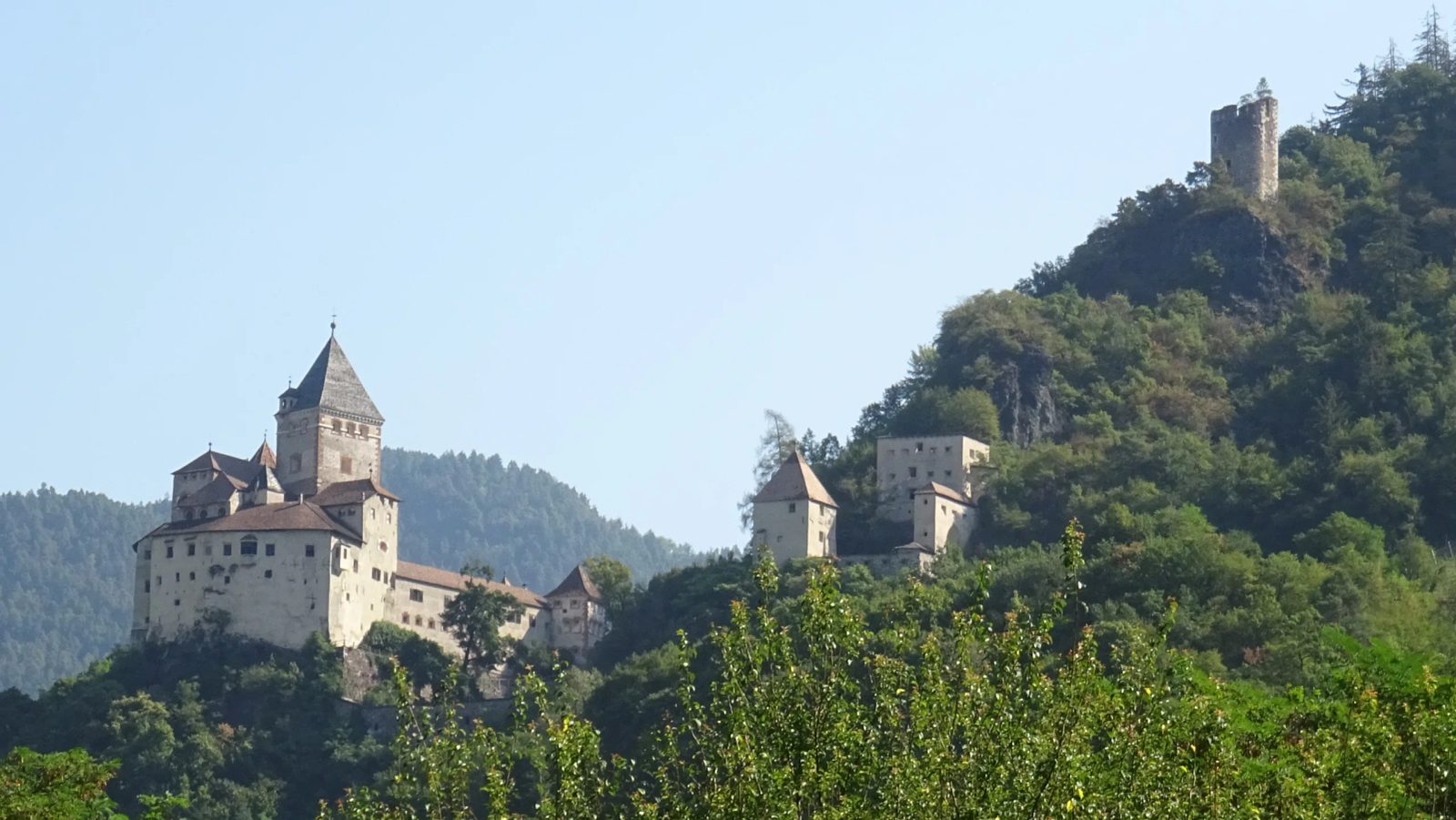
Trostburg Castle (originally Trostberg) is a hillside castle in natural terrain on an eastern slope above the South Tyrolean village of Waidbruck in the Eisack Valley.
History+
Here, where the ridge of the Schlern area steeply drops towards the confluence of the Grödner Bach into the Eisack, was the seat, mentioned in 1173, of a Cunrat de Trosperch (Trostberg), who originated from the Lords of Kastelruth. The seat then passed to the Lords of Velthurns (1243–1290), ministerials of the Bishops of Brixen, and as a Tyrolean princely fief to the Lords of Villanders. From 1385 to 1967, the former ministerial castle served the Lords, Barons and Counts of Wolkenstein-Trostburg as their noble residence. From here, they exercised lower jurisdiction over a Trostburg castle district, from which the municipality of Waidbruck emerged. They also temporarily administered the Villanders court from Trostburg. From the 17th century onwards, Trostburg was only inhabited by the Counts of Wolkenstein during the summer months. Although the family made honest efforts to maintain the castle, its decay could no longer be stopped in the 20th century. In 1967, six members of the South Tyrolean Castle Association founded a society on their own initiative to save Trostburg from decay. Their shares were transferred to the voluntarily run association in 1981, and since then Trostburg has been the official seat of the South Tyrolean Castle Institute, and since 2005 also the South Tyrolean Castle Museum.
Description+
A small inner courtyard is hidden downhill behind the keep (around 1230). It is enclosed by a Romanesque, three-story palas, which was raised by another story in the 17th century, and a residential wing built on older masonry during the Gothic construction phase. Between the late 15th and early 17th centuries, bastions and advanced defensive structures were added, some of which underwent further extensions for residential purposes in the 18th century. Separated by a wide moat is an extensive outer bailey (Michaelstor). On a higher rock outcrop is a so-called chalk tower (signal and watchtower for Crayenfeuer). The last significant alterations were commissioned between 1594 and 1632 by the later Count Engelhard Dietrich zu Wolkenstein (1565–1647); at that time, the ancestral hall, decorated with stucco work by Joseph Proys, was created. Significant restoration and conservation measures on the building structure led, among other things, to the removal of a south-facing floor in the Gothic palas around 1880. From 1967 to 1977, the most necessary safety and repair works were carried out, such as roofing of the ruined parts and repair of war damage from September 8, 1943. These were followed between 2000 and 2007 by conservation work on the castle facades and the re-roofing of the entire roof area of the habitable castle parts with historical beaver tail tiles, some dating back to the time of Nicholas of Cusa (15th century). In 2008/09, the interiors on the 1st floor of the Gothic west palas, built under Baron Hans zu Wolkenstein (lord of the castle from 1491 to 1517), were restored, and a large-scale wall painting with hunting motifs and a cooking scene, likely dating to 1514, was uncovered in one of the rooms.
Function as a Museum+
The well-preserved castle complex can be visited as the South Tyrolean Castle Museum with guided tours offered. The permanent exhibition "Castles – Buildings of History" provides a good overview of castle studies, illustrating the content with, among other things, 86 scale models of South Tyrolean castles made by Ludwig Mitterdorfer (1885–1963). From a cultural-historical perspective, the significance of the castle lies in its being the seat of the Lords of Wolkenstein; Trostburg is, among other things, also the parental home of the late medieval poet-composer Oswald von Wolkenstein (c. 1377–1445) and the first Tyrolean chronicler Marx Sittich von Wolkenstein (1563–1619). Inside the castle, valuable historical testimonies have been preserved, such as three Roman votive stones (c. 180 AD), a Gothic parlor vaulted with a triple barrel (before 1407), a 5 × 15 m Renaissance hall with figurative representations of the owners in plaster and a richly carved coffered ceiling with heraldic decor (1607–1618), a loggia painted with coats of arms, and one of the largest historical wine presses in the country (11 m long press beam). From a castle studies perspective, in addition to the construction method, the chapel, iron-clad gates (one with a manhole), the visible but very probably originally preserved wooden portcullis, 17th-century window embrasures, and storm poles installed at that time are noteworthy. Apart from designated natural monuments in the vicinity of Trostburg, a sandarac tree (Tetraclinis articulata) brought here in the early modern period is striking in the kennel garden. Due to the "unadulterated character of Trostburg," filmmakers chose Trostburg as the main motif for the feature film "The Fairy Tale of the Princess Who Absolutely Wanted to Be in a Fairy Tale" in 2012.
Take Mobile History with you
You are reading this text for free. Premium adds what matters on the road: descriptions read aloud, sites found through your camera, whole regions taken offline.
- Every description, including the ~17,700 Premium sites
- Audio guide: have descriptions read to you on location
- AR finder: see sites through your camera, with distance and bearing
- Unlimited saved sites
14 days free, then from €2.99 a month. Cancel anytime.
Source: Wikipedia · Licence: CC BY-SA 4.0 · Image: Foto: Jörg Heldt (Community)
This description is a machine translation of an excerpt from the linked Wikipedia article. The source text was written by its authors, the translation is by Mobile History; like the original it is licensed under CC BY-SA 4.0.
Location: 46.5951, 11.5342