International Theological Institute
Museum
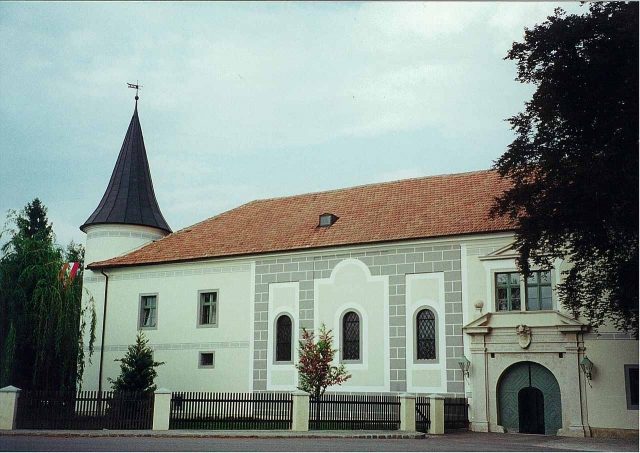
Trumau Castle

Trumau Castle is a moated castle in Trumau, Lower Austria. It has been owned by the Cistercian Heiligenkreuz Abbey from the beginning, with some interruptions.
The Trumau estate was gifted to the abbey by Babenberg Margrave Leopold IV in 1138 under Abbot Gottschalk to secure the abbey's economic future. The civilian population was relocated according to the order's rules, and the Cistercians established a grange, a fortified farmstead. In addition to arable farming and viticulture, sheep breeding was practiced. There was also a dedicated mill.
It was not until 1462 that it came into the possession of the mercenary leader Georg von Pottendorf, who fought on the side of Albrecht VI against his brother Emperor Frederick III. However, in 1468, the estate was taken from him by the Bohemian mercenary leader Hinko von Feinfalt. The village of Trumau slowly re-emerged around the estate.
In 1529, at the time of the First Turkish Siege, seven houses existed in the village. The estate itself was destroyed in 1548. After major reconstructions and alterations, the building was burned down again under Gábor Bethlen in 1621.
Under Abbot Michael Schnabel, work began in 1650 to expand the estate into a castle. The construction was completed in 1667. The castle served as a summer residence for the abbots. Frequent visits by Emperor Leopold I are also reported.
Although it must have been relatively well fortified this time, it was severely devastated in 1683 during the Second Turkish Invasion. During reconstruction, the towers were built lower than originally. The castle was also rebuilt after fires in 1811 and 1880. However, it is likely to have suffered significantly compared to its earlier appearances.
In the post-war period, a communications center was established by the Soviet occupation forces between 1945 and 1947, which severely damaged the building. Partition walls were torn down. The granary was used as a ballroom. For this purpose, the intermediate ceiling was removed.
The last restorations took place between 1993 and 1995. Since 1999, a museum has been set up, where prehistoric finds discovered during the construction of the Southern Motorway are also exhibited.
In 2009, the International Theological Institute for Studies on Marriage and Family moved into the castle. Until then, this institute was located in Gaming Charterhouse.
Construction+
The two-story building is almost square. At three corners, there are round towers with conical roofs. The original moat could be crossed via a drawbridge.
The spacious chapel contained an altarpiece painted by Johann Michael Rottmayr. However, this was stolen in 1945. In 1950, the painting was replaced by a copy of a Coronation of Mary by Martino Altomonte, painted by Alice Rougon.
The oldest part is the north wing, whose ground floor dates back to the original 12th-century construction.
The old manor farm from 1638 is located southeast of the castle. This was restored after a fire in 1880.
The museum can be visited in the castle. The courtyard is freely accessible.
Take Mobile History with you
You are reading this text for free. Premium adds what matters on the road: descriptions read aloud, sites found through your camera, whole regions taken offline.
- Every description, including the ~17,700 Premium sites
- Audio guide: have descriptions read to you on location
- AR finder: see sites through your camera, with distance and bearing
- Unlimited saved sites
14 days free, then from €2.99 a month. Cancel anytime.
Source: Wikipedia · Licence: CC BY-SA 4.0 · Image: http://commons.wikimedia.org/wiki/File:Trumau_Schloss.jpg
This description draws on the facts documented in the linked Wikipedia article; Wikipedia content is licensed under CC BY-SA 4.0. Wording and editing: Mobile History.
Location: 47.9927, 16.3382