CastleTüßling

Tüßling Castle

Tüßling Castle

To be privately owned

Tüßling Castle is located in the market town of Tüßling, 90 kilometers east of Munich, in the Upper Bavarian district of Altötting. It is situated on the edge of the town center. As a Hofmark castle, it was the manorial seat of the closed Hofmark Tüßling.

Exterior Architecture of Tüßling Castle+

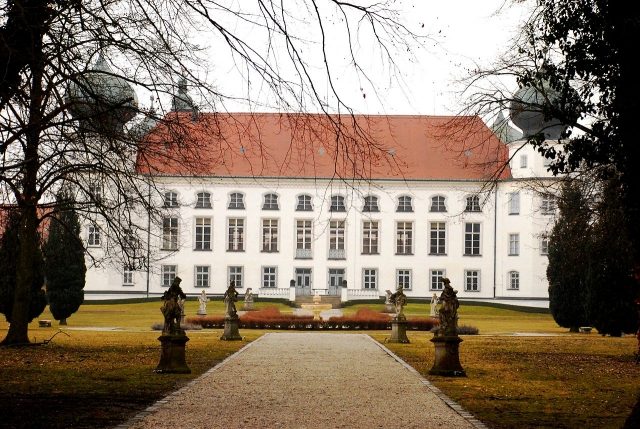
Tüßling Castle, with its regular four-wing layout, its four octagonal corner towers with crowning onion domes, exhibits all the characteristic features of a developed Renaissance castle. With its magnificent courtyard, surrounded by arcaded walkways on three floors, it can be considered a prime example of an Alpine type of the "four-wing complex with arcaded courtyard" genre. Tüßling was once a moated castle and is still surrounded by a moat today.

To maintain a uniform character, recesses were incorporated into the facades for articulation, animation, and as decorative blind windows for the castle.

The castle was built between 1581 and 1583 on behalf of Johann Veith Graf von Toerring. Despite fire damage in 1712 and Baroque alterations, its exterior has retained its character unchanged.

Inner Courtyard of the Four-Wing Complex+

The most charming part of the castle is the Gothic inner courtyard, which features six arcades on each side. While the ground floor has rough granite stone columns, slender Tuscan columns on baluster piers were used on the upper floors. In the two upper stories of the north and south sides, the loggias were later enclosed.

The arcaded walkway as a connecting path in the courtyard, simply designed as an open gallery on consoles or over arcades, was already a popular architectural element in early Renaissance buildings. The necessity for castles with multiple residential floors to have continuous corridors on the upper floors led, in multi-wing complexes, to the expansion and spread of this principle across all floors and on all fronts, so that eventually courtyards emerged that were surrounded on all sides by multi-story arcaded walkways. This architectural form was particularly cultivated in the Alpine countries.

Exterior View of the Facade+

The facades of Tüßling Castle were heavily weathered and, after the modernization phase, have been completely plastered in sgraffito style and reconstructed in their traditional design based on existing remnants and photographs. Sgraffito is a wall painting technique in which lines and surfaces are cut or scratched into different colored, superimposed layers of plaster. The color scheme has been restored according to views from the late 18th century and findings on the building, is kept in radiant white, and forms a contrast to the coral-red roof, the surrounding yellow-colored farm buildings, cavalier houses, and stables, as well as the green parkland.

The large red and white main portal is located in the east wing: the old curved stone bridge still leads over the now dried-up moat.

Building Description+

In recent years, much has changed in the appearance of the rooms of Tüßling Castle. There are still so-called salon rooms, which are kept in yellow, blue, red, or green. According to tradition, castles, including their inventory and furnishings, were sold and acquired; this was also the case with Tüßling. For this reason, the castle still houses cultural-historical treasures today.

After the fire of 1712, Ferdinand Marquard Joseph Graf von Wartenberg had the north wing converted in 1725 into a 340 square meter ballroom with eight window axes. The undivided window piers are covered with Régence stucco. Above the windows are ideal landscape paintings. The mirror vault rests on a console cornice. On its narrow sides are the coats of arms of the builder and his wife Maria Johanna Baptista de Melun.

The castle chapel of St. Vitus in the east wing of Tüßling Castle dates back to the 17th century. Its interior was completely renewed in 1712 after a fire. In the 1960s, a Romanesque stone altar was found here under the Baroque altar. Two precious reliquary boxes originally belonged to the inventory of this chapel; today they are in the Bavarian National Museum in Munich. Both are made in Limoges using the champlevé enamel technique and probably originated in the 12th/13th century.

Modernization and Renovations+

The current owner of Tüßling Castle undertook a general renovation in 1991, solely with private funds. Around 400,000 roof tiles were renewed, timberwork and exterior plaster were renovated, and damp areas in the masonry of the former moated castle were drained. Old friezes in friendly pastel tones were uncovered, and the new frames around the window openings are in a light gray. Stephanie Gräfin Bruges von Pfuel confessed to the Alt-Neuöttinger Anzeiger:

"I was [...] curious to see what would reappear when we chipped off the plaster. Because the massive brickwork showed bricked-up windows, arches, or other architectural alterations where no one would have suspected them. Especially after the Second World War, when the Americans requisitioned the castle, and in the years thereafter, when part of the castle was used as a retirement home, many building sins were committed through installations with a lot of concrete."

With mortar and cement, the operator built walls, destroyed stucco reliefs on ceilings, divided rooms, and installed toilets and sinks. The requirements of monument protection were high. When the castle was built between 1581 and 1583, no one thought of bathrooms, electricity lines, or central heating. The craftsmen and restorers had to be inventive to find ways for the necessary lines: heating pipes are now hidden behind carpet strips, and electrical lines run in the hollow spaces of the thick stucco ceilings. For the modernization measures and the preservation of Bavarian cultural heritage, the owner of Tüßling Castle was awarded the "Cultural Prize of the Altötting District" in 1997.

In the spring of 1997, the restoration of the garden hall in the north wing, beneath the Baroque ballroom with its Rococo wood paneling, was undertaken. This hall was in a miserable condition and infested with dry rot. A Polish art school was commissioned with the restoration. For the students, the project served as a necessary internship. There was and is no comparable institution in Germany. "The renovation of this hall alone swallowed the purchase price of a new single-family house," the owner told Mitteldeutscher Rundfunk.

The Changing Owners+

Since its construction, Tüßling Castle was owned by the Counts of Toerring. In 1659, Tüßling Castle passed to the Counts of Wartenberg. In 1731, the von Haßlangs married into Tüßling, a family that particularly promoted culture and science (expansion of the north wing into a Baroque ballroom). Johann Anton Freiherr Mandl von Deutenhofen acquired the lordship of Tüßling in 1806, which then passed by inheritance to Freiherr Adolph von Peckenzell in 1895. Finally, Alfred Michel and his wife Hertha, née Gräfin Wolffskeel von Reichenberg, bought the estate in 1905. Their son was Karl Richard Freiherr Michel von Tüßling, who died in October 1991, popularly known simply as the "Baron." Stephanie Gräfin Bruges von Pfuel is the first daughter from his second marriage to Ulrike Barth and, since her father's death, the sole owner of Tüßling Castle and estate.

Current Use+

Tüßling Castle is privately owned and not publicly accessible; guided tours and visits are not possible. The Michel family had to vacate the building after World War II on the orders of the American occupation government. Until 1958, the estate served as a retirement home for Caritas. When it moved out, the castle was in a catastrophic structural condition.

Events

Since 2003, an annual garden fair (approx. 30,000 visitors) has taken place in the castle park. Open-air concerts (e.g., Joe Cocker, Peter Maffay, Elton John, Xavier Naidoo), Christmas markets, and opera performances also enjoy great popularity. The rooms and halls can be rented; for example, Oliver Bierhoff celebrated his wedding with Klara at Tüßling.

Take Mobile History with you

You are reading this text for free. Premium adds what matters on the road: descriptions read aloud, sites found through your camera, whole regions taken offline.

  • Every description, including the ~17,700 Premium sites
  • Audio guide: have descriptions read to you on location
  • AR finder: see sites through your camera, with distance and bearing
  • Unlimited saved sites

14 days free, then from €2.99 a month. Cancel anytime.

Source: Wikipedia · Licence: CC BY-SA 4.0 · Image: https://commons.wikimedia.org/wiki/File:T%C3%BC%C3%9Fling_Schloss_Gartenseite.JPG?uselang=de

This description draws on the facts documented in the linked Wikipedia article; Wikipedia content is licensed under CC BY-SA 4.0. Wording and editing: Mobile History.

Location: 48.2134, 12.5983