CastleMoltzow - Ulrichshusen

Ulrichshusen Castle
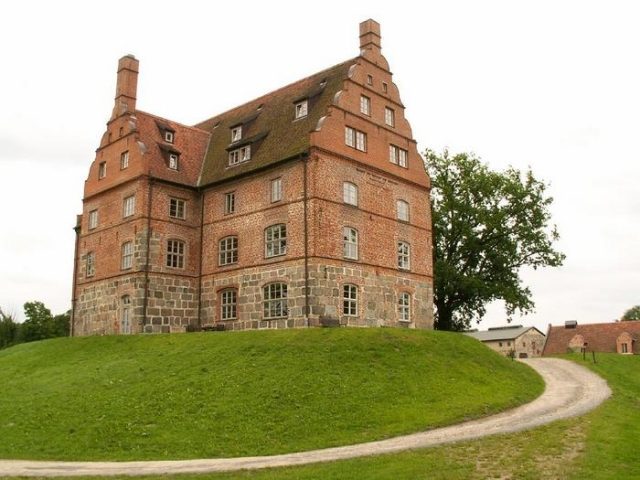
Ulrichshusen Castle

Hotel

Ulrichshusen Castle is a manor house in Ulrichshusen, a village belonging to Moltzow in the Mecklenburg Lake District. With its three-story main building and typical stepped gables, it is one of the most important Renaissance buildings in Mecklenburg. The building is located on the southern shore of Lake Ulrichshusen on a hill. Today it is used as a hotel. Outbuildings of the complex serve for various public events.

Since 1994, the castle has been one of the main venues for the Mecklenburg-Vorpommern Festival, which takes place annually throughout the state during the summer season.

After acquiring and exchanging several estates between Waren and Teterow by the Grubenhagen branch of the Maltzan family, Ulrich Moltzan († 1572), who had also acquired the arable and forest areas of the deserted village of Domherrenhagen, united some of these lands into a knight's estate and had a moated castle built in 1562, probably a rather small building in the style of a fortified house. In 1624 it burned down at least partially, and Bernd-Ludolph Maltzan (Wallenstein's quartermaster) rebuilt it within two years, enlarging the complex. In 1649 it was sold on pledge for 30 years to the Swedish General Carl Didriksson Ruth (also Rutt). From him it passed to his son-in-law J. Ehrenreich von Arnim, from whom it was pledged to Baron Erlenkamp of Vielist. Only in 1742 did it return to the Maltzahns line residing in Rothenmoor and in 1815 to the Counts of Maltzan of Militsch. In 1842 it was sold to the Hahn-Basedow line. At the beginning of the 20th century, Ulrichshusen was the residence of the German tennis champion, Count Viktor Eugen Voß, who at that time received the nickname "der Ulrichshusener". The Count built an asphalt tennis court at the foot of the castle, the outlines of which can still be recognized today by the shorter grass growth there. The estate came to the Counts of Bassewitz-Schlitz in 1929. From 1930, a poor structural condition with cracks in the masonry was reported. In 1945 the owners were expropriated and expelled by the communists.

After 1945, the castle served as refugee accommodation. Due to its historical significance, as the only one from the Müritz district besides Ludorf Manor, it was placed under protection by the Soviet military administration as early as 1946. Later, the castle housed a "Konsum" (cooperative store). In 1976, the castle was last inhabited and subsequently left to decay, only to be provisionally secured in 1983. In 1987, the main house burned down to its foundations.

After German reunification, the von Maltzan family bought back the ruin. From 1993, the entire complex was restored by Helmuth Freiherr von Maltzahn (* 1949) and his wife Alla in cooperation with the State Office for Monument Preservation Mecklenburg-Vorpommern, the German Foundation for Monument Protection and the German Federal Foundation for the Environment. Since 1994, concert performances as part of the Mecklenburg-Vorpommern Festival have taken place in the castle complex. Yehudi Menuhin, Anne-Sophie Mutter and Igor Oistrach, among others, have performed in the fieldstone barn. The gatehouse and the connecting building serve as residential buildings. Hotel operations began in the main house and outbuildings in 2001. Today there are 19 guest rooms. The former stable houses a restaurant, and Ulrichshusen has become a popular wedding venue. As new projects, Helmuth von Maltzahn is now dedicated to saving the baroque manor houses of Gützkow and Gnemern.

Architectural Description+

The main house is a three-story, rectangular building oriented east-west. A risalit protrudes from the facade to the north, and a round, four-story stair tower is placed in front of the building to the south. This tower had a curved dome with a hexagonal lantern at the latest in the 18th century, was fitted with a conical roof in the 19th century, and today has a superstructure with large glass windows.

To the east of the south wall of the main house, a square, also three-story connecting building adjoins, which in turn is supplemented to the southeast by a Zwinger (outer bailey), through which the path coming from the east leads into the castle. This gatehouse probably still corresponds in its entirety to the building from the second half of the 16th century and is today the best-preserved part of the old castle complex, as it was hardly affected by the fire of 1987. Its east gable received special ornamentation through plastic stucco work in the form of lion heads and spheres as well as tendril bands, pilasters and stucco cornices, which is partly reconstructed today. The other gables are significantly simpler and date from the second construction phase.

The walls of the ground floor of the main house and the connecting building are made of hewn granite ashlar, which probably dates back to the original fortified house. The brickwork above, however, dates from the expansion around 1625. The roofs, which are topped by ornamental gables, are reconstructions from the 1990s. The internal room layout and furnishings were largely lost due to the fire of 1987.

South and west of the castle were lower utility buildings, which are now only traceable by foundation remains. Between them and the main building, a partially enclosed castle courtyard was thus created. An alleged keep in the castle courtyard is documented in writing, but has not yet been archaeologically proven. In the 19th century, a stable and a barn were built further south of the castle, which still exist today and are now separated from the main house by ponds. The former administrator's house east of the castle was replaced by a residential building around the year 2000.

The castle complex includes a park with several lakes. From 1995, the park, which was largely overgrown at the time, was restored and the silted-up lakes reconstructed. A larger park, the "Gutspark Ulrichshusen", is located a short distance east of the castle complex.

Take Mobile History with you

You are reading this text for free. Premium adds what matters on the road: descriptions read aloud, sites found through your camera, whole regions taken offline.

  • Every description, including the ~17,700 Premium sites
  • Audio guide: have descriptions read to you on location
  • AR finder: see sites through your camera, with distance and bearing
  • Unlimited saved sites

14 days free, then from €2.99 a month. Cancel anytime.

Location: 53.6278, 12.6256