CastleUntermerzbach

Untermerzbach Castle
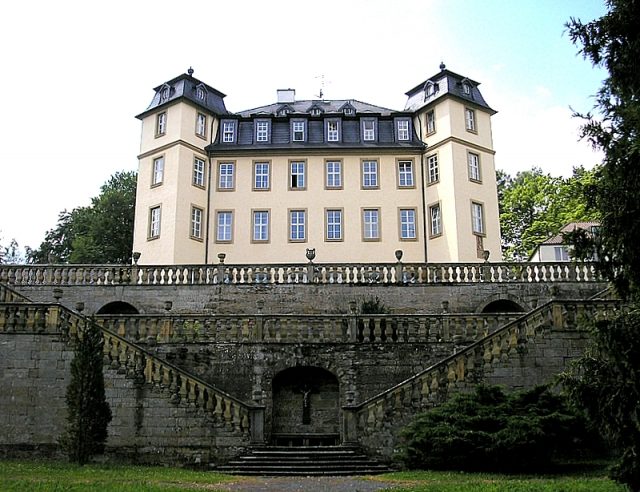
Untermerzbach Castle

Conference center

Untermerzbach Castle is situated on a hill above the old village center of Untermerzbach in the district of Haßberge in Lower Franconia. The former noble residence has belonged to the apostolic society of the Pallottines since 1922, who maintained a novitiate and a philosophical college there until 2009. The castle was expanded with a new building in 2010/11 and will be used from September 2011 as one of 5 academies of the statutory accident insurance VBG to offer seminars on occupational safety and health protection.

The high medieval castle of the Lords of Merzbach probably already stood on the castle hill above the village. After the extinction of this lineage in the 13th or 14th century, the lordship passed by inheritance to the von Rotenhan family. The core of the current castle building is said to date back to Kunz II. A sandstone slab with the Rotenhan-Altenstein marital coat of arms on the north tower indicates the year 1534 as the construction date.

Under Karl Alexander (1710–1777), the Merzbach line was elevated to the rank of count. To distance themselves from their "merely baronial" relatives, the counts added a second "t" to their name and henceforth called themselves Counts von Rottenhan. In the second half of the 18th century, the old castle was converted into a representative early classical country seat. In 1886, Maximilian von Rottenhan, the last representative of the comital line, died. In 1922, the Pallottines acquired the property and added several extensions and outbuildings (formerly a college, since the 80s a guest wing including conference/seminar rooms and a church deconsecrated in 2009) to the existing structure. With the relocation of the Pallottines and their novitiate to Salzburg, Austria, all facilities and buildings are no longer in use and are only conditionally accessible to the public.

In 2010, construction work began for the future use of the area as a seminar center for the Verwaltungs-Berufsgenossenschaft.

Description+

The rectangular castle building with its six window axes on the long side is flanked by two diagonally placed, four-story corner towers. The exterior design is kept simple, with only a plain string course running below the uppermost tower stories. The slate-covered mansard roofs on the main building and the two towers are interrupted by numerous dormer windows. The interior has been significantly altered due to the change in use. Of particular interest is the large hall on the ground floor with wide double doors, which was used by the Pallottines as a chapel before the construction of the church next to the castle and was converted into a dining hall in the 60s, and a representative hall on the first floor, which shows remnants of elaborate stucco work on the ceiling and walls. All other rooms have been adapted for use as a novitiate through multiple renovations (most recently in the 90s); large rooms have been converted into smaller living spaces, apartments, offices, and training rooms. An original wooden internal staircase spanning several floors is still present. Below the ground floor are various utility rooms and access to an old vaulted cellar. Under the plaster, larger remnants of the old 16th-century castle are certainly still hidden.

The representative effect of the property is mainly due to its elevated position above the village, which is balanced by a magnificent early classical terrace and staircase system. The first terrace is accessible via a two-flight staircase and a landing. From there, two further flights of stairs lead to the upper castle terrace, which, like the entire staircase system, is adorned with balustrade railings with attached vases.

The castle is surrounded by extensive walled park grounds, which are conditionally accessible through an elaborate wrought-iron portal. In the park, there are still two underground storage rooms; according to old documents, one of the storage rooms has access to a buried cellar in the castle. Both storage rooms are closed due to the risk of collapse.

Take Mobile History with you

You are reading this text for free. Premium adds what matters on the road: descriptions read aloud, sites found through your camera, whole regions taken offline.

  • Every description, including the ~17,700 Premium sites
  • Audio guide: have descriptions read to you on location
  • AR finder: see sites through your camera, with distance and bearing
  • Unlimited saved sites

14 days free, then from €2.99 a month. Cancel anytime.

Source: Wikipedia · Licence: CC BY-SA 4.0

This description draws on the facts documented in the linked Wikipedia article; Wikipedia content is licensed under CC BY-SA 4.0. Wording and editing: Mobile History.

Location: 50.1247, 10.8547