CastleMarkgröningen-Unterriexingen

Unterriexingen Castle
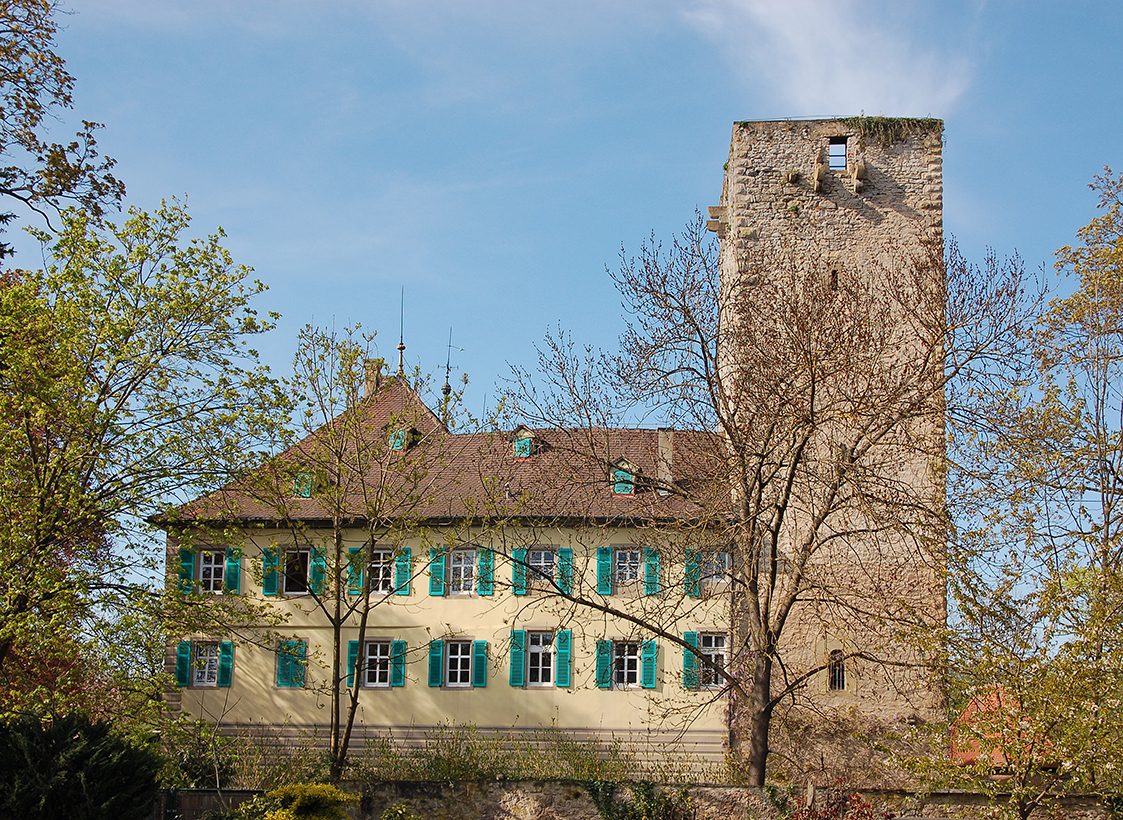
Unterriexingen Castle

To be privately owned

Unterriexingen Castle, located on a high terrace in the Enz valley, dates back to a castle built around 1100 and is situated on the northeastern edge of the village of Unterriexingen, which today belongs to Markgröningen in the Ludwigsburg district of Baden-Württemberg.

The current Unterriexingen Castle likely originates from a Staufer-era castle complex of the Lords of Riexingen, first mentioned in the late 12th century. Built on the northern edge of a high terrace to the right of the Enz and surrounded on three sides by a moat, the castle probably also served to secure timber transport on the Enz and the parallel road.

Lords of the Castle and Palace

In the donor registers of the monasteries of Hirsau and Reichenbach, the Lords of Riexingen first appear between 1080 and 1120 with "Sigeboto de Ruggesingen", "Heinricus de Ruggsingen" and "Gerlach de Ruxingen". From 1396 at the latest, when the Württemberg inhabitants of "Undern Rixingen" and Talhausen, together with the renegade Grüningen citizens, had to swear eternal loyalty to the Württemberg counts by a letter of Urfehde, a changing noble family shared the place with the House of Württemberg.

The lineage of the Lords of Riexingen died out in 1506. They were followed, among others, by the Barons of Urbach, of Sachsenheim, of Nippenburg, and Leutrum zu Ertingen. The inhabitants of Unterriexingen were either subjects of the local lordship or Württemberg subjects, depending on the location of their house to the left or right of the Glems as a natural border. With Württemberg's ascent to a kingdom, from 1806 onwards, the family of the local nobility also became subject to the King by Napoleon's grace.

Conversion to a Palace

The seat of the local lordship belonged to the Barons Leutrum zu Ertingen from 1717 to 1763 and again from 1815. They expanded the medieval castle in the second half of the 18th century by adding a palace extension on the west side, incorporating the large stone house and the keep. Further alterations took place from 1815 onwards, giving the palace its Neoclassical appearance. The park belonging to the palace covers an area of approximately 40,000 square meters. South of the castle, stately farm buildings such as a wine press can still be found today.

From the description of the Oberamt Vaihingen from 1856, to which Unterriexingen belonged at that time, the following is reported about castle relics and the palace:

"At the eastern end of the village stands, as a special ornament of the place and the immediate surroundings, the castle belonging to Baron von Leutrum-Ertingen, with its notable outbuildings and extensive, beautiful gardens, which surround the castle and extend for some distance along the Enz valley slopes. The castle, built in the style of the last century, contains three stories and leans with one of its side wings against an old square tower, the remnant of an earlier knight's castle, besides which much in the interior and exterior of the wing buildings still reminds one of medieval architecture. The tower, whose height is 92 Zoll, is entirely solid and built of bossages at the corners. Its walls have a thickness of 10 Zoll in the lower parts, and taper towards the top, so that they are only 3 Zoll at the battlements. The tower never had a stone interior, but was a so-called 'Mantel', equipped with wooden floors and ladders inside; its present stairs, through which it was made accessible again, it owes to Baron Carl Friedrich Ludwig v. Leutrum, who died in 1852. With the exception of the uppermost story, which has windows, it only has loopholes. From the battlements, from which a fir tree picturesquely grows, one enjoys a very pleasant view into the Enz valley and across the plateau as far as Nussdorf."

Pet Boarding+

The castle in Unterriexingen gained supra-regional recognition with the pet boarding facility housed within it. Nikolaus Prinz von Ratibor (* 1962), son of a veterinarian and breeder of Leonbergers, opened a pet accommodation facility in the castle in 1995. The pet boarding, referred to as a "pet castle hotel," offers pet owners the opportunity to house suitable dogs, cats, birds, or small animals for a fee during travels or illness. As a pet boarding facility, the castle received considerable media attention on television and in newspapers or magazines. In addition to accommodating animals, cruelty-free dog food is also directly distributed from the castle.

The documentary film "Der Südwesten von oben" (The Southwest from Above) portrayed the castle with a strong focus on the dog hotel.

Take Mobile History with you

You are reading this text for free. Premium adds what matters on the road: descriptions read aloud, sites found through your camera, whole regions taken offline.

  • Every description, including the ~17,700 Premium sites
  • Audio guide: have descriptions read to you on location
  • AR finder: see sites through your camera, with distance and bearing
  • Unlimited saved sites

14 days free, then from €2.99 a month. Cancel anytime.

Source: Wikipedia · Licence: CC BY-SA 4.0 · Image: P. Fendrich / CC BY 3.0 via Wikimedia Commons

This description draws on the facts documented in the linked Wikipedia article; Wikipedia content is licensed under CC BY-SA 4.0. Wording and editing: Mobile History.

Location: 48.9389, 9.0618