To be privately owned
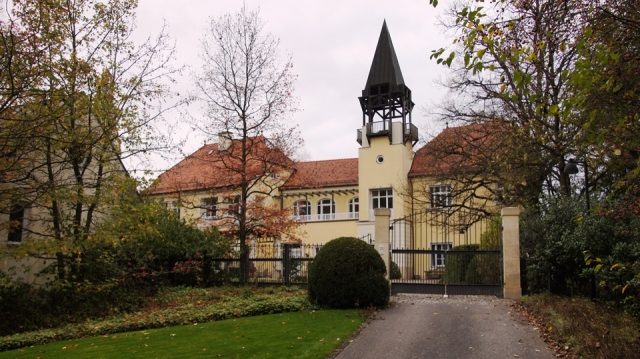
Vasoldsberg Castle

Vasoldsberg Castle is located in the municipality of Vasoldsberg in the political district of Graz-Umgebung in Eastern Styria, Austria. The castle is a protected monument. The castle is situated on a wooded hill between the Ferbesbach and Stiefenbach streams near the village of Vasoldsberg.
The complex was built at the beginning of the 13th century, its early history is unknown. The castle likely served a protective function for the road and for the Graz hill country. The first documented owner was Ulrich von Vasoldsperge in 1252, who belonged to the retinue of the Babenberg Duke Leopold VI. Later owners until the 15th century included the Fuller family and the Bishops of Seckau, who had to hand it over to the Styrian sovereign. At this time, Vasoldsberg Castle consisted only of a tower with a tower house and a defensive wall with a moat. In 1467, during the unrest surrounding Andreas Baumkircher, Vasoldsberg was occupied by rebellious troops. The Bishop of Seckau was forced by Emperor Frederick III to renounce his feudal rights over Vasoldsberg Castle. The castle became the "free property" of the Habsburgs. Administrators were entrusted with its maintenance.
Under the administrator Kolomann Prunner, the castle was renovated in the mid-16th century, with reconstruction beginning in 1542. At this time, forty subservient farmers were under the lordship. In 1578, the manor farm fell victim to arson, and in 1592, the castle itself had to be mortgaged due to high tax debts. From the 17th century onwards, there were several changes of ownership. In the 19th century, Vasoldsberg Castle became bourgeois property. Between 1911 and 1914, major renovations were carried out. From 1942, Vasoldsberg Castle was owned by Steyr-Daimler-Puch AG, which established a recreation home for workers and employees as well as a model farm; since 1987, it has been private property of the Coutinho family.
Description+
Previously, Vasoldsberg Castle, as a defensive structure, was surrounded by a deep moat. The moat, which encircled the castle, was spanned by two bridges and can be seen in Vischer's engraving from 1681, but no longer exists. The irregular building was grouped around two inner courtyards. Of these, the three-story north wing with the inner castle gate and the tower above it is preserved. East of the passage is the former sacristy of the castle chapel with early Gothic ribbed vaults, which extend into the current first floor. The St. John's Chapel from 1450 and the sacristan's room with strong pillars and groin vaults, integrated into the current first floor, are heavily altered. From 1911 to 1914, the castle received a new facade, the tower was raised, and the clockwork of the tower clock was renovated. A bell by Martin Feltl from 1778 hangs in the tower.
Take Mobile History with you
You are reading this text for free. Premium adds what matters on the road: descriptions read aloud, sites found through your camera, whole regions taken offline.
- Every description, including the ~17,700 Premium sites
- Audio guide: have descriptions read to you on location
- AR finder: see sites through your camera, with distance and bearing
- Unlimited saved sites
14 days free, then from €2.99 a month. Cancel anytime.
Source: Wikipedia · Licence: CC BY-SA 4.0 · Image: http://www.wehrbauten.at
This description draws on the facts documented in the linked Wikipedia article; Wikipedia content is licensed under CC BY-SA 4.0. Wording and editing: Mobile History.
Location: 47.0191, 15.5754