Cultural Events
Museum
Vetschau Castle

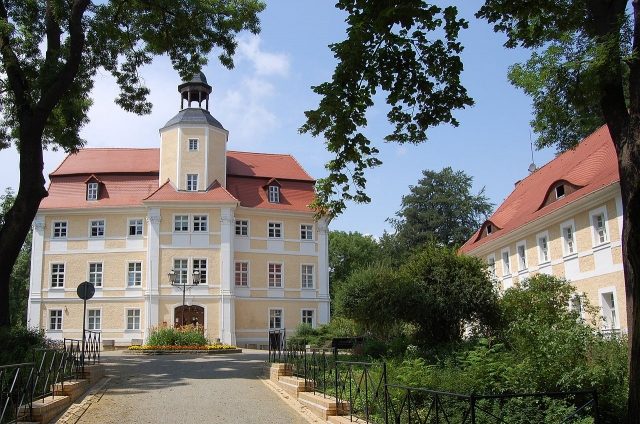
Vetschau Castle is a Renaissance-style castle in Vetschau/Spreewald and the seat of the local city administration.
Architecture+
The three-story building, situated on a small hill, is grouped around a small rectangular inner courtyard. The current appearance of the castle, built from 1538 onwards, dates back to renovations between 1860 and 1870. During this period, the structure was articulated by pilaster strips and the central risalit facing the town, which is framed by pilasters. Above the central risalit rises an octagonal timber-framed tower built in the 18th century. The tower, equipped with a lantern, is crowned by a hood. The roof of the castle building is designed as a mansard roof.
In the inner courtyard, there is an arcade resting on wooden columns on the northern and southern side wings. A neo-baroque open staircase leads to the first floor of the west wing.
Due to changed uses, the interior of the building has been altered several times. In one of the rooms on the ground floor, there is a net vault dating back to the 16th century. The vestibule is equipped with wall paneling and a ceramic fountain and only took on this form in 1920. On the first floor of the garden wing, there is a three-axis hall with a stucco ceiling, fireplace, and fluted wall pilasters. The historical furnishings of this room, known as the Knight's Hall, were added after 1880. A Steinway grand piano from 1920 also stands in the hall.
Northeast of the main building stands the Cavalier House. Both buildings are surrounded by a moat, which is fed by the Vetschauer Mühlenfließ flowing to the west. South of the castle, outside the moat, there is an old nursery and a stable building. Both buildings are currently (as of summer 2009) in great need of renovation. In the castle park, there is a monument to the Sorbian painter Wilhelm Schieber. Also noteworthy is the old tree population, which includes magnolias, plane trees, and bald cypresses.
At the site of today's castle, there was originally a Slavic ring fort surrounded by swamps. Margrave Gero had a moated castle built on the remains of the rampart in the 10th century, which served to control the salt and military road running along here. The castle is said to rest on oak piles driven 11 meters deep into the ground. The only access to the castle was via a drawbridge, the location of which is marked by the bridge still leading from the castle to the car park today. In 1538, Eustachius I von Schlieben acquired the castle. The castle was demolished down to its foundations, and the Renaissance castle, still preserved today, was built in its place from 1540 onwards. The castle park was redesigned, and a castle nursery was established. Parts of the old complex were used as building material for the new castle. In front of the castle, there were still two stone buildings and the gatehouse guarding the drawbridge. From 1540 to 1688, the castle remained in the possession of the von Schlieben family, but until 1879, there were 16 changes of ownership. In 1720, the castle received the small tower still present today. In 1721, Duchess Emilie Agnes von Sachsen-Weißenfels-Drehna became the owner. She planned to completely demolish the castle and build a new building. However, the plan was not implemented; only renovation work took place. She had the vaults removed on the upper floor. A stone spiral staircase leading from the former castle chapel to the cellar was bricked up. In 1879, Hermann Albert Graf zu Lynar acquired the property and had extensive renovations carried out. The passage to the inner courtyard was converted into a hall around 1900, the arcades were bricked up, and the Knight's Hall was given a new appearance. A weather vane with a sphere was placed on the top of the tower. The park was designed in the style of an English landscape park. A gate with the initials of Count Lynar, which stood in the castle until the renovations, was moved to Haus Markt 32 in Vetschau's old town.
The Lynars sold the castle in 1913. A year later, it was acquired by the manor owner Schwarzenberg, who sold it to the city of Vetschau in 1920. Since then, it has been used as the town hall. The mayor of Vetschau lived on the first floor. To allow direct access to the Knight's Hall, which was now also used for magistrate meetings, an open staircase was built from the castle courtyard. The renovation work was financially supported by Richard Hellmann, a citizen of Vetschau who had emigrated to the USA. The inauguration of the hall took place on October 23, 1931. With the construction of the Federal Motorway 15, the southern part of the castle park was lost.
During the GDR era, the inner courtyard was given new plaster. At the same time, an iron spiral staircase leading to the first floor was removed. The Knight's Hall received a new coat of paint in 1966, but the historical wall paintings were washed off. In 1971, the exterior facade finally received new plaster. In the 1990s, the roof was completely re-covered, and in 2002, the facade was renovated and the windows replaced. Since then, the castle has regained its baroque yellow color. The top of the tower, including the weather vane, was also restored. The renovation of the inner courtyard followed in 2004. The arcades were also uncovered again. In 2008, the bridges in the castle park were renovated. A small local history museum is also housed in the castle. The Knight's Hall is frequently used for weddings and cultural events.
According to a legend, there is an underground passage between the castle and the Wendish-German double church.
Take Mobile History with you
You are reading this text for free. Premium adds what matters on the road: descriptions read aloud, sites found through your camera, whole regions taken offline.
- Every description, including the ~17,700 Premium sites
- Audio guide: have descriptions read to you on location
- AR finder: see sites through your camera, with distance and bearing
- Unlimited saved sites
14 days free, then from €2.99 a month. Cancel anytime.
Source: Wikipedia · Licence: CC BY-SA 4.0
This description draws on the facts documented in the linked Wikipedia article; Wikipedia content is licensed under CC BY-SA 4.0. Wording and editing: Mobile History.
Location: 51.7829, 14.0698