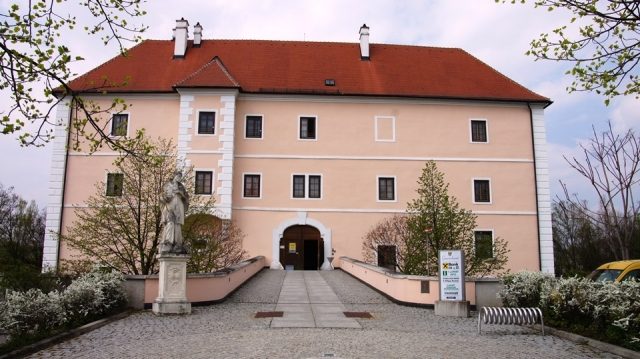
CastleVösendorf

Vösendorf Castle

Vösendorf Castle

The Castle can be visited
Cultural Events
Municipal offices


The town of Vösendorf is first mentioned in a document in 1175. However, when the castle was built is unknown. A castrum is first mentioned in 1308. The then free-owned castle belonged to Konrad Breitenfelder.

When he participated in a rebellion against Duke Albrecht I, the lordship was confiscated by the Duke. The sovereign sold Vösendorf to Wurisch Abraham in 1313. Through Hans den Laher, it came into the possession of Wolfgang von Winden in 1350. The Lords of Winden kept Vösendorf as a fief of Melk Abbey until about 1510. However, there were interruptions when the lordship was temporarily withdrawn from them in the second half of the 15th century, and between 1487 and 1494, when it was occupied by King Matthias Corvinus.

In the 16th century, the owners changed frequently. The present castle largely dates back to alterations made by the then feudal lord Kaspar Erlbeck around 1559. In 1578, Wilhelm I von Hofkirchen bought the castle. Due to Georg Andreas von Hofkirchen's participation in the noble uprising against Emperor Ferdinand II, the lordship was confiscated in 1620. Among the now rapidly changing castle lords were Lazarus Henckel von Donnersmarck (1625), Heinrich von Kielmannsegg (1660), and Johann Ignaz Spindler (1662). In 1694, Vösendorf belonged to Maria Josepha Countess Starhemberg, the wife of Rüdiger Count Starhemberg. From 1705 to 1707, the master miller Staufer successfully defended the castle against the invading Kuruc. From 1727, the lordship belonged to Princess Maria Gabriele Colloredo. In 1794, Emperor Franz II acquired the property. He had the building renovated and a model farm established, which existed until 1824.

Vösendorf was annexed to the Imperial and Royal Family Fund and administered jointly with Laxenburg. In 1850, the castle was leased to a Mr. von Wittgenstein. In 1918, it was incorporated into the state invalid fund, but in 1934, it temporarily returned to the Habsburg-Lorraine family. In 1938, Vösendorf was nationalized again and administered by the City of Vienna from 1940. After the end of the Second World War, the castle was claimed by the Russian occupation forces and suffered greatly. Since 1991, it has belonged to the market town and serves as the town hall and a local cultural center. In 1999, a comprehensive restoration took place, during which the interior was also newly adapted.

Take Mobile History with you

You are reading this text for free. Premium adds what matters on the road: descriptions read aloud, sites found through your camera, whole regions taken offline.

  • Every description, including the ~17,700 Premium sites
  • Audio guide: have descriptions read to you on location
  • AR finder: see sites through your camera, with distance and bearing
  • Unlimited saved sites

14 days free, then from €2.99 a month. Cancel anytime.

Source: Wikipedia · Licence: CC BY-SA 4.0 · Image: http://www.wehrbauten.at/noe/niederoesterreich.html

This description draws on the facts documented in the linked Wikipedia article; Wikipedia content is licensed under CC BY-SA 4.0. Wording and editing: Mobile History.

Location: 48.1209, 16.3428