CastleBad Vöslau

Vöslau Castle

Vöslau Castle

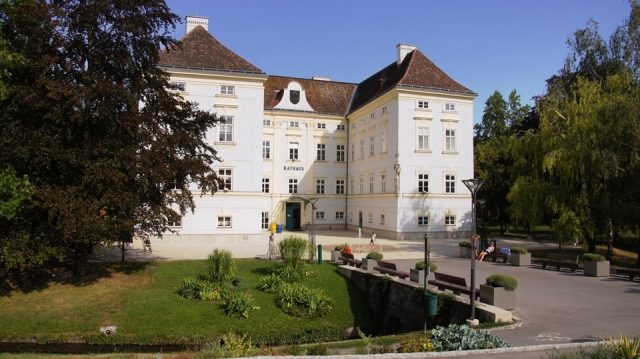
Municipal offices

Vöslau Castle is a former moated castle in Bad Vöslau.

The castle was originally built at the beginning of the 12th century. The first known owners were noble lords of Veselove. The subsequent owners from the burgher family of Pollen were dispossessed due to their participation in a rebellion against Duke Frederick the Fair, and the Hailpechen family became the new owners.

In 1483, it was devastated by the troops of Matthias Corvinus. In 1502, the castle became free property.

In the second half of the 16th century, the castle belonged to the Sinzendorfers. Around this time, the castle was a center of the Reformation for the entire region.

During the Second Turkish Siege in 1683, the castle was in such a poor state that it could not be used as a refuge. Only later was the castle converted into a palace using old building materials. The Baroque conversion took place under August von Wöber between 1740 and 1753. The architect Franz Anton Pilgram is presumed to have been involved.

From 1761, the now-palace belonged to Imperial Count Johann von Fries. The architect Johann Ferdinand Hetzendorf von Hohenberg carried out the installation of a staircase, as well as a ballroom and vestibule.

With individual interruptions, from 1773 to 1887, the castle was owned by the Counts Fries. For example, in 1826, the Fries family had to declare bankruptcy, and Georg Simon von Sina, who was among other things a pioneer of the Southern Railway, bought the castle from the bankruptcy estate. Johann Heinrich von Geymüller acquired it from him. He founded the Vöslau worsted yarn factory in 1833, but also went bankrupt due to his extravagant lifestyle. Already before that, namely in 1837, the castle came back into the possession of the Fries family, namely Count Moritz II von Fries. In 1887, it passed into the ownership of Moritz Ritter von Gutmann.

In 1940, the municipality became the owner, but had to return it to the Gutmann family after the war. During the war, the building also served as a military hospital. In the subsequent occupation period, it was severely damaged and devastated by the Soviets.

Still during this time, in 1951, the municipality finally acquired it. Since 1974, after a renovation, the castle has served as the town hall of the municipality.

Construction+

The castle houses a large hall that extends through two floors. A small hall is notable for its early Classicist paneling.

Castle Park+

In the park, artificial mountains and grottoes were created by Hetzendorf von Hohenberg. At the garden gate stand groups of putti, which, like the four stone vases, come from the Vienna Palais Pallavicini. The vases were created in 1783 and 1784 by Franz Anton von Zauner. They represent the four continents of Asia, Africa, America, and Europe.

Take Mobile History with you

You are reading this text for free. Premium adds what matters on the road: descriptions read aloud, sites found through your camera, whole regions taken offline.

  • Every description, including the ~17,700 Premium sites
  • Audio guide: have descriptions read to you on location
  • AR finder: see sites through your camera, with distance and bearing
  • Unlimited saved sites

14 days free, then from €2.99 a month. Cancel anytime.

Source: Wikipedia · Licence: CC BY-SA 4.0 · Image: http://www.wehrbauten.at/noe/niederoesterreich.html

This description draws on the facts documented in the linked Wikipedia article; Wikipedia content is licensed under CC BY-SA 4.0. Wording and editing: Mobile History.

Location: 47.9654, 16.2154