Hospital
Wabern Castle
The former hunting lodge Wabern is located on the northwestern outskirts of Wabern in the Schwalm-Eder district in North Hesse.
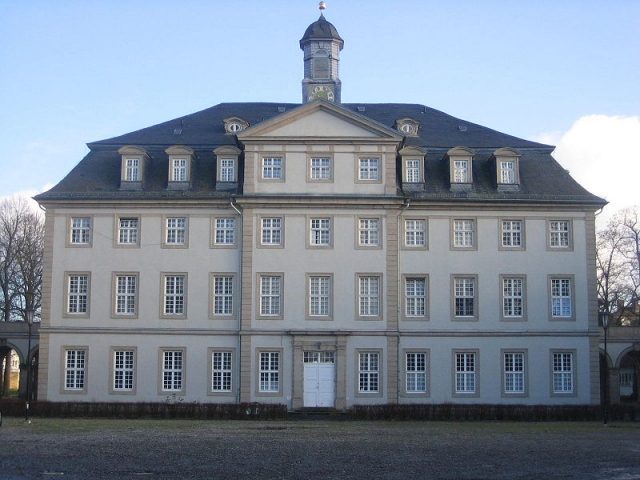
The three-story baroque main building of the hunting lodge was constructed from 1704 to 1707 according to designs by court architect Johann Conrad Giesler for Landgrave Karl of Hesse-Kassel and his wife Maria Anna Amalia of Courland in the wide plain between the Eder and Schwalm rivers. The swampy ground at the edge of the Eder floodplains was drained for the construction and reinforced with driven piles. A central risalit was built on the park side, topped by a balcony. This was decorated with medallions featuring relief heads of the Landgrave and his consort. The side buildings, connected to the main building by galleries, were built by Landgrave Friedrich II around 1770 by architect Simon Louis du Ry, completing the expansion of the now horseshoe-shaped complex.
The philosopher Voltaire was a guest of Landgrave Friedrich II in Wabern in 1755, when he had fallen out of favor with King Friedrich II in Potsdam and was returning to France. Knigge visited the castle on January 14, 1770. On September 16, 1779, Goethe traveled from Kassel to Wabern.
After the death of Landgrave Friedrich II in 1785, the castle was no longer used for a long time and fell into disrepair. Only Elector Wilhelm II restored the castle and park in the 1820s and furnished it with 500 oil paintings and 1200 copper engravings. The collection consisted largely of works by the Tischbein family of painters. The motifs included depictions of the castle in its heyday, portraits of its owners, scenes of heron hunting, and illustrations of particularly valuable falcons. Important parts of the collection are now in Fasanerie Palace in Fulda. In particular, the heron hunting pictures are highlights of the collection in Fulda. The wall-sized baroque paintings of the heron hunt were created by Johann Heinrich Tischbein the Elder (1722-1789).
Park+
The former stables are located in the adjoining park. They date from the 18th century. In 2007, they were converted into a school building, as was the former director's residence. The park was laid out with native and foreign plants, but is no longer preserved in its original form today.
Heron Hunting in the Heron Forest+
Under Landgrave Friedrich II, splendid Rococo festivals were celebrated. Friedrich maintained a falconry in Wabern. Every year in June, he held a court camp in Wabern, where he indulged his passion for hunting. The most popular hunting pleasure was hunting herons in the nearby "Heron Forest" on the Schwalm, where numerous heron nests and a large colony of the birds lived. For hawking with falcons, all staff from the falconry of Waldau near Kassel were transferred to Wabern.
Current Use+
With the annexation of the Electorate of Hesse by Prussia in 1866, Wabern also became Prussian property, although the question of the future use of the castle remained initially unresolved. During the Franco-Prussian War of 1870/71, Elisabeth Deichmann-Schaaffhausen managed a hospital in the castle for several months.
Between 1885 and 1886, the Prussian state established a "compulsory educational institution for male pupils" in the building complex, now renamed "Karlshof". In 1927, the municipal association in Kassel took over the institution. In 1953, the Landeswohlfahrtverband became the maintenance provider, and the former castle was now called "Landesjugendheim Karlshof". Today, the castle is used by "Vitos Kurhessen gGmbH" (formerly: Zentrum für Soziale Psychiatrie) in Merxhausen, which operates the "Vitos Pädagogisch-Medizinisches Zentrum Wabern" (PMZ Wabern; formerly: Sozialpädagogisches Zentrum Wabern/Homberg) facility here.
In his crime novel "Schmuddelkinder", published in 2010, the Kassel writer Matthias P. Gibert processes his experiences as a child in the Karlshof home.
Take Mobile History with you
You are reading this text for free. Premium adds what matters on the road: descriptions read aloud, sites found through your camera, whole regions taken offline.
- Every description, including the ~17,700 Premium sites
- Audio guide: have descriptions read to you on location
- AR finder: see sites through your camera, with distance and bearing
- Unlimited saved sites
14 days free, then from €2.99 a month. Cancel anytime.
Source: Wikipedia · Licence: CC BY-SA 4.0
This description draws on the facts documented in the linked Wikipedia article; Wikipedia content is licensed under CC BY-SA 4.0. Wording and editing: Mobile History.
Location: 51.1047, 9.3417