Museum
Restaurant
Wäscherburg Castle
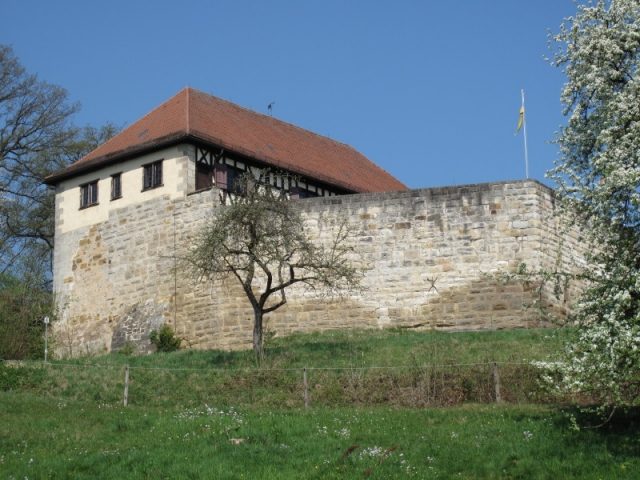
Wäscherburg Castle (also known as Wäscherschloss for short) is located in the Wäschenhof district of Wäschenbeuren in the Göppingen district of Baden-Württemberg. The castle stands about 436 meters high above the Beutental valley and offers an unobstructed view of the Hohenstaufen.
Friedrich von Büren (approx. 1020–1055), who possibly came from the Riesgau region around Nördlingen, is considered an ancestor of the famous noble family of the Staufer. Many historians assume that his surname von Büren refers to the later Wäschenbeuren and thus to Wäscherschloss, but this has not been proven. Through his marriage to Hildegard von Egisheim, he acquired large possessions in Alsace. The couple's son, also named Friedrich, built the family's ancestral castle on the Hohenstaufen.
Excavation findings indicate that a smaller castle already existed here in the 10th century, which was renewed and expanded in the 11th century. During this time, castles for the Staufer's ministeriales, such as Hohenrechberg Castle, were built around the Hohenstaufen. This complex, which belonged to the Schenken von Schüpf, was probably one of them. After 1200, Walter von Schüpf probably built a defensive and residential tower. Since he was constantly traveling in the retinue of the Staufer kings, he left it to Egeno von Staufen.
In 1271, the castle is first mentioned in a document. It settles a dispute between Lorch Monastery and a knight named "Konrad der Wascher". Konrad, a grandson of Egeno, had renounced territorial claims in the Welzheimer Wald and had been confirmed in possession of the "Hofgut in Buron". The knight's surname probably derives from the Waschbach stream in the Welzheimer Wald and gave the Wäscherschloss its name.
After the decline of the Staufer, Schenk Walter II pledged the castle in 1274 to his son-in-law Ulrich von Rechberg, in whose family the castle remained for generations. During the Württemberg War of the Cities, the complex was damaged in 1377. Afterwards, the defensive tower was extended to the palace with its current length. The construction joint is still clearly visible in the facade of the ground floor on the courtyard side. In 1380, a Rechberger called himself Konrad zu Weschenburg in a document, which is the first appearance of the current name.
In 1465, Veit von Rechberg zu Staufeneck exchanged the castle with the Wäschenbeuren manor for other territories with Archduke Siegmund of Austria, but immediately received it back as a fief. Only in 1599, after the extinction of the Rechberg line, did Wäscherschloss revert to the Innsbruck feudal court. With the transfer to Austria, the castle became the official seat of a Vogt for the Vorderösterreich office of Wäschenbeuren. From 1484, it was representatively expanded for this purpose. The first half-timbered floor of the conversion at that time is preserved; the second floor and the roof, however, date from a renovation in 1699. After the residential building of the castle had been converted into a castle-like structure, the complex was renamed Schloss Wäscherburg.
In 1588, the official residence was built in Wäschenbeuren, whereby Wäscherschloss lost its role as an official seat. In 1601, the lordship was divided between two imperial officials, the imperial treasurer Zacharias Geizkofler and the imperial court councilor Bartholomäus Bezz. In 1805, after Austria's defeat against Napoleon, the Wäschenbeuren manor came to Württemberg, but the castle itself remained in Austrian possession, which finally sold it to the Württemberg state administration in 1857 for 155,000 guilders. Today, the property is owned by the state of Baden-Württemberg through legal succession, and the state's castle administration is responsible for it. In 1976, reconstruction and renovation work was carried out on the castle.
Until 2008, the castle served as a museum, showcasing musical instruments, furnishings, and tools from past centuries. It is not barrier-free. Originally, the castle was to reopen as a museum and event venue in spring 2010. Due to further internal renovations to comply with fire safety regulations, the opening has been postponed to spring 2011. Until then, events will only take place outside the castle. As part of the renovation, the staircase will be separated from the floors by glass fronts, a rescue chute will be installed on the upper floor, and a café will be set up on the ground floor. The state of Baden-Württemberg estimates the costs of the renovation measures, which began in September 2010, at 500,000 euros.
In 2011, the state of Baden-Württemberg chose the complex as "Castle of the Year". The celebrations took place on May 28, 2011, at Wäscherschloss.
Architectural Description+
The trapezoidal enceinte wall, built in the 13th century with bossed ashlar, is among the oldest, original preserved parts of Wäscherschloss. Its east side with the entrance gate was rebuilt after a collapse from 1915 onwards. The west part is occupied by the three-story palas, which also shows a bossed ashlar wall on the ground floor facing the courtyard. On the outside, a mighty shield wall protects it up to the top floor. In the first half-timbered floor, which served residential purposes, a plank room was uncovered during the 1977 restoration. This floor shows the typical Swabian half-timbering with lap joints from the 15th century. The floor above it and the roof date from the 17th century.
During excavation work as part of the renovation of Wäscherschloss in 2011, a sandstone defensive wall was discovered, whose foundation was 70 cm deep. The enceinte wall of the castle courtyard was built slightly set back on it. A map from 1900 already showed this section of the wall, but it was forgotten in the subsequent period. The ditch and this proven second wall gave Wäscherschloss a fortified appearance. In addition to the defensive wall, various everyday objects from the 13th to 19th centuries were excavated.
Legend of the Name+
Emperor Barbarossa is said to have rested here on his way from the burial place of his ancestors in Lorch Monastery to Hohenstaufen Castle and fallen in love with a washerwoman. He then gave her Büren Castle. The local coat of arms of Wäschenbeuren is derived from this legend. In reality, however, the name goes back to Konrad der Wascher. See →History.
Take Mobile History with you
You are reading this text for free. Premium adds what matters on the road: descriptions read aloud, sites found through your camera, whole regions taken offline.
- Every description, including the ~17,700 Premium sites
- Audio guide: have descriptions read to you on location
- AR finder: see sites through your camera, with distance and bearing
- Unlimited saved sites
14 days free, then from €2.99 a month. Cancel anytime.
Source: Wikipedia · Licence: CC BY-SA 4.0 · Image: https://commons.wikimedia.org/wiki/File:Schloss_Waescherburg-4_tok.JPG
This description draws on the facts documented in the linked Wikipedia article; Wikipedia content is licensed under CC BY-SA 4.0. Wording and editing: Mobile History.
Location: 48.7670, 9.7059