CastleWaldenburg

Waldenburg Castle

Waldenburg Castle

Museum

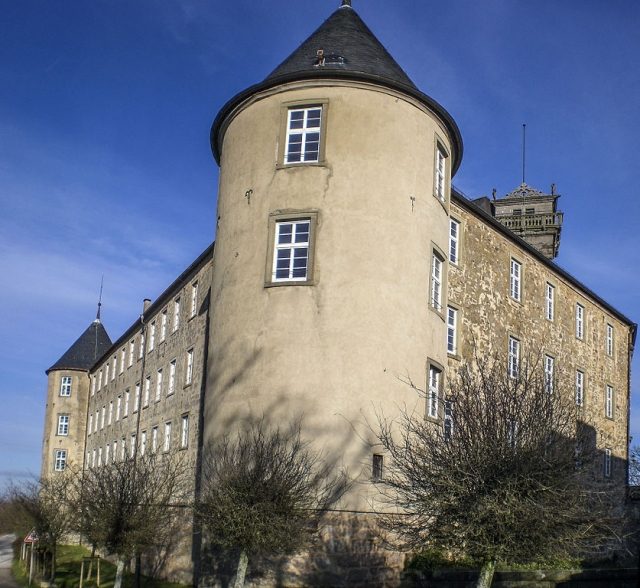
Waldenburg Castle is located on the edge of the Hohenlohe town of Waldenburg on a mountain spur that rises above the Hohenlohe plain. The building, partly designed as a Renaissance castle, is owned by the House of Hohenlohe-Waldenburg-Schillingsfürst.

The Waldenburg region became a fief of the noble family of Hohenlohe around 1250. A first documented mention of a castle can be found for the year 1253. Waldenburg was granted town rights as early as 1330. The conversion to a castle took place in the 16th century, with parts of the changes being reversed in the 18th century. The building became the main seat for one of the Hohenlohe lines in 1553. The keep, also known as the Männlesturm, received its current form in 1576. Further structural changes, with Heinrich Schickhardt acting as a consultant, were carried out in the early 17th century. The castle stood empty from 1679, as the Hohenlohe-Waldenburg line died out. The castle church of St. Michael was built by the master stucco artist Christian Dornacher in the years 1781 and 1782. In the 19th century, the castle was extensively renovated by a newly formed Hohenlohe-Waldenburg line due to inheritance division. The castle, like almost 80 percent of the entire urban area, fell victim to flames in 1945 due to artillery fire. Reconstruction took place from 1948 to 1963.

Waldenburg Carnival

On February 7, 1570, Count Eberhard von Hohenlohe-Waldenburg and his wife, Countess Agathe von Tübingen, invited noble friends and relatives, including the Countess's brother, Georg III von Tübingen, nephew Count Albrecht von Hohenlohe-Neuenstein, Valentin von Berlichingen, Kunz von Vellberg, and Simon von Neudeck. Possibly inspired by local customs, they had the idea of dressing up, although a state ordinance had been issued three years earlier prohibiting carnival activities: The women dressed as angels and the men as devils. A fire broke out at the feast, triggered by a costume that caught fire. Several visitors died as a result of this misfortune, many were seriously injured. Court preacher Apin describes what happened in an authentic contemporary report:

"Anno 1570, on February 7, things went badly in Waldenburg; a sad incident occurred, where the wretched Satan, by God's permission, arranged a terrible tragedy and spectacle, and, like a malicious Schadenfreude, cooled his temper to his heart's content: therefore one should not paint him over the door, nor invite him as a guest, for he comes of his own accord, or if he does not come himself, he sends his messengers.
At that time in Waldenburg during Carnival, besides the counts and nobles, there were nine countesses, some of whom disguised themselves in a beautiful English habit, walking in very white clothing with white paper wings, as angels are usually painted, and wore white paper crowns on their heads, in which small wax candles burned and shone: in contrast, the gentlemen and nobles disguised themselves in a hideous habit, having thick tow of flax strongly sewn and knotted to their trousers and jerkins, arms and legs, so that they appeared shaggy and ragged, as Cacodaemones and black hellhounds are usually painted.
As they, after dancing, at night around 10 o'clock in the upper hall by the light, kneeling, performed a mummer's dance for each other, and did not handle the light carefully, the tow unexpectedly caught fire from the burning candle: soon there was a great tumult and commotion in the hall, a great fright, shouting and lamenting: Kunz von Vellberg quickly fled, and thus disguised, he jumped down the stairs, so that he escaped unharmed and was not infected by the others, but Veltlin von Berlichingen and Simon von Neudeck, also Count Albert von Hohenlohe (Neuenstein) burned so severely that they had to lie in bed for several weeks. Count Georg von Tübingen received communion on February 22.
Thereafter (on March 5), which was Sunday Laetare, (when another and new accident of fire unexpectedly struck him), he died at 8 o'clock in the morning and was then buried on the 7th of this month with his wife's great sorrow, pain, and lamentation, in Öhringen in the collegiate church, where I then delivered a funeral sermon for him, which I afterwards sent to his mother at her request on May 22 with my G. H. funeral sermon to Lichteneck, in return for which her Grace had the following delivered to me on July 24 by von Bubenhofen: a silver goblet with a lid, on which the Tübingen coat of arms was engraved. My gracious lord, Count Eberhard, burned so severely that afterwards, on February 21 and 22, all the fingers on both his hands had to be cut off at the front, yet he had previously received the Most Holy Communion on the 29th (which was then Sunday Reminiscere), made a very beautiful Christian confession, in which I took particular pleasure. Afterwards, on March 9, four days after the departure of his brother-in-law Count Georg, he died in the ladies' chamber at 10 o'clock in the morning in my presence, and was buried on the 11th of this month in Öhringen in the collegiate church next to his mother and next to Count Georg of blessed memory, where I then delivered a funeral sermon for him. On March 14, Count Albrecht had himself driven back home to Neuenstein, and recovered with the advice and help of his mother."

In the fire, Veltin von Berlichingen and Simon von Neudeck, as well as Counts Albert von Hohenlohe, Eberhard von Waldenburg, and Georg von Tübingen, lost their lives.

Buildings+

The exterior of the castle was rebuilt as far as possible according to its historical appearance. Parts of the building are in the Renaissance style, while the castle church already contains classical elements. The interiors were not rebuilt true to the original, but in a simplified manner.

Seal Museum+

A seal museum has been set up on the ground floor of the castle since 1972. The collection dates back to the 19th century and was founded by Prince Karl zu Hohenlohe-Waldenburg. He is considered one of the founding fathers of sphragistics. The seals on display are reproductions, some of which are already of considerable age themselves.

Take Mobile History with you

You are reading this text for free. Premium adds what matters on the road: descriptions read aloud, sites found through your camera, whole regions taken offline.

  • Every description, including the ~17,700 Premium sites
  • Audio guide: have descriptions read to you on location
  • AR finder: see sites through your camera, with distance and bearing
  • Unlimited saved sites

14 days free, then from €2.99 a month. Cancel anytime.

Source: Wikipedia · Licence: CC BY-SA 4.0 · Image: https://commons.wikimedia.org/wiki/File:Schloss_Waldenburg_02.jpg?uselang=en

This description draws on the facts documented in the linked Wikipedia article; Wikipedia content is licensed under CC BY-SA 4.0. Wording and editing: Mobile History.

Location: 49.1908, 9.6430