To be privately owned
CastleDeutschfeistritz-Waldstein
Waldstein Castle (New Castle)
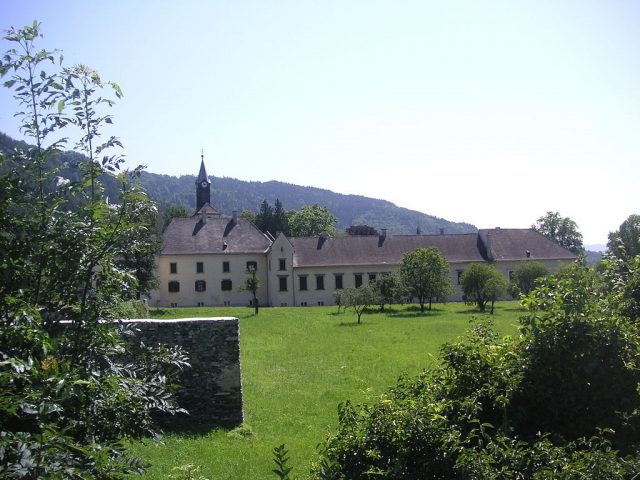
Waldstein Castle is a castle located in Deutschfeistritz in Styria. It is currently owned by the Liechtenstein family. The castle is located in the cadastral community of Waldstein, which belongs to Deutschfeistritz.
The castle originated in the 16th century from a manor farm of Waldstein Castle, which was expanded by Christoph von Windischgraetz. From 1555, Pankratz von Windischgraetz continued the expansion work. In 1598, the Windischgraetz family granted asylum to a Protestant teacher at the castle. As they refused to dismiss the teacher upon a state request, the castle was stormed by princely troops in 1602, and the teacher, along with Christof and Friedrich von Windischgraetz, was captured. In the first half of the 17th century, Waldstein Castle was finally abandoned, and the Windischgraetz family only resided in the lower-lying Waldstein Castle. Since Friedrich von Windischgraetz, a confessed Protestant, had to leave the country in 1630, he sold the estate to Johann Ulrich Fürst von Eggenberg, who later merged it with his lordship of Stübing. The latter had the castle extended to the east in 1667. Furthermore, the castle was connected to a regional court.
After the last Prince of Eggenberg died in 1717, the estate passed by marriage to the Counts of Zinzendorf. Franz Gottfried Graf Dietrichstein acquired the estate in 1730 and, in 1747, incorporated it into a fideicommissum along with Stübing Castle and Rabenstein Castle. Julie Gräfin Dietrichstein had the castle thoroughly renovated. Prince Karl von Öttingen-Wallerstein married the Countess in 1864 and thus became the owner of the castle. In 1883, the later Nobel laureate in physics, Viktor Franz Hess, was born at the castle as the son of the then forester. In 1912, Moritz Prinz von Öttingen-Wallerstein sold the estate to the Liechtensteins, who are still the owners today. A renovation of the estate was carried out in 1956. Zita von Bourbon-Parma, the last Empress of Austria, spent several summers at the castle before her death, as her daughter was married to the then lord of the castle.
Design+
Today, the castle consists of a two- to three-story four-wing building enclosing a rectangular courtyard. The northern part of the west wing is among the oldest parts of the castle and dates from the 16th century. The rest of the west wing, as well as the north and the northern east wing, date from the period up to 1565. On the courtyard side of these wings, double-story column arcades in the Baroque style, designed by Antonio Pozzo, were erected in 1667.
Source: Wikipedia · Licence: CC BY-SA 4.0 · Image: http://commons.wikimedia.org/wiki/File:Schloss_Waldstein_Deutschfeistritz.JPG
This description draws on the facts documented in the linked Wikipedia article; Wikipedia content is licensed under CC BY-SA 4.0. Wording and editing: Mobile History.
Location: 47.2224, 15.2914