Hospital
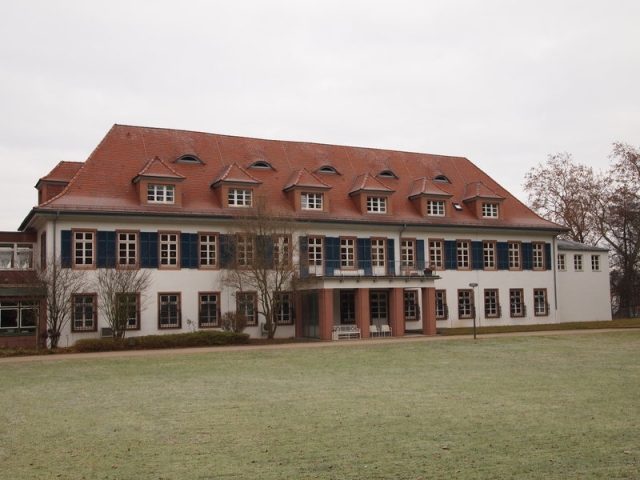
Wasserlos Castle

Wasserlos Castle was built in 1790 on the remains of the former castle by Prince Ludwig Eugen, son of Duke Karl Alexander of Württemberg. The owner around 1800 was Johann Gabriel Marquis von Chasteler de Courcelles; under him, the garden complex and the farm buildings were expanded, and a pavilion was erected as a tea house. Among the other castle owners from 1845 to 1868 was Ludovica des Bordes, née Brentano, known as Lulu, who restored the castle chapel in 1851, as well as her adopted daughter Meline, wife of Count Moritz Casimir IV zu Bentheim-Tecklenburg.
In 1866, the castle served as a military hospital during the German War. In 1901, Baron von Mumm acquired the Wasserlos estate. He was a progressive farmer, and the wines and brandies produced here were of good repute. He also ran a well-known cattle and horse breeding operation. He was succeeded in 1916 by Wilhelm Weigang, who rebuilt the castle after the First World War. In 1942, the Weigang family sold the castle estate, which again served as a military hospital during the Second World War, to the Reichsjugendverwaltung of the NSDAP. At the end of the war, the castle and park were confiscated by the military government and then passed into the possession of the State Office for Asset Management. In 1945, the military government approved the transfer of the castle to the then district of Alzenau.
On April 1, 1949, the property was transferred to the State of Bavaria, which handed over the entire area with the 3.3-hectare English Garden to the district of Aschaffenburg in 1951. Since then, the Wasserlos District Hospital has been located in the castle and its annexes.
Interesting Facts+
In the hospital park with walking paths along ponds, the Rückersbach, and through mixed forests with historic trees (red beeches, oaks, plane trees), exotic trees (e.g., sequoias) also grow, which normally do not thrive in this region. Furthermore, here is the entrance to a former secret passage that ends at the war memorial (former tea house and belvedere). It is not conclusively historically clarified whether the secret passage really served as an escape route or fulfilled other purposes.
Take Mobile History with you
You are reading this text for free. Premium adds what matters on the road: descriptions read aloud, sites found through your camera, whole regions taken offline.
- Every description, including the ~17,700 Premium sites
- Audio guide: have descriptions read to you on location
- AR finder: see sites through your camera, with distance and bearing
- Unlimited saved sites
14 days free, then from €2.99 a month. Cancel anytime.
Source: Wikipedia · Licence: CC BY-SA 4.0 · Image: http://www.wehrbauten.de/thread.php?threadid=928
This description draws on the facts documented in the linked Wikipedia article; Wikipedia content is licensed under CC BY-SA 4.0. Wording and editing: Mobile History.
Location: 50.0696, 9.0761