CastleFeucht-Weiherhaus

Weiherhaus Castle
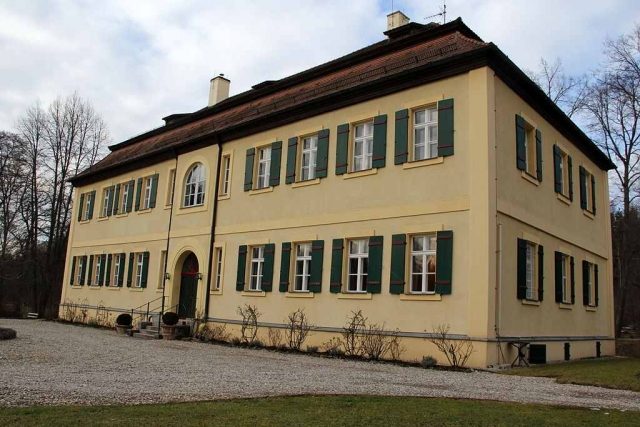
Weiherhaus Castle

To be privately owned

In 1376, Heinrich von Thann zu Lichtenegg renounced any feudal rights over a farm and the pond in the Nuremberg Forest near Hannenhof (Hahnhof) to Hermann Ebner. These properties had previously belonged to the Ortlieb family and now to the Ebner family (Hermann Ortlieb's mother is said to have been an Ebner), because they were not held in fief from him, but from the Empire. Apparently the same imperial fiefs, namely a pond and the Burgstall (i.e., a ruined seat) near Hahnhof, which previously belonged to the Ortlieb family, were sold by Christian Feuchter on June 19, 1381, along with houses and barns, to Conrad I. Haller. The year before, Feuchter had bequeathed this farm to Conrad Zeydler on the condition that Feuchter or his successors could at any time build a "seat and dwelling" on the farm with as many rooms as Zeydler maintained. However, Zeydler sold the right of inheritance (to the farm at the ponds near Hahnhof) on October 14, 1381, to his new lord, Conrad Haller.

After the Nuremberg Council had already enforced on May 28, 1381, that the castle site could only be sold to a citizen of the imperial city, Conrad II. Haller (his namesake father had already died in 1388) pledged on June 9, 1395, that if he were to "build a house on the castle site there," he would open it to the Council in case of war.

In 1399, Conrad II sold half of the "Hahnhof" (he possibly kept the other half himself for the time being) to his cousin Martin I. Haller, although it is not clear whether the manor had been rebuilt by then. In 1465, Martin II. Haller's son handed over his fiefs, including the Hahnhof, to his son-in-law Ulrich Grundherr, who, however, left the income from them to his parents-in-law for life. Two years later, Martin Haller died; after a settlement on February 29, 1472, his widow Barbara renounced the use of the fiefs, including "the Weyerhaus at Hannenhoff together with all ponds and waterways, also woods, fields, meadows," and handed them over to Anna and Ulrich Grundherr for an annual rent of 24 guilders.

In 1486, the "weyer hewsslin zu dem Hanhof" is also mentioned among Ulrich Grundherr's imperial fiefs, and in 1504, during the exploration of the Nuremberg landscape, "Hannhoff ein sitz" is attested. In 1516, Leonhard Grundherr's son granted the imperial city of Nuremberg the right of opening, which allowed the council military use in case of war. Leonhard was succeeded by Paulus Grundherr (1497–1557), who also acquired the estates of Gauchsmühle and Altenthann around 1535.

The Grundherr manor house, sometimes also called "Weiherhaus Oberhahnhof," fell victim to the Second Margrave War. On May 29, 1552, it was burned down along with the Gauchsmühle manor by invading enemy troops. The Grundherr family apparently restored the destroyed seat soon after the end of the war. Already around 1560, it was documented as a "manor in the Weyer and a farm nearby." Paulus's son Carl Grundherr (1535–1605) applied in 1605 for the establishment of a workshop for a linen weaver, who also served as the Vogt of the seat. His widow renewed the initially rejected building application to the Lorenzi Forest Office in 1609.

In 1627, the manor and other possessions of the Grundherr family were attacked by unspecified "people" from the Altdorf area who sought revenge on the family. The marauders set fire to and plundered the manor house. It is possible that further damage occurred a few years later due to the war in the 1630s. For when the Weiherhaus was in a very poor structural condition in the early 18th century, Carl Sigmund Ferdinand Grundherr once declared that the damage from the Second Margrave War and the Thirty Years' War had never been adequately repaired. In 1730, it was even described as the "old manor house recently sunk into the Weyer."

The building fabric was apparently so ruinous that the Grundherr Family Foundation, which had been established in 1679 after many years of inheritance disputes, finally decided to demolish it and had a new castle built in 1761. A two-story manor house with a mansard roof and solid exterior walls was erected. The long rectangular building has nine window axes on the eaves side and stucco facades structured with corner pilasters and a string course. Rococo stucco work can be found on the representative upper floor. In 1943, the castle was hit by an aerial bomb and damaged in the southern part. The Grundherr Family Foundation, newly established in 1857, repaired the damage after the war. The Grundherr von Altenthann und Weiherhaus family is still the owner of its ancestral seat.

Take Mobile History with you

You are reading this text for free. Premium adds what matters on the road: descriptions read aloud, sites found through your camera, whole regions taken offline.

  • Every description, including the ~17,700 Premium sites
  • Audio guide: have descriptions read to you on location
  • AR finder: see sites through your camera, with distance and bearing
  • Unlimited saved sites

14 days free, then from €2.99 a month. Cancel anytime.

Source: Wikipedia · Licence: CC BY-SA 4.0 · Image: http://commons.wikimedia.org/wiki/File:Weiherhaus_01.jpg?uselang=de

This description draws on the facts documented in the linked Wikipedia article; Wikipedia content is licensed under CC BY-SA 4.0. Wording and editing: Mobile History.

Location: 49.3829, 11.2711