CastleWeinburg am Saßbach

Weinburg Castle
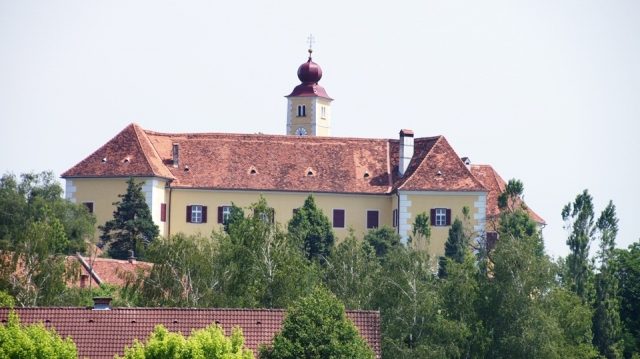
Weinburg Castle

To be privately owned

On the hill above the entrance to the Saßbach valley, a small fortified complex, known as "Seebach" until the 14th century, already stood by the end of the 12th century. The first fortification was probably built by the Lords of Wildon, who are attested here from 1211.

The Wildoners later handed over the dominion to the Diocese of Seckau, only to take it back as a fief. After an uprising by the Wildoners against Duke Albrecht failed, their property was confiscated and handed over to the Wallseers. However, the Wallseers returned the castle to the Wildoners in exchange for a settlement. Nevertheless, the uprising had incurred such high debts for the Wildoners that they had to sell Weinburg to the Wallseers again in 1308.

After that, the owners changed frequently, with several inheritance disputes occurring. During this time, the Pettauer, the Herberstorff, the Counts of Cilli, and the Liechtenstein families appear as owners. In 1460, Niklas von Liechtenstein was the lord of the castle. However, he supported the Hungarian King Matthias Corvinus, whereupon Emperor Frederick III confiscated the dominion. In 1529, Max Leisser, the previous administrator of Weinburg, received the castle as a princely fief.

In 1576, the castle reverted to the sovereign. Archduke Karl of Inner Austria had extensive renovations carried out, transforming the medieval fortification into a habitable Renaissance castle. After the Archduke's death, Weinburg was mortgaged. In 1658, the Counts Breuner appear as owners. After several changes of ownership, Eduard Graf Wimpffen united Weinburg with the neighboring Brunnsee in 1825. Since then, both castles have had the same owners. Thus, Weinburg also came into the possession of Marie-Caroline, the widowed Duchess of Berry, in 1837.

She was succeeded by inheritance in 1864 by Prince Heinrich Graf Chambord and in 1918 by the Counts Lucchesi-Palli, to whom Schloss Weinburg still belongs today. In 1945, the south wing was blown up by retreating German soldiers. Its reconstruction was limited to the ground floor.

Take Mobile History with you

You are reading this text for free. Premium adds what matters on the road: descriptions read aloud, sites found through your camera, whole regions taken offline.

  • Every description, including the ~17,700 Premium sites
  • Audio guide: have descriptions read to you on location
  • AR finder: see sites through your camera, with distance and bearing
  • Unlimited saved sites

14 days free, then from €2.99 a month. Cancel anytime.

Source: Wikipedia · Licence: CC BY-SA 4.0 · Image: http://www.wehrbauten.at

This description draws on the facts documented in the linked Wikipedia article; Wikipedia content is licensed under CC BY-SA 4.0. Wording and editing: Mobile History.

Location: 46.7548, 15.7195