Local government
Weinheim Castle

Weinheim Castle is a former castle of the Electors of the Electoral Palatinate and the current seat of the Weinheim city administration.
In 1403 and 1423 respectively, Electors Ruprecht III and later Ludwig III purchased various adjacent properties in Weinheim to use them as storage and sporadic accommodation. The Electoral Palatinate government occasionally held meetings in these buildings.
In 1509, Elector Ludwig V mortgaged the castle to the family of Dieter von Handschuhsheim. In 1537, the northwest wing was built in its current form on the site of the court acquired by Ludwig III. In 1547, the later Elector Ottheinrich fled the plague in Heidelberg with his court to Weinheim and used the northwest wing as his residence.
After the Palatinate War of Succession (1688–1697) and the accompanying partial devastation of Heidelberg, the Electoral Palatinate administration (as well as other institutions such as Ruprecht-Karls-University Heidelberg and the electoral mint and printing press) briefly settled in Weinheim. In 1698, Elector Johann Wilhelm moved his residence from Düsseldorf to Weinheim and planned to expand the castle into a monumental palace, but this failed due to disagreements with the local population.
Southern Part: Noble Court of the Ulner von Dieburg+
In the 16th century, the court south of the Obertor was owned by the Ulner von Dieburg family. In 1725, Pleikart von Dieburg had the still-existing south wing built. In 1771, the line died out, and the property fell to the von Dalberg family, who then rebuilt the south wing in a classical style as early as 1780. In 1835, Baron von Venningen briefly lived in the castle with his famous wife Lady Jane Digby; the French writer Honoré de Balzac visited Weinheim and especially the then already notorious Lady Jane Digby. In 1837, Countess Auguste Waldner von Freundstein, née von Stumm, second wife of Count Theodor Waldner von Freundstein, acquired the southern part and established the Berckheim ancestral estate for her eldest son Christian from her first marriage to the early deceased Baron Christian von Berckheim. Theodor and his second wife Auguste lived predominantly here in the castle in Weinheim, and the family was very popular there. Among their regular guests here was Stéphanie de Beauharnais, the widowed Grand Duchess of Baden and adopted daughter of Emperor Napoleon, who lived in Mannheim.
Berckheim Castle+
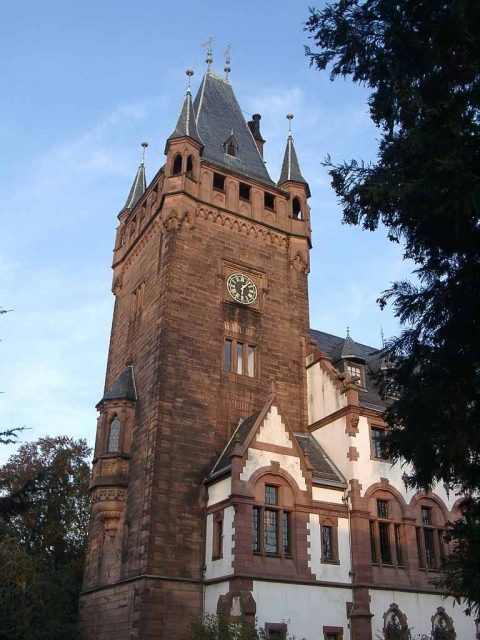
The castle tower and connecting building were erected in 1868 in the Neo-Gothic style by Baron Christian Friedrich Gustav von Berckheim (1817–1889). This was preceded by the demolition of the cellar wing of the Electoral Palatinate castle. The 39-meter-high castle tower, which was modeled after the Blue Tower in Wimpfen, features Neo-Gothic architectural elements. Christian also laid out the Exotenwald (Exotic Forest) near the castle, which still exists today and is open to the public. The castle is still characterized by the diversity of its various architectural styles.
Since 1938, the castle and the adjacent park have been owned by the city, which has housed its administration in the castle buildings. In the southern part of the castle, there is a restaurant on the ground floor. This was completely renovated and restored from January to October 2006. Efforts were made to restore the original condition. Both the stucco work and the old oak parquet floor, which had been hidden under a carpet for years, have been visible again since November 2006.
Take Mobile History with you
You are reading this text for free. Premium adds what matters on the road: descriptions read aloud, sites found through your camera, whole regions taken offline.
- Every description, including the ~17,700 Premium sites
- Audio guide: have descriptions read to you on location
- AR finder: see sites through your camera, with distance and bearing
- Unlimited saved sites
14 days free, then from €2.99 a month. Cancel anytime.
Source: Wikipedia · Licence: CC BY-SA 4.0
This description draws on the facts documented in the linked Wikipedia article; Wikipedia content is licensed under CC BY-SA 4.0. Wording and editing: Mobile History.
Location: 49.5458, 8.6703