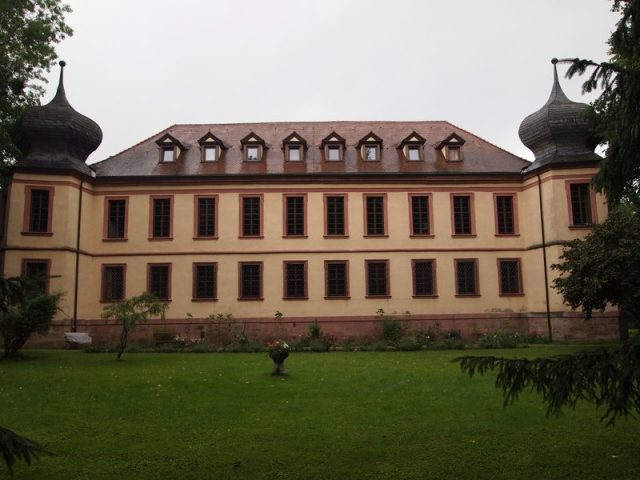
Conference center
Weisendorf Castle

The Knights of Berg (1288-1438) built a stone and heated residence ("Kemenate") in Weisendorf on the Gilgenberg east of today's Auracher Bergstraße, which was called "Burg" (castle) from 1397. Over time, like many of their peers, they became impoverished and turned into robber knights. The imperial district judge from Nuremberg then destroyed the Weisendorf residence of the Bergs in 1397. The family died out in the male line. The niece of the last Berg married Arnold von Seckendorff.
In the First Margrave War in 1449, Weisendorf Castle was conquered and burned down by the Nuremberg field captain Reuß von Flauen. The population suffered greatly. In the Landshut War of Succession in 1504/5, Balthasar von Seckendorff was pursued by Nuremberg troops to Weisendorf, and the entire town burned down with the exception of the church. His son Friedrich Joachim built a fortified moated castle opposite the Junkerngut, in accordance with the fashion of the time.
In the Second Margrave War in 1552, Nuremberg soldiers once again plundered and pillaged the Seebachgrund and thus Weisendorf. In the midst of the Thirty Years' War, which had been raging since 1618, the Franconian colonel and commander in Franconia, Wolf Dietrich Truchseß von Wetzhausen, who was in Swedish service, bought the castle for his Italian mistress and himself. In 1632, he transferred the lordship to his brother Philipp Albrecht. The destruction of the town and many surrounding villages falls into this period. The area was partly deserted, but some inhabitants in Weisendorf survived the war.
Major Martin Ballhorn of the Wrangeish Leibregiment acquired the Weisendorf manor and appropriated land from former communal property. Like all later castle owners, he was Catholic and began the re-Catholicization of the village, which in the coming times led to a mixed-confessional population with fierce disputes. Under Hans Georg Freiherr von Lauter, bailiff of the Diocese of Bamberg in Höchstadt and Wachenroth, the manor now included, in addition to the castle, 29 farms, the mill, a brewery, the brickworks, and the shepherd's house. In addition, there were two estates in Schmiedelberg, two in Oberlindach, and one each in Sauerheim and Arnshöchstädt. During this time, the suburb was created, where the Baron settled craftsmen and day laborers - mostly Catholic.
Freiherr von Lauter had the castle rebuilt in its form preserved to this day. Seehof near Bamberg served as a model. In 1723, his daughters Barbara von Brandenstein and Sybilla von Hanstein took over the lordship. Sybilla's grandsons Damian Joseph and Franz Maximilian von Langen could no longer maintain the estate due to their extravagant lifestyle and had to sell it.
1761 -1784:
The Privy Councillor, Chamberlain, and Lieutenant Colonel Freiherr Philipp Wilhelm von Bibra acquired the Weisendorf manor and had the Catholic castle chapel enlarged. During the Seven Years' War, in 1762, 800 Prussian soldiers marched into Weisendorf on their way to Nuremberg, plundered, took all the horses, and demanded 120 thalers.
Count Rummerskirch from Bohemia bought Weisendorf; he filled the castle pond with 400 cartloads of sand - thus the building lost its character as a moated castle. For the population, a very tragic and painful period now began again, in which events escalated. In the course of the First Coalition War of the European great powers against revolutionary France, French troops first marched into Weisendorf in 1796. In 1802, Palatine-Bavarian troops occupied the Prince-Bishopric of Bamberg, which came to Bavaria in the Imperial Deputation Main Resolution of 1803. The office of Herzogenaurach and thus Weisendorf came to Prussia. With its defeat in 1806 against Napoleon, the former Hohenzollern margraviates of Ansbach and Bayreuth finally came under French administration before becoming Bavarian in 1810. In this eventful period, the inhabitants repeatedly had to bear the costs of troop quartering, which eventually became so high that the Weisendorfers suffered from them for decades to come.
Towards the end of the Napoleonic Wars, in 1813, the Austrian and Grand Ducal-Tuscan Chamberlain Franz Ludwig Freiherr von und zu Guttenberg acquired the Weisendorf fiefdom, which had meanwhile become royal Bavarian. From 1825-1882, his son Hermann ruled over the village. In the course of the peasant uprisings in March 1848 throughout Franconia, tumultuous riots also occurred in Weisendorf; Hermann von Guttenberg fled with his family to the safe Würzburg. For the inhabitants, the revolution brought an end to taxes and corvée labor, as well as the long-awaited dissolution of the local patrimonial court of the 1st class.
In 1945, the Americans marched into the market town without significant resistance. The castle was confiscated as troop accommodation. From 1946-1948, refugees from the eastern territories and the Sudetenland were housed in the castle.
In 1957, Karl Theodor Freiherr von und zu Guttenberg transferred the castle, which was in a ruinous state, to the Carmelite Secular Institute Notre Dame de Vie. The members of the order began renovating the building complex, which today serves both as a conference center and as a place of retreat for the sisters working worldwide.
Source Text: www.weisendorf.de
Take Mobile History with you
You are reading this text for free. Premium adds what matters on the road: descriptions read aloud, sites found through your camera, whole regions taken offline.
- Every description, including the ~17,700 Premium sites
- Audio guide: have descriptions read to you on location
- AR finder: see sites through your camera, with distance and bearing
- Unlimited saved sites
14 days free, then from €2.99 a month. Cancel anytime.
Source: Wikipedia · Licence: CC BY-SA 4.0
This description draws on the facts documented in the linked Wikipedia article; Wikipedia content is licensed under CC BY-SA 4.0. Wording and editing: Mobile History.
Location: 49.6226, 10.8274