To be privately owned
Weißdorf Castle
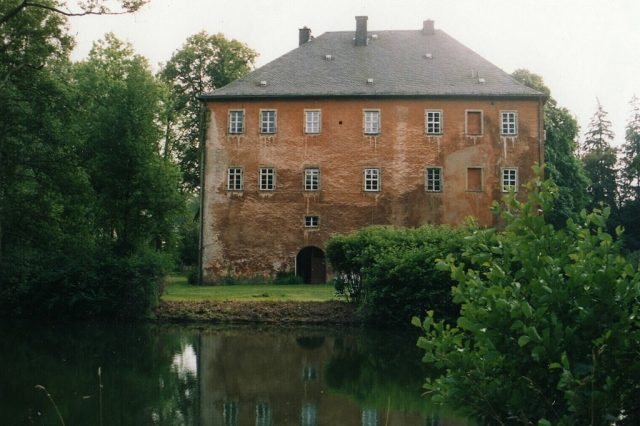
Weißdorf Water Castle is a moated castle in Weißdorf, a municipality in the district of Hof in Upper Franconia. The knight's seat was founded by the von Sparneck family and belonged to the family's ancestral territory for centuries.
Foundation and Rule of the Sparnecks+
The castle complex was first documented on July 13, 1364. It was owned by the von Sparneck family, who ruled over an area roughly corresponding to the former district of Münchberg for centuries. A prominent representative of the family was Hans II von Sparneck as Hofmeister and Marshal of Burgrave Friedrich V of Nuremberg and bailiff in Hof (Saale). He subordinated the allodial property in Weißdorf to the Burgrave and received it back as a fief. His son Hans III von Sparneck was a knight and bailiff of Münchberg. Around 1430, the Hussites attacked the knight's seat. In the 16th century, the family's influence declined. Sebastian von Sparneck appeared as a robber knight and helper of Hans Thomas von Absberg, which led to the destruction of the castle complex by the Swabian League in 1523.
The Fateful Year 1523+
Before the League's army set out to destroy a total of 23 "robber's nests" (five of which alone were owned by the Sparnecks), Absberg's helpers were given the chance to renounce their complicity by an oath. This process began on April 26, 1523, and is known as the Bundestag zu Nördlingen. Some of the nobles took this oath, but most either did not appear at all or, like the Sparnecks, were not admitted to the oath.
On June 16, the League's army, which allegedly consisted of 10,000 foot soldiers and 1,000 horsemen, carrying 100 cannons and 40 arquebuses, set in motion. This army had the task of "tearing down, burning, and destroying" a total of 23 castles belonging to Absberg's helpers. These included, besides Weißdorf, the castles in Gattendorf, in Sparneck on the Waldstein, and the Uprode near Münchberg. On Wednesday, July 8, 1523, the forces arrived in the Sparneck area. While the proud fortresses of Sparneck, Waldstein, and Uprode collapsed in flames, the fate of the castle in Weißdorf was also fulfilled.
When the troops wanted to blow up the castle, which they believed to be abandoned, they found Sebastian von Sparneck's wife lying in childbed in labor. She probably believed that by staying, she could prevent the destruction of the dwelling. The field commander left some of the arquebusiers in the castle and ordered them to blow it up after the child's birth. However, the woman left her childbed beforehand with the words: "If it must be, then I will not stop it." Thereupon, on July 12, 1523, the castle in Weißdorf was blown up.
With the League's army marched the war correspondent Hans Wandereisen, who made woodcuts of the burning castles. He also depicted the valley fortress of Weißdorf at its demise. The heavily fortified complex, consisting of a main house and a strong surrounding wall, is shown as being surrounded by a moat and secured by a palisade fence. A drawbridge led over the moat to the main gate, which was guarded from a gatehouse. Around the castle were grouped the houses and the church of St. Mary with its striking tower.
Further Structural Development into a Castle+
Weißdorf Water Castle was the only Sparneck possession that was rebuilt after the League's campaign in 1543. In the process, the original fortified complex lost its defensive character and is today a small Baroque country castle. In 1606, the castle was renovated and raised by another floor. In 1775, the inner moat was filled in, and in 1875, the curtain wall and tower were demolished. The castle has been in the private possession of the Leuckart family since 1853, who were elevated to the baronial rank in 1879 and have since called themselves Leuckart von Weißdorf. Visits are not possible.
Take Mobile History with you
You are reading this text for free. Premium adds what matters on the road: descriptions read aloud, sites found through your camera, whole regions taken offline.
- Every description, including the ~17,700 Premium sites
- Audio guide: have descriptions read to you on location
- AR finder: see sites through your camera, with distance and bearing
- Unlimited saved sites
14 days free, then from €2.99 a month. Cancel anytime.
Source: Wikipedia · Licence: CC BY-SA 4.0
This description draws on the facts documented in the linked Wikipedia article; Wikipedia content is licensed under CC BY-SA 4.0. Wording and editing: Mobile History.
Location: 50.1868, 11.8477