To be privately owned
Weißenbach Castle

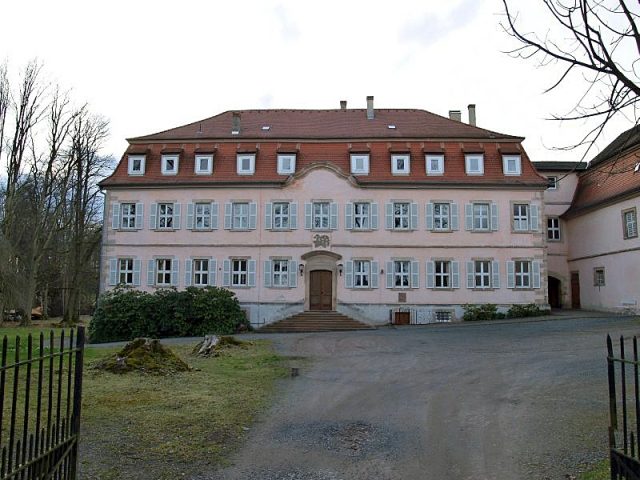
The historical development of Weißenbach is closely linked to the fate of the dominion of Weißenbach. Only remnants of walls and a well-preserved retaining wall on a small hill at the upper end of the village still remind us today of Weißenbach Castle, the seat of the Lords of Weißenbach. According to old depictions of the castle, it must once have been a rather stately fortress that dominated the townscape of Weißenbach. Two wings adjoined the main front in the west, to the north and south. In the middle stood a tall, pointed tower. The structure was surrounded by a strong wall with loopholes, which was washed by the castle pond to the south.
Weißenbach is first mentioned in 1112, when four farms and six homesteads there were subject to tithes to St. Georgen. Place names: Weyssenbach, Weissenpach, Wisenbach, Wizenbach, Weisbach bei Illmau, Weißenbach am Reinberg and finally Weißenbach am Heidenreichsteinerwald. The regional jurisdiction over Weißenbach was exercised by Dobersberg. The manorial lordship was initially in the hands of the Lords of Weißenbach and passed to the Heidenreichstein dominion from 1747.
When Margrave Ottokar VII donated a forest in the Riedmark to Garsten Monastery in 1142, we hear for the first time of the castle lords in Weißenbach. A Hetel von Wizenbach was then the margrave's witness to the donation.
In 1380, Hertel der Weizenpeck sold Weißenbach Castle to Albrecht von Puchheim zu Litschau and Heidenreichstein. Before 1384, Simon Teindorfer received the fortress of Weißenbach, the village of Weißenbach, and Ruders as a fief from Albrecht von Puchheim. Documents from 1432 and 1461 then refer to a Jörg Teindorfer as the lord of Weißenbach Castle. From Emperor Heinrich (1452 - 1493), Hans Teindorfer received the Weißenbach fief, which later fell to his grandson Watzlaw Peuger (Poiger).
In the 15th century, the Hussites invaded Weißenbach. The village suffered greatly at that time. The Hußkaberg between Weißenbach and Ruders still commemorates that time today. The wayside shrine outside Weißenbach on the road to Gastern is said to have been erected over soldiers' graves from that period.
In 1521, Jakob Peuger von Puige is mentioned as the owner of Weißenbach, appearing on the knight's bench at the Diet in Vienna. This Jakob Peuger had disputes with the pastor of Thaya, as the pastor of Thaya complained in 1526 that the lord of Weißenbach had withheld the tithe from Weißenbach and Ruders. After Jakob Peuger, who was a son of Hans Peuger von Reitzenschlag, probably died childless, the estates of Weißenbach and Reitzenschlag passed into the possession of the four sons of his brother Watzlaw. However, one of these sons, Georg Peuger, was already the sole lord of Weißenbach again in 1544; only he received the income from the benefice. In 1568, Wenzel Peuger the Younger was the owner of the Weißenbach estate. In 1609, Johann Wenzl Peuger is mentioned as the lord of Weißenbach. In 1611, he appointed a Lutheran preacher, who, however, could only serve in Weißenbach for five years.
1615 was a terrible year for the village and the fortress of Weißenbach. Warriors from Bohemia invaded and devastated the place. Only two houses remained intact, 21 were destroyed. The church, the manor farm, the sheepfold, and the brewery - today's house No. 9 (Adolf Bauer) - fell victim to the hostilities. Where the castle stood, a pile of stones was found after the mercenaries had passed through. The castle was rebuilt in the following years. The then lord of the castle, Johann Wenzel Peuger, was married twice. His first wife was Susanna Katharina Woytich von Taxen. She bore him two sons, Hans Christof and Wenzel Bernhard. His second wife was Magdalena Amstetterin.
Johann Wenzel Peuger must have sided with the Bohemian rebels in 1615. Imperial commissioners assessed his assets after the withdrawal of the warriors. It was probably intended to be confiscated. The fact is that the Weißenbach estate was sold in 1622 to Johann Ernest Freiherr von Montrichier, imperial colonel and chamberlain. Montrichier also already owned the Schandachen estate.
One year before the sale of the castle, in 1621, Johann Wenzel Peuger had a cemetery built in Weißenbach, which existed for over 150 years and had to be closed down again in 1787. Six years later, the Weißenbach estate already had another owner. In 1628, Alexander Truckenmiller acquired it together with the Schandachen estate. His son Sigmund Truckenmiller then took over the Weißenbach estate in 1635. He had to pay his mother and siblings a severance payment of 12,000 guilders.
The founding of the parish of Gastern goes back to Sigmund Truckenmiller. It was he who, in 1636, applied for the establishment of a parish in Gastern. His application was granted, and the parish of Gastern was established in 1642. The parishioners committed themselves in the foundation deed of February 26, 1642, to contribute to the support of the pastor. The lord of Weißenbach also promised to give the pastor provisions in kind. However, the agreements were not adhered to for too long, so the pastor left the parish again. Under Dominik Rudolf Truckenmiller, the contract was renewed in 1704.
Sigmund Truckenmiller died in 1653 at the age of 55 and was buried in the church of Weißenbach. His widow Dorothea is mentioned as the lady of Weißenbach in 1655.
In 1658, Emperor Leopold I rewarded Dorothea's sons Dominikus, Franziskus, and Maximilian Tobias with the Weißenbach estate. Between 1662 and 1664, the estate was administered by a Sigmund von Issem, who went down in history because in 1663 he complained to the consistory in Vienna about the pastor Gregor Augustin Eichelbrenner. The latter had allegedly insulted his wife in his absence.
From 1667, Dominik Rudolf, the eldest of the three brothers, was the sole lord of Weißenbach. He bought the shares of his mother and his two brothers for 12,000 guilders and received not only Weißenbach but also the Schandachen estate.
Dominik Rudolf Truckenmiller was also dissatisfied with the pastor. In 1687, he lodged a complaint with the dean in Raabs that the priest Claudius Werter neglected his duties despite proper payment.
In 1691, Dominik Rudolf was elevated to the knighthood. At that time, Weißenbach had 18 houses, six of which, however, were deserted.
Dominik Rudolf Truckenmiller was married to Anna Franziska Theresia, born Countess de Mazadas. She bore him four children, all of whom were born in Weißenbach: Rebekka Theresia in 1687, died on October 13, 1705. Hans Adam was baptized on January 8, 1690, in the church of Weißenbach. Adam Constantin Gottlieb received the sacrament of baptism from Pastor Urban Velikaina from Gastern in Weißenbach on February 22, 1701. His godfather was Adam Anton Gundemann von Falkenstein, who, however, was represented by his son Ernst Constantin. Franziska Josefa Antonia Charlotte, the youngest child, was baptized on March 13, 1703. This daughter was only three years old when Knight Dominik Rudolf Truckenmiller died on June 12, 1706, at the age of 74.
Karl von Gattersburg, the children's guardian, sold the Weißenbach dominion in the same year to Philipp Jakob Ritter von Unkhrechtsberg, a Bohemian provincial estate holder. However, the widow and children continued to live in the castle for another two years until she married Franz Ferdinand Konrad Freiherr von Gastenfels, lord of Horgheim and Nordheim, on February 14, 1708. The marriage was concluded in the presence of witnesses Johann Woidi von Hibowitz zu Taxen, Johann Karl Sedlitz von Neukirchen auf Eisenreichs, and Maximilian Ludwig von Grünberg auf Pfaffenschlag.
In 1747, the ownership of the Weißenbach estate changed again. Philipp Jakob Ritter von Unkhrechtsberg sold the estate to Count Nikolaus von Palffy ab Erdöd, the lord of Heidenreichstein. At that time, the Weißenbach estate included the villages of Weißenbach, Ruders, Steinbach, Pertholz, Langegg, and subjects from Triglas. This amounted to a total of 141 local holdings and 65 overseas subjects. The possessions of the Weißenbach dominion also included twelve ponds, most of which were leased. These ponds were located in Heidenreichstein (Steinbruckteich), in Brand (Feldteich), in Pfaffenschlag (Flohmühlteich), in Pengers, in Ruders, Langegg, Pertholz, Artholz, and in Weißenbach.
The year 1787 brought the decay of the Weißenbach estate. It was also the beginning of an independent development of the village of Weißenbach. Two farmers acquired the buildings. The manor farm was bought by the ancestors of today's "Schloss"-Winkelbauer, No. 35. The castle buildings were acquired by the Hörmann family. In 1897, Alexius Hörmann bought the farmhouse No. 20 - today Litschauer. The castle was now completely abandoned to decay. The grounds were divided among 7 houses; current numbers: 1, 31, 32, 33, 35, 36, 37. The castle mill and barn are still visible today.
In 1813, a tithe barn was built, but it was no longer in use by 1848, as the farmers were freed from paying tithes. The Erhart weaving mill bought the disused barn in 1858.
In 1842, Weißenbach had 43 houses (28 of which were farmhouses) with 276 inhabitants; in 1934, there were 50 houses with 256 residents. In 1976, only 171 people lived in 42 houses. The Second World War ended in Weißenbach with a terrible tragedy: disagreements caused a dispute with Russian soldiers, which led to the Russians shooting father and son Rupert Winkelbauer on the spot. Adalbert Rausch was taken to Waidhofen, where they killed him. He is buried in the cemetery there. Franz Grausam, Christian Dangl, Stefan Zuba, and Josef Müller were abducted to Russia. Of these men, only Grausam and Müller returned home in 1954; nothing more was heard of the other two.
Take Mobile History with you
You are reading this text for free. Premium adds what matters on the road: descriptions read aloud, sites found through your camera, whole regions taken offline.
- Every description, including the ~17,700 Premium sites
- Audio guide: have descriptions read to you on location
- AR finder: see sites through your camera, with distance and bearing
- Unlimited saved sites
14 days free, then from €2.99 a month. Cancel anytime.
Source: Wikipedia · Licence: CC BY-SA 4.0
This description draws on the facts documented in the linked Wikipedia article; Wikipedia content is licensed under CC BY-SA 4.0. Wording and editing: Mobile History.
Location: 50.2490, 9.7247