CastleUhlstädt-Kirchhasel-Weißen

Weißenburg Castle
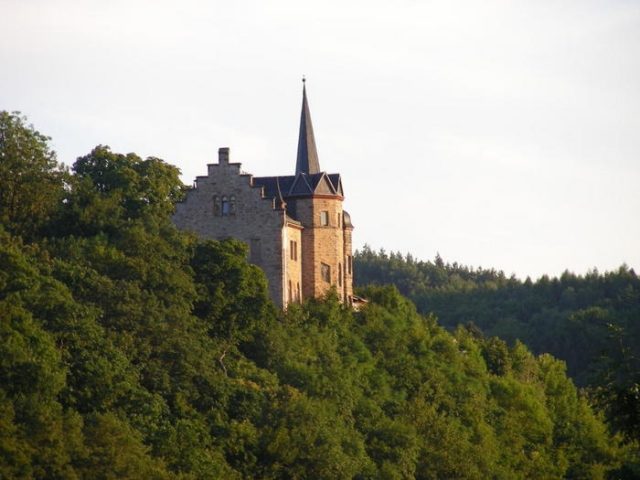
Weißenburg Castle

Hospital

Weißenburg Castle is a hilltop castle in the Weißen district of the municipality of Uhlstädt-Kirchhasel, east of Rudolstadt in Thuringia, on a rock face rising steeply from the Saale river.

It is assumed that the complex was built around 1248 in connection with a division of the Weimar-Orlamünde count's house. The old dynastic seat is undoubtedly a 13th-century complex. It came into the possession of Margrave Friedrich II of Meissen in 1344. Count Heinrich IV of Orlamünde received lifelong residency rights in the purchase agreement.

The "Wizzenburgk" was a castle-like structure with five towers, which occupied the higher part of the present castle grounds and was secured to the north by the steep slope to the Saale and on the other sides by a rampart, moat, and wall with a solid gate. Remains of the towers still existed towards the end of the 19th century; the moat and castle wall are still visible today. It is also possible that the extensive, branched cellar systems in the sandstone rock under the southwestern part of the castle, the so-called "Schleiflöcher" (grinding holes), date from the Orlamünde period.

With the various owners, the appearance and character of the castle also changed in the first half of the 15th century. The ducal bailiffs were followed by the Lords of Entzenberg and around 1443 by the Lords of Kochberg as feudal lords. In 1488, Eucharius von Kochberg sold one half of the property, and in 1501 his brother Ernst sold the other half to Friedrich von Thun (Thüna), a close relative who enjoyed high esteem as an advisor to Saxon electors and dukes. On April 18, 1521, he accompanied Martin Luther to the session of the Diet of Worms and is said to have been among those who then orchestrated the "arrest" of the reformer near Eisenach and his stay at Wartburg Castle.

During the Peasants' Revolt in 1525, the last abbot of Saalfeld Monastery, Georgius von Thüna, fled from the rebellious peasants and citizens to his cousin in Weißenburg. Two years later he died here, according to legend, sitting on his treasures in the deepest cellar.

In 1529, Friedrich von Thüna had the old castle converted into a habitable palace. His coat of arms above the castle gate commemorates this. After his death (at the latest) in 1535, the considerably increased property fell to his sons. Nevertheless, the castle remained in Thüna's hands for more than 150 years, although finally managed jointly with the Lords of Lengefeld, who, as Schwarzburg vassals, owned property in the Rudolstadt, Saalfeld, and Leutenberg areas.

From 1707 to 1761, the Lords of Lengefeld owned Weißenburg alone, but then had to sell it due to their debts.

With the Lords of Lengefeld, the long line of holders of the Weißenburg male fief, who came from local nobility, died out. Charlotte von Lengefeld, later Friedrich Schiller's wife, expressed her longing for the former family property with words about her childhood home, the "Heißenhof" in Rudolstadt: "I stood for hours at my chamber window, looked into the dark windows of the tower (of the city church), listened to the bells.... My horizon was free. In the distance we saw beautiful mountains and an old castle lying on the mountain, which was so often the goal of my wishes..."

In July 1777, as letters to Frau von Stein attest, Weißenburg was repeatedly visited by Goethe. The young poet looked after the family's three boys and drew here. A few years later, in 1792, large parts of the old castle and the Thüna palace fell victim to a fire.

Through the reconstruction carried out from 1796 onwards, the castle acquired a shape similar to today's. In the higher southwestern part there was now a two-story residential building, and at the foremost edge of the rock plateau, the larger, for the time being lower, castle building. From the Thüna castle, the ground floor of the gatehouse with its cross vaults and probably also the lower part of the octagonal tower in the north had been preserved. The owners of the property, which had been converted into a free hereditary fief since 1795, were at that time the bailiffs Breithaupt and Fränkel, who were followed around the turn of the 19th century by Baron von Elking. In 1878, the property was bought by the Sachsen-Meiningen domain treasury, and in 1881, the merchant Krüger acquired the northeastern half of the castle area with the "Villa," which he had raised by one story. The southwestern part has since served as the seat of the Meiningen Forestry Office Reichenbach, which was later renamed "Oberförsterei Weißenburg" and "Thüringisches Forstamt Weißenburg." In 1893, the Prussian envoy to the Weimar court, Baron Eduard von Derenthall, became the owner of Weißenburg Castle. His widow leased it in 1927 to the Zwickau Youth Welfare Office, which maintained a children's home there until 1932. In 1936, a "retraining home for unemployed girls" was established. In 1945, Weißenburg Castle and the neighboring country estate Weißenbeck became public property. The buildings initially served as accommodation for displaced persons and refugees (called "Umsiedler" in the GDR). In 1946, the administration of the Rudolstadt district established a sanatorium for lung patients. After the reunification, the castle complex was privatized and a rehabilitation clinic for oncology and rheumatology was established. The "old" Weißenburg gained a modern sister with the interdisciplinary therapy center. Thus, reconstruction work could begin. The Thuringian regional association of the German Rheumatism League e.V. is now located in the former servants' quarters right next to the castle.

Take Mobile History with you

You are reading this text for free. Premium adds what matters on the road: descriptions read aloud, sites found through your camera, whole regions taken offline.

  • Every description, including the ~17,700 Premium sites
  • Audio guide: have descriptions read to you on location
  • AR finder: see sites through your camera, with distance and bearing
  • Unlimited saved sites

14 days free, then from €2.99 a month. Cancel anytime.

Source: Wikipedia · Licence: CC BY-SA 4.0 · Image: http://www.wehrbauten.de/thread.php?threadid=638

This description draws on the facts documented in the linked Wikipedia article; Wikipedia content is licensed under CC BY-SA 4.0. Wording and editing: Mobile History.

Location: 50.7312, 11.4484