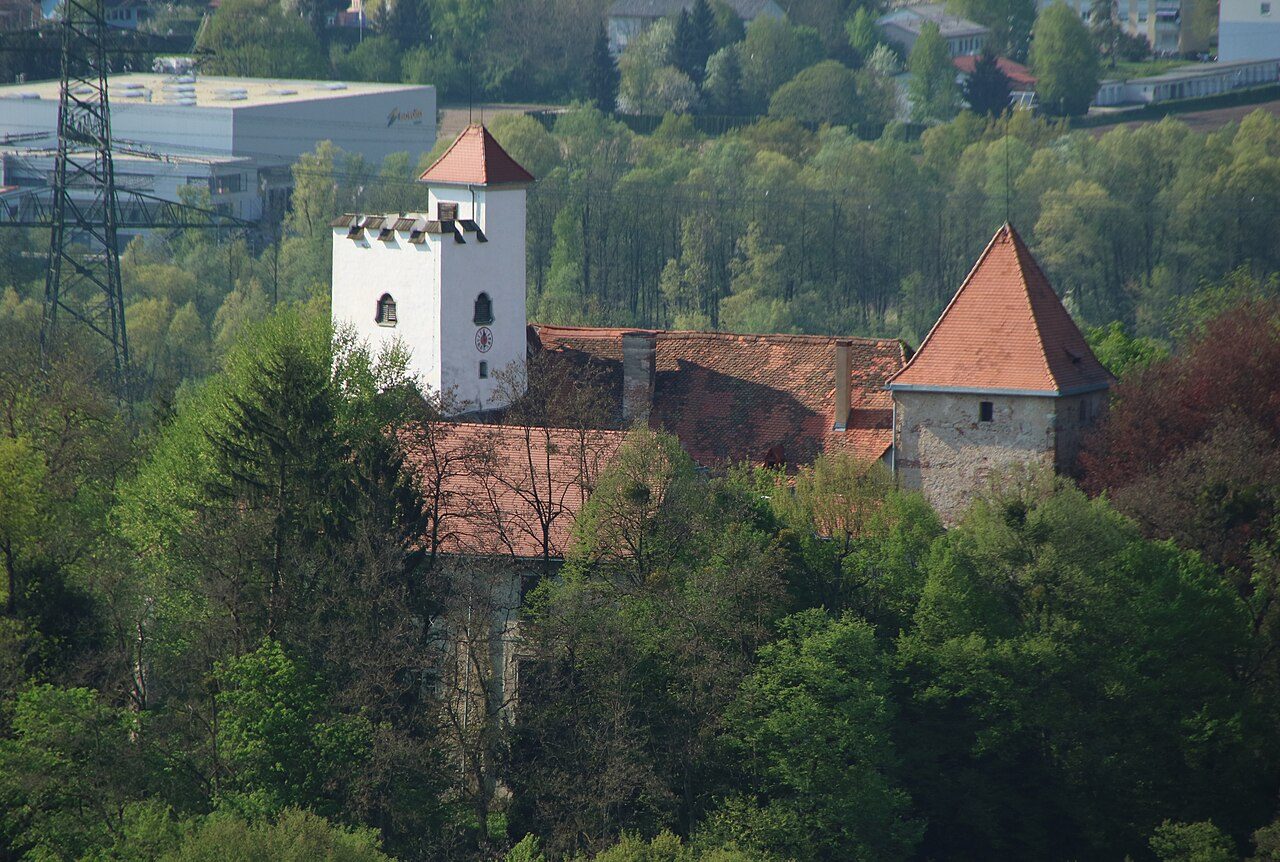
CastleMellach

Weissenegg Castle

Weissenegg Castle

To be privately owned

Weissenegg Castle is located in the municipality of Mellach in Styria. The history of the estate dates back to the end of the 13th century. Today it is privately owned.

Location+

The castle is located in the municipality of Mellach, Schlossweg 1. It stands on a steep ridge on the southern edge of the Graz Basin.

At the end of the 13th century, Konrad von Thurn built a fortified seat called "Thürndl" on the site of the present castle. Between 1363 and 1456, it was a fief of the Counts of Cilli. In 1505, the estate came into the possession of Jörg von Weissenegg. His family expanded the fortified seat into a castle and owned the estate until the 17th century. From the 17th century until 1923, there were frequent changes of ownership. Between 1923 and 1981, the castle was owned by the Counts of Trauttmansdorff. Today it remains in private ownership.

Architecture+

The castle is a three-story building complex with an irregular pentagonal floor plan around a rectangular inner courtyard. In the inner courtyard there are three-story column arcades with sgraffito decoration from the 16th century, which are stoutly shaped on the upper floors. The core of the masonry dates from the Middle Ages (13th century), part of the western wing from the 15th century. Two square towers are attached to the eastern and western sides of the castle. On the western tower, the original onion dome was replaced by a battlement at the end of the 19th century. The entrance gate to the inner courtyard is on the north side of the building. The former neck ditch with a bridge to the gate has been leveled. The thickness of the inner courtyard wall of the north wing suggests that it was originally an outer wall. Parts of a battlements are preserved in the eastern wing. Parts of the former bastions now serve as retaining walls. In the entrance there is a coat of arms stone of Maximilian Trauttmansdorff from the first third of the 17th century.

The north and east wings were extended at the beginning of the 17th century. Wooden beam ceilings from this period are preserved in the north wing. In the south and west wings there are stucco ceilings from 1771/72. A special feature is the room with illusionistic wall painting by Franz Moser from 1784, depicting exotic river landscapes and garden arbors in the corners, in the west wing.

The castle chapel dates from the end of the 17th century and received a mass license in 1698. The room is spanned by a mirror vault with stucco work by J. Antonio Quadrio, whose signature is below the window. Painted scenes from the Old Testament are depicted in the fields of the stucco work. The altarpiece of the black and gold altar, made at the end of the 17th century, depicts John the Baptist. The chapel bell was cast in 1693 by Florentin Streckfuß.

At the access road to the castle there is a statue of Mary with Child from the middle of the 17th century. This was restored in 1955 and comes from the Palais Trauttmansdorff in Graz.

Take Mobile History with you

You are reading this text for free. Premium adds what matters on the road: descriptions read aloud, sites found through your camera, whole regions taken offline.

  • Every description, including the ~17,700 Premium sites
  • Audio guide: have descriptions read to you on location
  • AR finder: see sites through your camera, with distance and bearing
  • Unlimited saved sites

14 days free, then from €2.99 a month. Cancel anytime.

Source: Wikipedia · Licence: CC BY-SA 4.0 · Image: Clemens Stockner / CC BY-SA 3.0 via Wikimedia Commons

This description draws on the facts documented in the linked Wikipedia article; Wikipedia content is licensed under CC BY-SA 4.0. Wording and editing: Mobile History.

Location: 46.9107, 15.4943