CastleMatrei in Osttirol

Weißenstein Castle
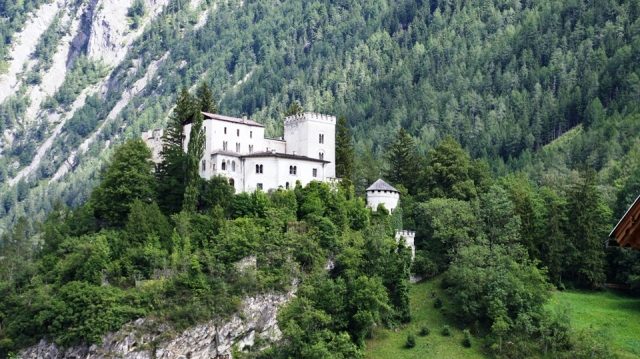
Weißenstein Castle

To be privately owned

The fortified building, long known as Matrei Castle, was founded by the Swabian Counts of Lechsgemünd. In connection with a donation, Count Konrad von Lechsgemünd is mentioned around 1160 in the Neustift Tradition Book. He may have been the builder. His successor was his nephew Heinrich IV von Lechsgemünd. As he had no children, he transferred his assets to the Archdiocese of Salzburg during his lifetime. Matrei was then administered by Salzburg burgraves, who named themselves after the lordship. To prevent the burgraves residing in Matrei from gaining too much power, the Salzburg bishops primarily appointed minor nobles as administrators. Only between 1407 and 1414 was Matrei given as a pledge.

In the 15th century, the name Weißenstein gradually became established for the castle. Archbishop Leonhard von Keutschach had the previously rather modest complex significantly expanded and more strongly fortified at the beginning of the 16th century. In 1524, Archbishop Matthäus Lang ceded the lordship to the Salzburg Cathedral Chapter for the provision of the Cathedral Provost. In 1645, unrest almost broke out among the population because the administrator Johann Helmreich was extremely hated by the farmers due to his harshness. Archbishop Paris Graf Lodron then leased the lordship and had Helmreich removed. Since Weißenstein had long since lost its military significance and was no longer inhabited by its owners, the Salzburg canons were reluctant to invest. The administrators also moved into the administrator's house in the village.

The castle was practically uninhabited by the end of the 18th century. After the secularization of Salzburg in 1803, the lordship of Windisch-Matrei was taken over by the Austrian state. The municipality of Matrei was able to purchase the castle at auction in 1823 and temporarily use it as a poorhouse. In 1863, it was sold to the Viennese master builder Franz Poduschka. He had the semi-ruin restored in the Neo-Gothic style and established a hotel in it in 1875. However, it was not a success and soon had to be closed and sold. Under Baron Adalbert von Mengershausen, a renewed general renovation took place from 1896, this time in the Neo-Romanesque style. In 1921, Carl and Else von Thieme acquired the castle.

Take Mobile History with you

You are reading this text for free. Premium adds what matters on the road: descriptions read aloud, sites found through your camera, whole regions taken offline.

  • Every description, including the ~17,700 Premium sites
  • Audio guide: have descriptions read to you on location
  • AR finder: see sites through your camera, with distance and bearing
  • Unlimited saved sites

14 days free, then from €2.99 a month. Cancel anytime.

Source: Wikipedia · Licence: CC BY-SA 4.0 · Image: http://www.wehrbauten.at

This description draws on the facts documented in the linked Wikipedia article; Wikipedia content is licensed under CC BY-SA 4.0. Wording and editing: Mobile History.

Location: 47.0084, 12.5381